
The ‘Ghostbusters’ reboot ain’t afraid to bust female movie stereotypes—and it pays off in a big way
The film has its hiccups, but transcends tropes about women found in so many Hollywood films.
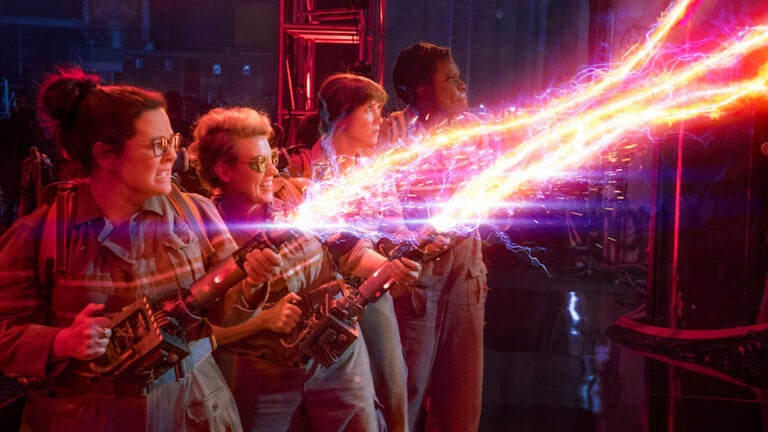
The new Ghostbusters reboot is self-aware. Too self-aware, perhaps.
The film’s stars — Leslie Jones, Melissa McCarthy, Kate McKinnon, and Kristen Wiig — faced a pronounced backlash when the project was announced. The beloved classic, remade with female stars? Many fans wanted it to remain untouched, and some of their criticisms dripped with misogyny.
That reality was not lost on the cowriter and director Paul Feig, and we discuss his decision to confront those criticisms head-on — sometimes to the film’s detriment — here. Indeed, it sometimes fails to find its own footing because it’s too concerned with addressing all of the outside noise.
Despite this, Ghostbusters accomplishes something notable: It stars an all-female leading cast and doesn’t use romantic subplots.
In doing so, it transcends some limiting, gender-specific tropes that permeate Hollywood films. These days, it’s hard enough finding movies that pass the Bechdel test. In order to pass the test, a movie must have at least two named female characters, and those named female characters must talk to each other about something other than a man. Many of 2015’s biggest movies failed it.
Ghostbusters not only passes the Bechdel test, it annihilates it.

Before delving further, a disclaimer seems necessary: Ghostbusters is not 100-percent feminist, nor is it a revolutionary film. It meanders at times, but it’s fun; it will hover in the mid-70s on Rotten Tomatoes. But it’s a big-budget Hollywood film with possible sequels (and the revenue that comes with those sequels) on the line. The fact that it stars four female actors says a lot; the fact that none of them are getting married says more.
The plot centers around two friends, Abby (McCarthy) and Erin (Wiig); they’re joined by Jillian, who goes by Holtzmann, (Jones) and Patty (Jones), to form a fully-fledged squad.
One possible threat to Ghostbusters’s potential for Bechdel obliteration emerges in the form of Chris Hemsworth, who plays an endearingly dumb assistant named Kevin. Erin, a Columbia professor who gets back into ghost investigating, is infatuated with Kevin. But far from being a driver in some romantic subplot, Kevin is merely a beefy ornament. He’s there to ogle, to flip the script and play the role usually occupied by females: that of the hot, ditzy assistant. Erin’s infatuation goes unnoticed —because Kevin is an idiot — and the Ghostbusters keep the story moving.
The rest of the squad’s sexuality is never discussed. McKinnon’s Holtzmann could be interpreted as being particularly flirty with Wiig’s Erin. But when asked by a reporter with The Daily Beast, Feig, the director, wouldn’t say whether Jillian was gay or not. (“‘What do you think?” he said.)

None of the characters try to conform to conventional standards of beauty. The movie makes that clear from the outset, when Erin’s boss cringes at her outfit: a fully-covered grey plaid ensemble that buttons up to her neck, secured with what Holtzmann called “the world’s tiniest bowtie.” The other three are also sartorial outliers, especially McKinnon’s Holtzmann, who frequently rocks green bifocals to go with her unruly blond hair.
There’s no “makeover” scene. None of the Ghostbusters emerge as the hidden “hottie” of the group. The brown and orange jumpsuits are statement enough: These women are here to catch ghosts and make jokes. If they’re wearing ugly onesies while doing so, that’s just fine.
The world needs more movies like Ghostbusters — little girls need more movies like Ghostbusters — because they show that women can carry a story (and possibly an entire franchise) without falling in love, dissecting their sex lives, or having to find a man.
These Ghostbusters are simply here to do their jobs. We’d pay to watch them do it again in a sequel.




To comment, please create a screen name in your profile
To comment, please verify your email address
Conversation
This discussion has ended. Please join elsewhere on Boston.com