
Four reasons why ‘Jaws’ became a classic
The world had to be ready for a bloodthirsty shark to terrorize it, and more.
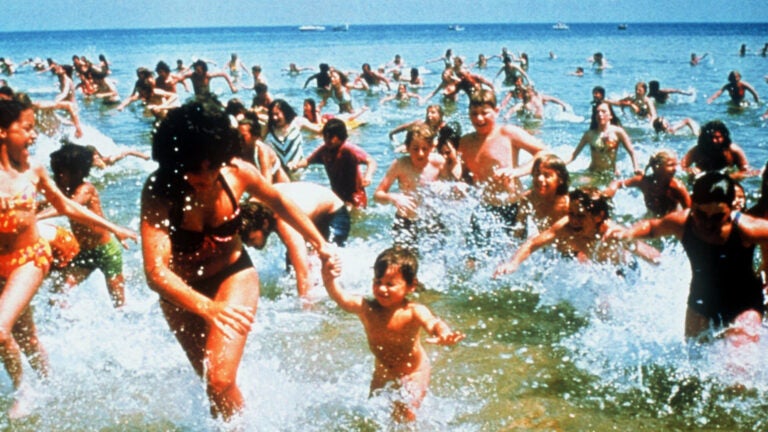
Jaws is, inarguably, a great film. It has drunken sailors, it has a severed head, and it recently turned 40 years old.
But none of those reasons really answer why it’s a classic.
“Stories about various monsters and threats are always being written. It’s the ones that catch fire that tell us what society is feeling and thinking at a given time,’’ said Margee Kerr, a professor at the University of Pittsburgh with a PhD in sociology.
So why do some movies become classics while others fade into obscurity on a long list of titles? We chatted with Kerr and more experts to find out. Spoiler alert: It’s not simply a question of good versus great screenwriting, directing, or cinematography.
1. Movies really do reflect the zeitgeist, and the really successful movies tell a story about one thing that taps into anxieties about another.
“When Jaws was released, it was the aftermath of Vietnam. Nixon had been impeached, so America was at that time feeling very powerless,’’ said Pythia Peay, whose writing explores psychology and the American psyche.
Americans had grown accustomed to feeling victorious in the aftermath of World War II, she said.
“There was a kind of depression in the American people, and I think that Jaws played to that,’’ said Peay. “Because what you really see in Jaws is this whole confrontation with something powerful that comes up from the deep that human beings have no control over.’’
Lawrence Rubin, a psychology professor at St. Thomas University and UMass Boston, agreed that the shark is reminiscent of the Vietkong, whose masterful concealment tactics undermined America’s war efforts. But he also said it could be an embodiment of the voracious appetite of the rapidly commercializing American culture.
“It’s an equal-opportunity killer,’’ said Rubin.
2. There can be something therapeutic to watching your fears play out on screen. No, really.
This might be because it gives people some sense of control, to experience the fight-or-flight reaction and come out on the other side.
“It becomes an example of how we can make it through scary experiences, we can tolerate our own threat response,’’ Kerr said. “And even though the threat is false, it still feels real, so we can experience a boost of confidence leaving us feeling more resilient and competent.’’
There’s also a sense of camaraderie that comes from watching a scary movie in a crowded theater, or on a couch at a friend’s apartment, the experts said.
“You get the crap scared out of you in the safety of other people,’’ Rubin said. “In an unintentional way, the release of movies like this gives us an experience to come together as a community. We talk to each other and have a vicarious sense of defeating the enemy when the shark blows up, or the dinosaurs are caged.’’
3. And while Jaws is a phenomenon, it’s not unique. Through the years, other horror movies have also capitalized on the marriage of a cultural fear with a well-executed film.
“Classic horror movies earlier in the century took place largely in a kind of Gothic ‘elsewhen,’ not in normal everyday surroundings,’’ said Andy Tudor, professor of theater, film, and television at University of York. “From the late 1960s on, that changed, and we increasingly found horror movie threats — be they psychotic killers, zombies, or ‘natural’ monsters like the shark — invaded our familiar everyday world.’’
Godzilla tapped into the cultural fear of the atomic bomb and radiation, and science fiction movies of the ’60s and ’70s strongly reflected the fear of communist invasion during the time. That many of the alien movies produced during that time had xenophobic undertones is not a coincidence, the experts said.
“Movies like Terminator and iRobot address our fears about unbridled technology in the late 20th century, while the brief popularity of ‘torture porn’ films (Hostel, SAW) of the early 21st century reflected the growing uncertainty and tension around wars across the globe and American occupation, and the ever-increasing blood and gore we see on TV,’’ Kerr added.
4. So, if Jaws were released for the first time today (perhaps with some slightly enhanced special effects) would it be a hit?
Rubin said that the current cultural climate is perfect for bringing back Jaws.
“Between global warming, ISIS, racial tensions…it’s a good time to resurrect this icon of unseen danger,’’ he said.
Tudor thinks it would still work as a film, but wouldn’t elicit as strong a reaction to the “‘threat from nature’’ aspect of it. People are always going to find the intrusion of violence into everyday life unsettling, he said, but audiences these days tend to be a bit more self-aware.
Kerr echoed him, saying that in order for Jaws to really take off in a modern context, it would need to tap into the current cultural climate.
As we transition from one societal concern to the next, we don’t get rid of the fearful reactions to the others. This is why the imagery of a shark emerging from placid water works. It hits the sweetspot of an instinctual fear, the startle effect, and the embodiment of the unknown and the powerless, which were all palpable in June 1975.
If Jaws were released in 2015, Quint might be recast as an environmental activist, or the shark’s ferocity could stem from experiences inhumane captivity – tapping into societal fears of global warming and technology and love of “damaged monster’’ narratives.
But still, even without these plot tune-ups, a gargantuan shark with an uncanny knack for suspenseful timing will always be terrifying.
Related slideshow: When Jaws invaded Martha’s Vineyard:
[bdc-gallery id=”109644″]





To comment, please create a screen name in your profile
To comment, please verify your email address
Conversation
This discussion has ended. Please join elsewhere on Boston.com