
The ‘50 Shades’ Movie is Sexier Than the Book
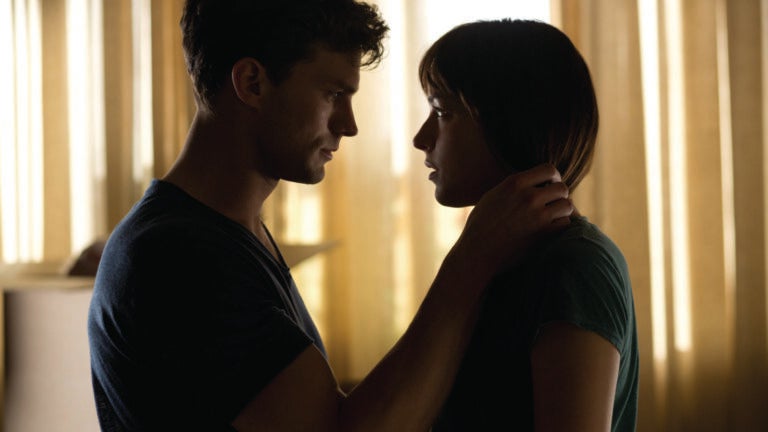
When 50 Shades of Grey debuted in 2011, I dismissed the self-published book widely referred to as “mommy porn.’’ As far as I knew, it was self-published BDSM erotica with some romance. None of this appealed to me, but everyone seemed to be reading it, hidden behind copies of the New Yorker or stashed in the depths of their Kindle. Even my mother read them after the women in her office convinced her. It wasn’t until director Sam Taylor-Johnson signed onto the film-based-on-the-story that I felt it was part of my professional duty to pick up a digital copy of my own.
The book is not sexy.
If you don’t know the story, here’s the gist: Anastasia Steele is a college student who meets a 27-year-old billionaire and engages in a sexual tryst with suggested S&M behaviors. Yes, there’s light bondage in the book, but overall, their physical relationship is pretty vanilla. They almost always have missionary sex that ends in a discussion of feelings and tender embraces. The only actual time Grey comes off as intimidating is outside of the bedroom, as he tirelessly harasses/pursues Steele.
He’s a bully and a bad boyfriend. And she’s completely receptive to it.
Unlike in real BDSM relationships that are anchored in the control of pleasure and pain, it’s dominate-submissive in a psychological sense: He’s her overbearing, selfish boyfriend, who wants all the toys and restraints.
I never finished the book. I gave up about ¾ of the way in. Likewise, I didn’t expect to like the movie. The trailer was fine, but the hype surrounding its release roused such similar feelings to the book that I came to dread it. The soundtrack was quite good, but the disastrous press tour of Dornan and Johnson had me convinced of its imminent failure, despite the sigh-inducing confirmation of the two book-to-screen sequels before the first’s release.
Despite all my preemptive judgement—I really liked it. And I think you should see it. Here’s why.
Dakota Johnson’s Anastasia Steele is more likable than the book version.

Girl, you know.
The 25-year-old celebrity didn’t have many fans after she was cast, mostly because she didn’t have many fans, period. Her short-lived 2012 FOX comedy Ben and Kate may have won her a small following, but other than a cameo in The Social Network that involved her rolling around in bed in her underwear with Justin Timberlake, Johnson was coming into the film a relative unknown.
Let me preempt this by saying, Steele is an insufferable narrator. As a character, she’s weak and indecisive but impulsive and irrational at the same time. She says things like “Holy cow!’’ and “Double crap!’’ She’s a college student who falls instantly, madly in love with Christian Grey, because, heh, he’s so hot, you know? And mysterious! And he puts a tracking device in her phone and follows her out at night after their second meeting! How romantic.
Once [fragment number=0] he decides to enter exclusivity, Steele promptly drops all social boundaries and allows herself to be whisked away in his private helicopter. She loses her virginity to him, immediately, which results in a million orgasms and even more mentions of her “inner goddess.’’
All of this is horrible. Johnson is not
Because this is a movie, we don’t have to climb inside her head and see the “inner goddess’’ in all its brainless glory. Johnson is just a naive, cautious, well-read college student who happens to bite her lip a lot. Plus, she is sexy. In promotional photos and the laughable, but not-so-great for business press conferences, Johnson seems more despondent than desirable. She’s no Scarlett Johansson, no Jennifer Lawrence, no pre-Brad Angelina Jolie. There’s no inherent raw, smoldering, surface-value sex appeal. She’s humble, subdued, and sometimes self-deprecating. This works.
Johnson plays Steele with humor and earnest. She’s clever, honest, and dare I say it, relatable? Steele doesn’t fall for his fancy gifts (though she accepts them), and maintains the upper hand, dangling her contract-bound sexual submission for the length of the film. She refutes his persistent advances and demands romance. She wants dates—movies, dinners, long emotional talks—like “real people.’’ There were few times I wanted to shake her by the shoulders and say, “Get a grip!’’ My reaction more often was, “His loss, honey.’’ Plus, there is only one mention of her “inner goddess,’’ and honestly, it didn’t make me cringe.
The film version of Christian Grey is still a masochist, just not a macho masochist.

Every generation gets their own Mr. Big. This ain’t him. Sorry.
There obviously was a lot of stigma surrounding the 32-year-old Irish actor playing the stone-cold-fox-masochist billionaire, but that wasn’t really his fault to begin with. Like with all books that have a cult following, fans have a specific image of the main characters in their heads. In a book, that started as fan fiction, I imagine the expectations are even more skewed. If not the given, Robert Pattinson (Edward Cullen himself) Vampire Diaries actor Matt Bomer had been the popular choice (to Alexis Bledel’s Anastasia Steele), and the originally cast Charlie Hunnam had been a surprise. The hulking, long-locked, 6-foot-1 actor would have brought brooding sex appeal, yes. And anyone who has seen him in Sons of Anarchy knows he can bring near terrifying levels of lust. But in a movie with a stipulation that walks such a fine line between S&M and domestic violence, he also could have been just plain scary.
Dornan’s Christian Grey paints a less intimidating picture. His simpering, suffering character is more human than anticipated. In the book, Grey is a nonsense character. He’s a 27-year-old billionaire in an ambiguous industry, who takes Steele on a whirlwind romance and almost immediately, despite his constant verbal protests, transforms from a dominant with a “no touching’’ clause to a submissive partner in domestic bliss. Part of that is Dornan’s own demeanor, most importantly his looks. He’s boyishly handsome. Like a young Colin Firth with serial killer eyes.
Despite fan protests, Jamie Dornan’s Christian Grey is a fine damsel in distress.

Elevators! Big theme!
Dornan brings Grey’s sad backstory to life with an attitude that’s more plaintive than looming. There’s no shroud of mystery that protects Grey’s tortured history of child abuse (physically and mentally by his birth mother until age 4, and then again—no matter what he calls it—sexually and mentally by a family friend at age 15) that leads him to demand a dominant lifestyle of sleeping in different beds and locking women up in his playroom and slapping them with whips. But despite all of the insisting and all of the internal frustration of Steele in the books and film, Dornan’s on-screen response is more whining than unsatisfactory. I began to feel sorry for the guy as he sighs, pouts, and gives prolonged looks of pent up despair that say, “I really should have gone to therapy for this years ago’’—making him more of a believable person in his predicament.
A sad and confused young man who never made peace with his past is less threatening than a soulless man who likes to hurt for the sheer pleasure of it. Yeah, sure, he stalks her constantly and presents her with a non-disclosure agreement days after their first meeting, but (what can we say?) he’s messed up. He is, indeed, “50 shades of fucked up,’’ and he’s not afraid to show it. (Dornan’s delivery of the book’s title line brought the house down. No really, people were in hysterics, but they seemed relieved he said it nevertheless.)
Yes, all the things you wanted from the books are in there—but not that, you sickos.

Just your average 27-year-old’s apartment in Seattle.
The book is full of weird status symbols that are presumably supposed to mean something to us. Many of these are rooted in Twilight culture, as author E.L. James originally wrote the book as fan fiction based on the vampire trilogy and there’s a lot of assumption that the reader has: No. 1 Read Twilight, No. 2 Enjoyed Twilight. If you missed one, or both, you might as well give up before you begin.
So for all those 50 Shades purists, rest assured, all your favorite parts are in the movie, too—even when they make no sense to the rest of us.
Dornan appears to be on the verge of smirking while delivering some of most cringeworthy/memorable lines of the movie, and, strangely, this works. And when Grey enters his red room of pain, you better believe he’s wearing those “soft ripped jeans, top button casually undone,’’ and nothing else. He’s a Mike Jeffries’ dreamboat, but with more pubic hair.
But that’s where you find pleasure in the pain, so to speak. Not in the pubic hair—which there is plenty of, you’ve been warned—but in the subtleties of the movie that make it worth watching. Like how Grey Enterprises Holdings only seems to stock custom black pencils (weird because he distributes so many contracts), or when after Steele’s graduation, the duo sips champagne out of overfull teacups in her Washington apartment. Steele’s aversion to technology is played down (in the book she’s a college student without a computer. In the film, it’s just on the fritz), but present via her enormous flip phone. The film’s main characters don’t take themselves nearly as seriously as their book counterparts—and if they do, they sure don’t talk about it.
Despite all the reporting that the chemistry between the actors was dismal, I think the two did a pretty good job. In one of the final scenes, Steele tells Grey to physically (and mentally) do the worst he can do to her, so he bends her over a table and beats her with his belt. It’s unexpectedly, gut-wrenchingly painful to watch.
The film ends with cruel abruptness. But with two sequels on the way, the yearning is new, and real.


To comment, please create a screen name in your profile
To comment, please verify your email address
Conversation
This discussion has ended. Please join elsewhere on Boston.com