
Newsletter Signup
Stay up to date on all the latest news from Boston.com
Hidden in the depths of Wittenborg Woods lies a 30-foot-tall stone wall surrounded by forest.
A chain-link fence runs along the top, granting hikers a path along the top of the 900-foot-long structure.
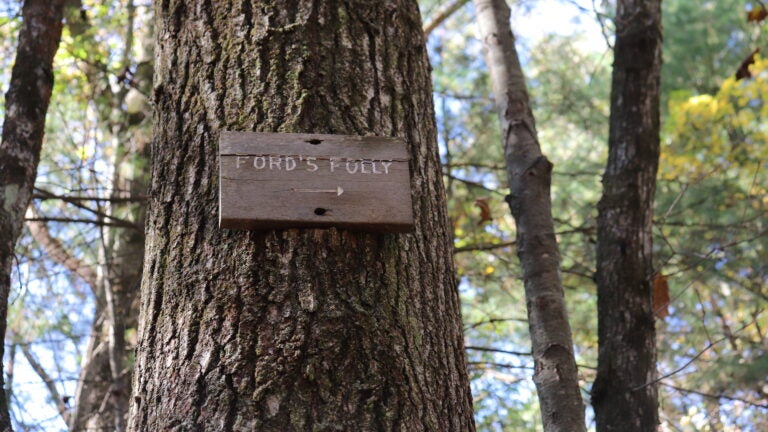
There are no signs, no landmark markers. Just a small wooden plaque bolted to a tree a few hundred meters down the trail that reads “Ford’s Folly.”
“You just come across this giant stone wall in the middle of the woods for no apparent reason,” said Sudbury’s Conservation Coordinator Lori Capone. “It’s kind of a hidden gem.”
Built in the 1920s, the structure was the brainchild of Henry Ford — the founder of Ford Motor Company and creator of the assembly line. Ford purchased almost 3,000 acres of land in 1923, which now includes the Wayside Inn, Martha-Mary Chapel, and the Grist Mill.
“He had a vision in mind that he was going to create this colonial village, in which people would live and work the way they did in the 18th and 19th centuries,” said Aline Kaplan, a Boston-based tour guide and blogger who lived in Sudbury for 37 years. “He had this idea that being close to the land was like a patriotic lifestyle.”
In order for this colonial village to operate, he needed to stop Hop Brook from flowing onto the land. So, he and his project manager John Campbell created a large stone dam that would act as a reservoir.

The entire dam was built with nothing but manpower and oxen. Oxen lugged stone from local hillsides and men used pullies and levers to heave the stone into place.
When completed, the dam was structurally sound. It was a mammoth barrier between the trickling brook and the land that would become Ford’s village.
But, somehow, the water broke through.
“The reservoir area is underlain by what’s called incompetent fractured bedrock,” Kaplan said.
The ground beneath the dam is porous and cracked, and some parts of it is sand. So, the water simply streams right underneath it.
The dam was a failure. After all the work it took to build it, the water would fill up in the spring and drain out in the summer.
From 1930 to 1946, Campbell tried to save the project, building large concrete blocks to plug the holes in the earth where the water broke through. But the brook just ran underneath the blocks. Once Ford died in 1947, his village idea was abandoned.
The Wayside Inn still operates as an inn. The Martha-Mary Chapel still holds weddings. The enormous dam still stands in the path of new hiking trails, but the village was never built.

Now it’s nicknamed Ford’s Folly to commemorate his failed efforts.
“It’s a shame,” Capone said. “There are people who work for the town that don’t even know about it.”
Very few people, even within Sudbury, know of its existence. While the Wayside Inn and the Grist Mill are well-known, the dam is hidden away in the woods.
And Ford’s legacy lives on in other respects. The same man who revolutionized the automobile industry was stumped by the tiny Hop Brook hidden in the woods.
But even if Ford’s plans worked, Kaplan said the village was most likely never going to get off the ground.
“Henry Ford never seem to want to go back to the land himself. This was something he saw other people doing, but not himself,” she said. “People don’t really want to live in a colonial village.”
Now the land and the dam are public property owned by the town of Sudbury. Hikers stumble upon it only to wonder why it’s there and what it does.
The dam is just the leftover skeleton of his elaborate project. Capone said she hopes to place signs along the trails to educate hikers and locals on the dam’s history.
“That structure isn’t going anywhere anytime soon,” Capone said.
Stay up to date on all the latest news from Boston.com





To comment, please create a screen name in your profile
To comment, please verify your email address
Conversation
This discussion has ended. Please join elsewhere on Boston.com