
Antiques & Collectibles: news about auctions
The top seller at James D. Julia’s firearms auction this month, which grossed nearly $16 million, the second highest grossing firearms auction in history, was a Winchester model 1866 rifle that sold for $224,250 against a $100,000-$175,000 estimate.
The cased silver-plated engraved Winchester originally belonged to James J. Hill (1838-1916) of St. Paul, the Canadian-American railroad magnate. Hill founded the Great Northern Railway, which in 1893 began running between St. Paul and Seattle, the northernmost transcontinental railroad route in the United States.
The rifle was from the collection of the late Wes Adams (1949-2011), a West Coast developer, who amassed “one of the finest collections of Winchesters and probably the finest collection of Savage firearms in the world today,’’ noted James Julia, president of the Fairfield, Maine, auction house.
The Wes Adams collection is being sold in three equal parts. The first was sold last spring at the record-setting two-day auction that grossed nearly $18 million, the highest grossing firearms auction in history. This month’s auction of 203 lots will be followed with the sale of the collection’s remaining lots.
An extremely rare factory-engraved Colt single-action Army sheriff’s model revolver from another consignor brought the auction’s second highest price of $201,250 against a $150,000- $250,000 estimate. It was originally owned by the legendary lawman Jefferson Davis “Jeff’’ Milton (1861-1947), who worked for the US Immigration Service from 1904-32 patrolling the southwest border from El Paso and California on horseback to apprehend smugglers and illegal immigrants.
Other top-selling Colts included an extremely rare cased
First Model Dragoon percussion revolver and a Civil War presentation pair of cased and engraved Colt 1861 Navy percussion revolvers. The First Model Dragoon, believed to be one of the finest of the 7,000 models made from 1848-50 for use in the Mexican War, brought $181,125 against a $125,000-$225,000 estimate, and the pair of Navy revolvers, presented to Adjutant Charles A. Clark of the 6th Maine Infantry
for his Civil War leadership at the 1862 battle at Marye’s
Heights, near Fredericksburg, Va., fetched $109,250 against a $75,000-$125,000 estimate.
The Savage M1907 semiautomatic pistol that belonged to William (Buffalo Bill) Cody sold for $60,125 against a $50,000-$100,000 estimate, and a special order Parker shotgun that belonged to Annie Oakley, a star performer in the Buffalo Bill shows, sold for $28,750 against a $30,000-$50,500 estimate.
The Walther PPK pistol surrendered by Reich Marshal Hermann Goering when he was captured in World War II went for $40,250 against a $30,000- $90,000 estimate.
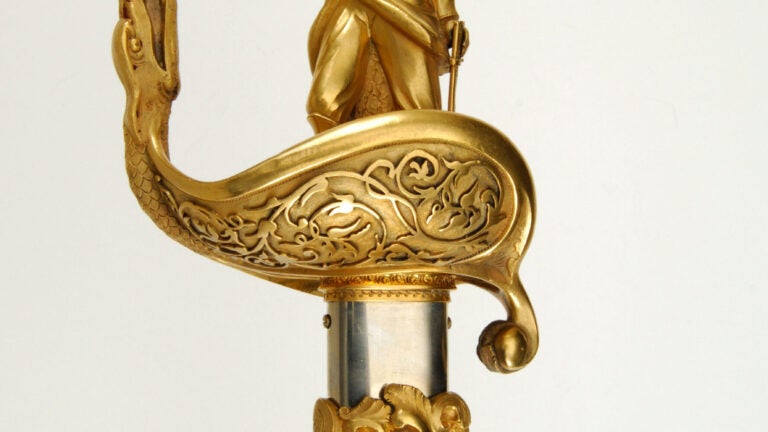
Topping the 25 Civil War swords in the sale was the one worn by Brigadier General James Haskin that brought $109,250 against a $90,000-$110,000 estimate. The rarest of all statue-hilted swords, it has a full-figured Union Army officer thrusting a saber through the open mouth of a serpent (representing the Confederacy).
. . .
The continuing popularity of Norman Rockwell illustrations of everyday life in 20th-century America was underscored last month in New York when his works topped both Sotheby’s and Christie’s American art auctions.
“Is He Coming?,’’ his oil painting of a young pajama-clad boy peering into a fireplace with a lighted candle, sold for $602,500 at Sotheby’s, more than doubling the high of its $200,000-$300,000 estimate. The painting was an illustration for a December 1919 issue of Red Cross magazine.
Rockwell’s “Keeping His Course (Exeter Grill),’’ an illustration for Ralph Henry Barbour’s book “Keeping His Course’’ (D. Appleton, 1918), and his study for “The Runaway’’ brought the two top prices at Christie’s auction. “Keeping His Course,’’ depicting a Phillips Exeter Academy student enjoying a slice of pie at the canteen known by the students as the “Grill,’’ brought $218,500 against a $100,000-$150,000 estimate, while his study for “The Runaway,’’ the illustration of a young runaway and a police officer that appeared in the Sept. 20, 1958 issue of The Saturday Evening Post, fetched $206,500 against an $80,000-$120,000 estimate.
. . .
A 17th-century Dutch still life from a Maine collection became the sleeper at Skinner’s American & European Paintings and Prints Auction last month when it sold to a London bidder for $666,000 or more than 22 times the low of its $30,000-$50,000 estimate
“Still Life With Tazza, Peeled Lemon and Roemer,’’ an oil on panel of a compote, lemon, and wine glass on a table, was painted in 1630 by Willem Claesz Heda (1594-circa 1680).
It was followed by a 17th-century Continental School oil portrait on an oval panel of a man in a ruff that brought $79,624, or more than 26 times the low of its $3,000-$5,000 estimate, and by an 18th-century French or Italian School crayon on paper, “Jacob and Angel,’’ that brought $27,255 or more than 38 times the low of its $700-$900 estimate.
The top-selling American paintings were a circa 1785 oil portrait of Captain John MacBride of the British Royal Navy by Gilbert Stuart (1755-1828), which sold for $37,500 (against a $15,000-$20,000 estimate), and an oil, “Decatur’s Sloop Intrepid at Tripoli’’ (1803), by the marine artist Thomas Birch (1779-1851), which also sold for $37,500 (against $50,000-$70,000).
The top sellers in the auction’s fine prints and photography session were “Shipboard Girl,’’ a 1965 color offset lithograph by Roy Lichtenstein (1923-97) that brought $15,998 against a $7,000-$9,000 estimate and photographs of two nudes each selling for $8,295. The gelatin silver print of a seated nude woman by the American photographer Edward Weston (1886-1958) had a $4,000-$6,000 estimate, while the print of a reclining nude by the German photographer Erwin Blumenfeld (1897-1969) had a $2,500- $3,500 estimate.
An Andy Warhol screenprint with diamond dust on paperboard of Senator Edward Kennedy went for $10,073 against a $5,000-$7,000 estimate. It was from the 1980 edition of 300-plus proofs published by the Kennedy for President Committee in Washington.




To comment, please create a screen name in your profile
To comment, please verify your email address
Conversation
This discussion has ended. Please join elsewhere on Boston.com