
Antiques & Collectibles
A rare pair of circa 1802 China Trade portraits of James Cary, the captain of the Nantucket ship Rose,
and of the Hong merchant Chung Qua of Canton painted by Spoilum, the earliest known Chinese painter in the Western style, will be offered at Northeast Auctions’ Annual Marine, China Trade & Historical Americana Auction Saturday and Sunday at noon at Treadwell Mansion, Portsmouth, N.H.
Cary was a 24-year-old captain in 1801 when he first sailed to China, where, according to family legend, he commissioned Spoilum to paint his portrait as a gift to Chung Qua, his trading liaison in Canton. Reciprocating, Chung Qua had his portrait painted by Spoilum and gave it to Cary, who, meanwhile, was so impressed with his own portrait that he sat for a duplicate, which he brought back to Nantucket along with Chung Qua’s portrait.
A friendship developed between the two young men. It became so strong that the Hong merchant and his manservant spent the winter of 1807 with the Cary family at their Nantucket home at 117 Main St. In 1809 Chung Qua made a return visit. Three years later, Cary died on a voyage to China.
The pair of portraits, which descended in the Cary family, has a $100,000- $150,000 estimate and is being sold along with four of the items that Cary brought back to his family during his years as master of the Rose, one of the most successful vessels in Nantucket’s early China trade.
The items include a 62-piece porcelain tea service monogrammed “JBC,’’ the initials of Cary and his wife, Betsy, which is said to have been purchased by Cary for everyday use. It has a $4,000- $6,000 estimate. A porcelain cider jug that Cary commissioned for his parents, Edward and Lydia Cary, with their initials and a view of a small Nantucket farm has a $30,000-$50,000 estimate.
This also is the estimate for a silver and cut-glass eight-piece cruet stand initialed “JBC’’ and marked “CS’’ for Cumshing, one of the earliest known Chinese export silversmiths. A pair of porcelain candleholders initialed “BC’’ and with bases modeled as a recumbent dog is being sold along with a 15½-inch porcelain urn. The estimate is $25,000- $40,000.
The large selection of scrimshaw being offered is highlighted by two whale’s teeth. An 8-inch tooth engraved by the so-called Pagoda/Albatross artist depicts a fully-rigged ship on the front and a Federal period house on the reverse. It has a $140,000-$180,000 estimate, while a 7½-inch tooth, dated “August 28th 1829’’ and showing the ship Susan of Nantucket, has a $125,000- $175,000 estimate. It was engraved by Frederick Myrick, a seaman on the Susan who became famous for his art.
Another highlight of the nearly 1,100-lot auction is a carved and painted figurehead of a young woman from the four-masted bark Joseph Dollar, expected to bring $50,000-$75,000. It was originally carved in 1902 for the Schuerbek, the German ship that was awarded to Italy after World War I under the terms of the Treaty of Versailles and which was later purchased by the Dollar Steamship Co. in San Francisco to deliver lumber to the Orient. In 1929 the figurehead was removed from the Joseph Dollar and was in the collection of the M.H. de Young Memorial Museum in San Francisco until 2000.
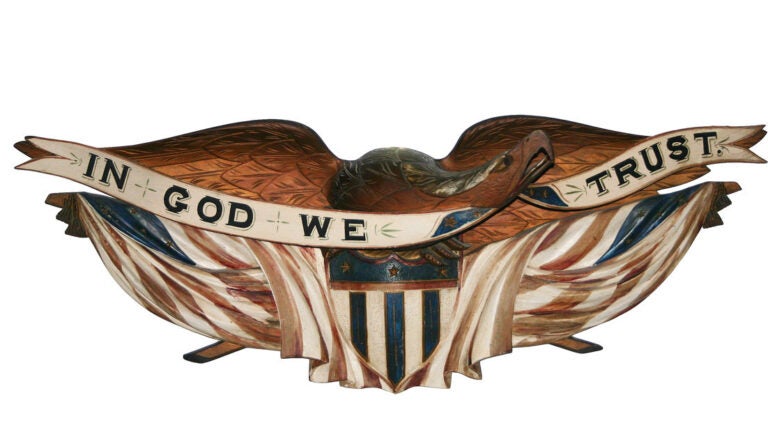
The auction’s expected top seller is an early eagle wall plaque with an “In God We Trust’’ banner by the Kittery Point, Maine, carver John Haley Bellamy (1836-1914). The estimate is $150,000-$200,000.
. . .
A painting of tigers in the wild and a pair of hissing Canada geese decoys were the two top sellers at Copley Art Auctions’ Sporting Sale last month in Plymouth, where a red-breasted merganser hen from a 19th-century Salem rig become the auction’s sleeper.
“Roused: A Tiger and Tigress,’’ the 24-by-39-inch oil painted in 1912 by the German wildlife artist Friedrich Wilhelm Kuhnert (1865-1926) sold for $333,500, more than doubling the low of its $150,000-$250,000 estimate, while the geese carved around 1900 and 1920 by Harry V. Shourds
and his son Harry M. Shourds
of Tuckerton, N.J., sold for $201,250 against a $200,000-$300,000 estimate.
The circa 1850 red-breasted merganser hen from the rig of Samuel Augustus Fabens (1814-99), a Salem-born sea captain, sold for $184,000 against a $15,000-$25,000 estimate.
Fabens, who went to sea as a cabin boy on the Tarquin, the ship owned by his father, Captain William Fabens, went on to command several ships, including the clipper ship Challenge on its 1858-60 voyage from New York to Hong Kong. But he also was an avid bird hunter, and the decoys from his rig are considered the best not just from the North Shore but from any region.
Only four Fabens mergansers in their original paint have ever surfaced. The merganser hen sold last month was from a private Connecticut collection.
The top-selling bronze in the sale was “The Last Drop,’’ which set an auction record for Charles Schreyvogel
(1861-1912) when it sold for $109,250 against a $60,000-$90,000 estimate. Depicting a cavalryman giving the last of his water to his horse, the 12-by-18½-by-5-inch sculpture was crafted on the roof of the Hoboken, N.J., building where Schreyvogel lived.
The original owner of the bronze, cast in 1904 by the Roman Bronze Works in New York, was a New Jersey collector, who is said to have made the purchase to help Schreyvogel’s late-budding career. It was eventually acquired by a Virginia collector in whose family it descended.
The 651-lot auction grossed $3,357, 389.





To comment, please create a screen name in your profile
To comment, please verify your email address
Conversation
This discussion has ended. Please join elsewhere on Boston.com