
Newsletter Signup
Stay up to date on all the latest news from Boston.com
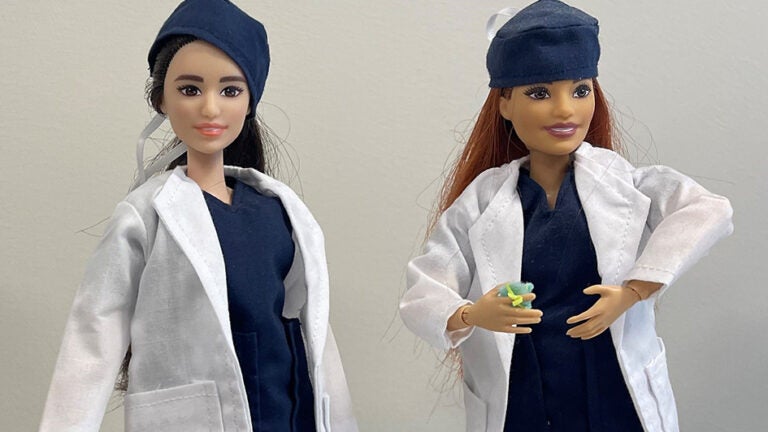
Four female surgeons from Newton-Wellesley Hospital were recently asked to reflect on whether the current Barbie dolls representing medical careers were accurate, up-to-date representations of women in medicine. Guess what? They weren’t.
That’s what the surgeons argued in“This Barbie is a surgeon,” published in December in the British Medical Journal in response to a previously written study by Katherine Klamer of the Indiana University School of Medicine. In the piece, Dr. Cornelia Griggs, Dr. Sophia McKinley, Dr. Erika Rangel, and Dr. Sareh Parangi identify major gaps in Barbie’s representation of the medical field.
“As surgeons in decidedly male dominated fields, we support Klamer’s conclusion that Barbies should represent a more diverse field of medical and scientific professions and that safety comes before fashion,” the Boston-area doctors wrote.
Barbie dolls have been a longstanding sensation for children, well before the blockbuster “Barbie” movie debuted last summer. And while Mattel has made attempts at diversity and inclusion — the first “Doctor Barbie” debuted in 1973 — many professionals in male-dominated fields feel something is still lacking.
There are so many medical specialties that Dr. Parangi, endocrine surgeon and chair of surgery at Newton-Wellesley, feels are missing from Barbie’s line-up.

Parangi points to two homemade Barbie dolls created in 2021 by two colleagues — Jessica Hall and Jordan Demasi — modeled after general surgeons Dr. Sheila Partridge and Dr. Susana Wishnia. In this patient-forward space, Dr. Parangi felt they received positive feedback from doctors and patients alike.
“In a weird way, Mattel hasn’t come up with a surgeon Barbie. But look, our staff members came up with one right here, in our clinic, modeled after our surgeons,” Dr. Parangi told Boston.com.
This is not to say Barbie does not have medical dolls. Since that first one in 1973, an entire section of Barbie’s line is dedicated to those in medical fields. But upon looking, you will find a marine biologist in a bathing suit, a pediatrician with infant accessories, scientists with blue hair, and various clinician and nurse playsets — but no surgeons.
Also, the study found that 98% of the dolls came with stethoscopes, but only 4% came with face masks, and that the dolls’ medical accessories were generally “inadequate for standard practice.” Plus, many of the medical dolls are wearing high heels with exposed legs and their hair down.
According to a press release from Newton-Wellesley Hospital, the local doctors believe this lack of realism is reflective of current attitudes toward women in STEM (science, technology, engineering, and math) fields. Particularly, Dr. Parangi mentions her own position as the chair of surgery. Not only is it difficult to pursue surgery, but it is even harder to get a leadership position.
According to Dr. Parangi, more than half of medical students are women. But as each year of medical school goes by, fewer of these women are choosing a surgical track. Dr. Parangi believes it’s about the signals sent to women that surgery is too time-consuming.
“You can’t have children, you can’t have a family, it’s too difficult for your family life,” echoed Dr. Parangi. These false narratives have narrowed the amount of women in the surgical field, she says.
Barbies can represent how a child perceives their future possibilities.
“You can’t be something that you can’t see,” Dr. Rangel, a gastrointestinal surgeon and surgical intensivist, told Boston.com.
Both surgeons — Dr. Rangel and Dr. Parangi — are hopeful that more accurate representations of medicine will allows young girls to see their futures clearly.
“We’re just concentrating on making sure that all girls are looking at STEM fields in a way that says, ‘These are open to you,’” said Dr. Parangi.
Dr. Rangel agreed, saying, “It’s really an opportunity to break down those gender schemas at a very early age.”
Whether this Barbie is a surgeon, veterinarian, or dentist, both women concur that Barbies are not simply playthings. And with a team of fellow physicians and allied health professionals, Dr. Parangi says she would be open to continuing this project with Mattel.
Stay up to date on all the latest news from Boston.com





To comment, please create a screen name in your profile
To comment, please verify your email address
Conversation
This discussion has ended. Please join elsewhere on Boston.com