
Cambridge Startup Saves Valuable Time for HIV Patients
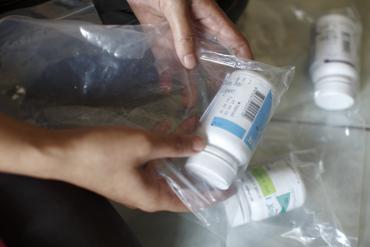
Receiving ineffective HIV drugs jeopardizes the health of patients while wasting healthcare system funds. The founders of a Cambridge startup think they’ve found a way to match patients more efficiently with the right drugs in a matter of hours, lowering costs for healthcare providers, and improving care for patients.
The startup, Aldatu Biosciences, focuses on the development of affordable HIV drug resistance diagnostics to improve patient care and health. Their technology will shorten the testing time of HIV drug resistance from two days to two hours and lower the cost of testing, helping healthcare systems in developing countries become more efficient.
“Personally for me, I looked for something that was both a good business opportunity that was commercially viable, but also something that I believed in strongly,’’ said David Raiser, co-founder of the year-old company. He founded the company with Iain MacLeod, who developed the technology in a lab at the Harvard School of Public Health about three and a half years ago.
To address the problem, Aldatu developed their platform technology, Pan Degenerate Amplification and Adaptation (PANDAA) for HIV drug resistance genotyping. The PANDAA HIV6 testing kit enables healthcare providers to properly match HIV patients with effective medication.
The kit took advantage of existing infrastructure in clinical testing labs. After a blood sample is obtained from the patient, the virus is tested to determine, in two hours, whether resistance is present to different HIV drugs. With the current technology, it takes about two days to get the result, according to MacLeod.
By creating a low-cost diagnostic test for the HIV drug resistance detection, the company aims to improve patient outcomes and to reduce cost for both patients and healthcare systems, whose funds are often wasted on incorrect drug matching.
Raiser and MacLeod said they are trying to make a difference for HIV patients globally by providing affordable HIV care for resource-limited healthcare systems.
According to the World Health Organization, more than 15 million people will access the HIV drugs by the end of 2015. Approximately 120,000 people start therapy each month. However, 10 percent of people show resistance to their HIV drugs every year, because the resistance testing is not implemented until late in the treatment process.
“In general, what these tests allow healthcare systems to do is be more efficient with their funds that are already appropriated to HIV treatment and management,’’ said Raiser.
The money saved then could be used to provide drugs for additional patients or provide additional services. Instead of only reducing the price of each HIV drug, Aldatu wants to solve the problem from a higher level.
“It’s about providing more economic healthcare,’’ said Raiser.
Earlier this month, Aldatu Bioscience received a $250,000 prize from the Verizon Powerful Answers Awards. The company’s statement on the prize called the fund a “game changer.’’
As two first-time entrepreneurs, “the prize means a lot of things to us,’’ said Raiser. “From a business perspective, with this amount of money, it’s enough to make a very tangible impact on our work, and allow us to move forward more quickly.’’
With the funds from the award, Aldatu will be able to move into an independent lab space in Cambridge and begin engaging with manufacturing partners to help them turn the PANDAA HIV drug into a clinical testing kit. Developing a prototype kit will take half a year, and then it will take 12 to 18 months to do the evaluations in the U.S. and Africa, before they eventually put the kit into the market.
Clarification: A previous version of this article erroneously reported that David Raiser developed the PANDAA technology at the Harvard School of Public Health. His co-founder Iain MacLeod developed the technology at the school.





To comment, please create a screen name in your profile
To comment, please verify your email address
Conversation
This discussion has ended. Please join elsewhere on Boston.com