
The Fight to Repair Marathon Bombing Ear Trauma Isn’t Over Yet
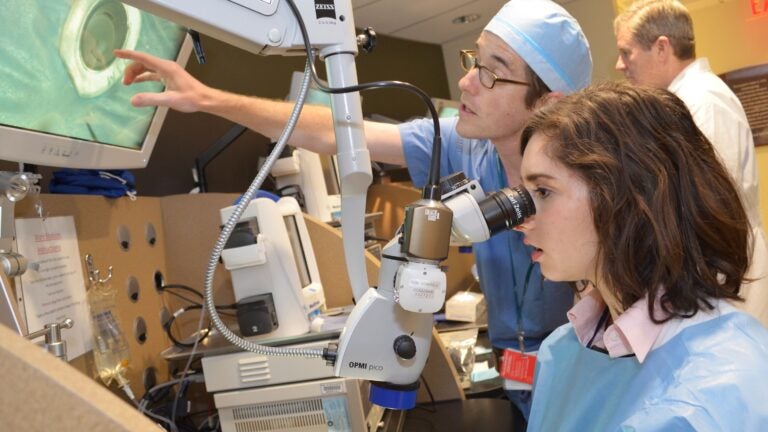
The Boston Marathon bombings turned Boylston St. into an environment much like a war zone. Ear injuries were one of the most common — if little-publicized — side effects of the bombings that victims continue to deal with today.
Dr. Aaron Remenschneider and Dr. Alicia Quesnel were on the front lines at Massachusetts Eye and Ear Infirmary that day. They are also the leading authors behind a recent study tracking the injuries of those affected by the bombing and observing the long-term effects of ear-related trauma.
Remenschneider told Boston.com that in the aftermath of the bombings, the most common trauma was soft tissue injuries in the ear, face, head, and neck as well as eardrum perforations. Ear trauma was found in 90 percent of patients who were hospitalized with other wounds. In the days and weeks that followed, patients continued to come in with inner ear injuries such as hearing loss, tinnitus (ringing in the ears), difficulties hearing background noise, and sensitivity to sound.
Ultimately, more than 100 patients from eight different medical campuses were evaluated for blast-related otologic grievances, and 94 enrolled in the study.
The study also gave doctors a rare opportunity to see how trauma-related ear injuries impacted civilians. Usually, these types of injuries are confined to military patients in war zones.
“There were many injuries that I had not seen before in a civilian environment, and that was challenging to see,’’ Remenschneider said.
Throughout the study, Remenschneider realized that the civilian population, when exposed to acoustic trauma, responds differently from military patients. This is because civilians are not equipped with the same protective gear as military personnel, and members of the military have a history of loud noise exposure. Remenschneider believes this may predispose their auditory system to damage. He says that it is still unclear what the long term auditory consequences will be for patients without previous noise exposure. The Massachusetts Eye and Ear Infirmary hopes to answer this question through the study.
“A lot of these patients still have hearing loss that has continued a year and a half after the bombing,’’ Quesnel said. “A lot of that can be related to the inner ear, as a result of the blast trauma and pressure waves that occur as a result of the blast.’’
Quesnel said there are also many patients with hearing loss caused by holes in the eardrum incurred by the blast. Some of these patients have undergone surgery, while other patients have healed on their own. Spontaneous healing occurred in 38 percent of the study’s patients, while surgery had an 86 percent success rate.
Eardrum perforations aren’t the most likely source of continuous ear pain: inner ear injuries, about which little is known, are thought to be the cause.
“That is what our future research is aimed at, looking at the effects of blasts on the inner ear with advanced testing,’’ Quesnel said.
Many forms of therapy and treatment are being used to help the victims today.
Steroid therapy was used to help many of the victims immediately after the bombing to deal with noise trauma, and counselors have helped those with chronic difficulties in hearing adapt to their environments. Dr. Daniel Polley, a scientist in the Neural Plasticity Unit at Mass. Eye and Ear, developed a tablet-based computer program that retrains the brain and auditory system away from experiencing tinnitus. Polley hopes to alleviate symptoms through an immersive gaming interface that works to “reset’’ the pathological activity in the brain areas that cause tinnitus. This could potentially eliminate the symptoms, and allows patients to work on rehabilitation within their own homes.
Hearing aids have played a large part as well, and Remenschneider says they’ve been lucky to receive funding from the One Fund, the fundraising organization created to help those affected by the bombing.
“We’re very excited that the One Fund center helps patients receive ongoing care for hearing-related injuries in the future,’’ Remenschneider said.
Although further research is necessary, Remenschneider and Quesnel were able to draw some conclusions in the recent release of their study.
“There certainly was a correlation with proximity in the blast to holes in the eardrum,’’ Quesnel said. But that wasn’t true of every case. “We found some correlation with hearing loss, but there were a few patients who were in very close proximity to the bomb that didn’t have hearing loss while others were a block away and had perforation.’’
Moving forward, Quesnel said the focus of the research will be on continuous symptoms from inner ear injuries.
“The lasting conclusion is that many patients have ongoing symptoms that we would like to better understand,’’ Remenschneider said. “And we don’t know what the long-term impacts of acoustic trauma are.’’




To comment, please create a screen name in your profile
To comment, please verify your email address
Conversation
This discussion has ended. Please join elsewhere on Boston.com