
A Partial Lift on Gay Men Blood Donation Ban Not a Win
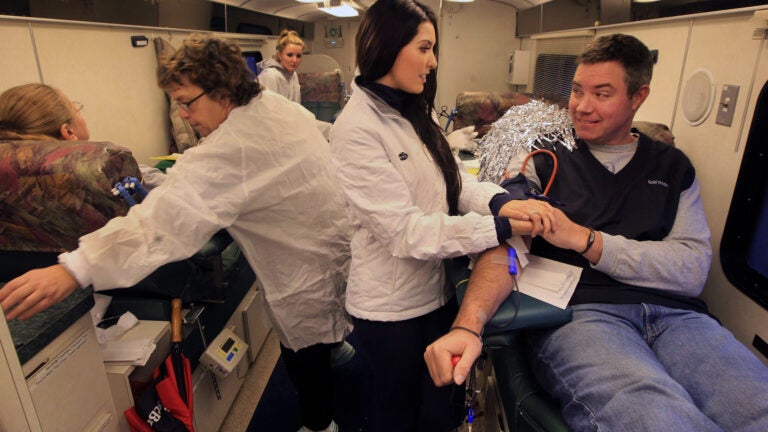
Gay men might soon be able to donate blood—something that has been banned in the U.S. since 1983. The catch? Men would have to stay abstinent for one year before donating, and according to activists in Massachusetts, that’s not good enough.
While it might be a progressive step in addressing the current donation ban on men who have sex with men, MassEquality executive director KC Coredini said the one-year deferral policy further stigmatizes same-sex relations among men.
“Mandating one year of abstinence prior to donating blood is not only unrealistic, but perpetuates stereotypes around men who have sex with men, HIV/AIDS, and high-risk sexual behavior,’’ Coredini said in a statement to Boston.com. “The standards used to assess eligibility for blood donations should be completely equitable and based on scientific and medical facts.’’
The U.S. Health and Human Services’ Advisory Committee on Blood and Tissue Safety and Availability voted on Nov. 13 to change the current policy, which bans men who have had sex with men at any time since 1977 from ever donating.
The policy was made at the height of the AIDS crisis amid concerns that the disease could be contracted through blood transfusions.
A joint statement from the American Red Cross, America’s Blood Centers and the American Association of Blood Banks released on Nov. 14 said the organizations support the committee’s recommendation, and that the current lifetime ban is “medically and scientifically unwarranted.’’
Advisers for the Food and Drug Administration, which determines the policy, will consider the committee’s recommendation in a Dec. 2 meeting.
The new rules would allow gay men, as well as people who have had sexual relationships with a HIV or hepatitis-infected person, to donate blood after one year. It would not consider men who are in monogamous relationships with other men to be eligible.
Gay and Lesbian Advocates and Defenders senior attorney Bennett Klein said instead of initiating a policy that makes broad exclusions, deferral of donations should be based on individual behavior.
“I think the safety of blood supply is paramount, but a one year ban continues to be discriminatory and unscientific,’’ he said. “A sound policy would be based on current HIV screening technologies and individual risk behavior.’’
Challengers to the partial ban, like Coredini and Klein, said there is no scientific basis for upholding a one-year waiting period when detection of HIV/AIDS in a blood sample can be found in far less time.
Dr. Christopher Stowell, who specializes in blood transfusion and medicine at Massachusetts General Hospital, said there are two main tests for detecting HIV/AIDS in blood samples: an antibody test and an RNA test.
The most popular test screens for two strains of HIV by seeing if the blood contains HIV antibodies. A person will typically have enough antibodies to test positive for HIV two to eight weeks after infection, said Stowell.
The time period directly following the point of infection with HIV is called the “HIV window,’’ where an antibody test would not make a positive result from a blood sample. In 2002, Stowell said medical advancements developed a genetic-based screening that looks at RNA and can detect the virus as soon as a few days to two weeks after the point of infection.
“It was much more common in some regions of the country,’’ he said of HIV being transferred through blood transfusions in the 1980s. “It almost never occurs anymore. People try to do estimates of the likelihood today, and there is such a low rate that it can’t be measured. It must be one in several million.’’
Canada has a five-year donation deferral for men who have sex with men while Australia, Japan and the United Kingdom have moved to a one-year deferral policy.
Countries such as Italy, Mexico, Russia and Spain have no deferral periods.
“We get hundreds of calls from people with legal concerns and issues. What struck me were the calls from gay men about the blood ban,’’ Klein said. “They conveyed that so many gay men, as citizens, want to be able to participate in blood drives in times of emergencies.
“It’s a basic civil engagement and to be excluded on unscientific principals is not only hurtful, but it is not consistent to ensure sufficient blood supply in the country.’’





To comment, please create a screen name in your profile
To comment, please verify your email address
Conversation
This discussion has ended. Please join elsewhere on Boston.com