
Tanning Beds Cause Cancer, but College Girls Are Still Lining Up
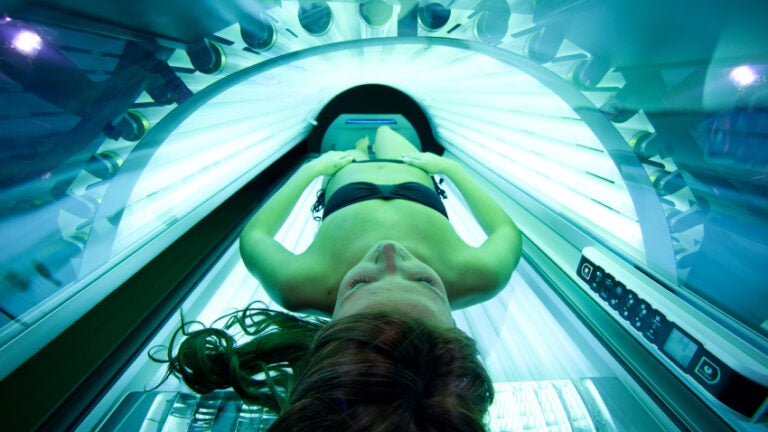
Tanning beds cause cancer—they produce ultraviolet rays that are a known carcinogen. And yet college students continue to flock to tanning salons to keep their summer glow alive in the winter. As many as 59 percent of college students have reported using a tanning bed in their lifetime, according to the American Academy of Dermatology.
Researchers at the University of Massachusetts Medical School found that 48 percent of schools nationwide have indoor tanning facilities either on campus or in nearby off-campus housing, and 13 percent of schools in the Northeast have tanning facilities on campus.
Boston.com spoke to eight local universities, and all of them said they did not have tanning facilities on campus. (Three other schools did not comment, but according to maps, they are also lacking in ultraviolet-emitting beds.)
Yet tanning facilities are within easy walking distance of these schools. A quick search on Yelp shows that Boston University and Suffolk University have the highest concentrations near campus, with three salons within a half-mile radius. Harvard, Northeastern, Emerson and MIT all have at least one tanning salon within that distance. Tufts, Bentley, and Boston College each have at least one tanning salon within a mile; Brandeis and UMass Boston are the only schools with no nearby tanning salons.
[fragment number=0]
“Definitely BU students [bring in the most business],’’ said Katie Medrano, who works at Dellaria Spa Kenmore Square, located right by Boston University. “Mostly girls. For age, I would say starting at 19.’’
The majority (70 percent) of bronzers are young, white, women between the ages of 16 and 29, according to the AAD. And it’s clear that behaviors established in teenage years continue into college. The Centers for Disease Control and Prevention has found that approximately 32 percent of high school senior girls use tanning beds. The exact same percentage (32 percent) continue to tan through their college-age years (18 to 21 years old).
This is what drove the researchers to study campus-adjacent tanning facilities.
“The presence of indoor tanning facilities on and near college campuses may passively reinforce indoor tanning in college students, thereby facilitating behavior that will increase the risk for skin cancer both in short term and later in life,’’ Dr. Sherry Pagoto, an associate professor of medicine at U Mass. Medical School and lead author of the study, said in a statement about the research.
This is a problem. For women in Massachusetts, the risk for skin cancer is particularly high.
According to the Centers for Disease Control and Prevention, melanoma of the skin is the fifth-most-common type of cancer in Massachusetts. The most recent Massachusetts Cancer Incidence and Mortality report found the mortality rates for all cancers are higher in Massachusetts women compared to all US females. Melanoma ranks as one of the top cancers for women.
We know, Boston. It gets dark and cold. You may not have as much Vitamin D, or as much of a tan, as you did just a few months ago. But tanning beds are never the answer.





To comment, please create a screen name in your profile
To comment, please verify your email address
Conversation
This discussion has ended. Please join elsewhere on Boston.com