What critics had to say about ‘First Man’
The reviews (good and bad) of Damien Chazelle and Ryan Gosling's new Neil Armstrong film.
For a few glorious moments in 2017, the Providence-born, Harvard-educated Damien Chazelle was a Best Picture Oscar winner. “La La Land,” which shares DNA with Chazelle’s first feature film and was set in Boston in early drafts, had capped off a whirlwind awards season for the director and his film’s stars, Ryan Gosling and Emma Stone.
And then it all came apart moments later, when a producer announced that “Moonlight” was the actual Best Picture winner, in one of the most memorable moments in Oscars history.
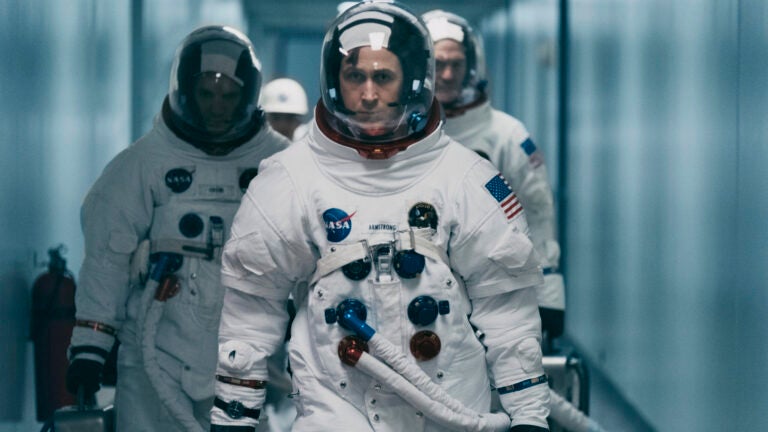
Now Chazelle is back, teaming up with “Spotlight” scribe Josh Singer on “First Man,” the Neil Armstrong biopic that has some critics crowing about its potential to bring home more awards for the Harvard grad. Starring Gosling as Neil Armstrong, the movie made waves on the festival circuit, and landed in Boston theaters Thursday night.
Critics have been largely positive about the film, earning it an 88 percent freshness rating on critic aggregation website Rotten Tomatoes as of this article’s publication. But a single number doesn’t adequately capture the range of critical response to the film, as many reviewers haven’t bought into the “First Man” hype.
To help you decide whether to catch the film in theaters this weekend, here’s a roundup of what critics are saying (both good and bad) about “First Man.”
The Good
Though The Boston Globe’s Ty Burr called “First Man” Chazelle’s “least show-offy” movie to date, he also cited one specific scene as a “historical achievement” that he said should be viewed in a movie theater with the biggest screen you can find.
Chazelle plays games with film stock, shooting on grainy 16mm for the most private moments, on 35mm for the bulk of the film, and widening out into crystalline IMAX film when the Lunar Excursion Module’s hatchway reveals the surface of the moon. That scene is, appropriately, an unprecedented historical achievement and a stunning movie moment, like Dorothy stepping from black-and-white Kansas into a Technicolor Oz. It deserves to be seen on the largest canvas possible.
Peter Travers of Rolling Stone called Chazelle’s “First Man” — which he said was “eons away” from his whimsical, musical work on “La La Land” — “unmissable and unforgettable.”
There have been astronaut movies before, good (Apollo 13) and better (The Right Stuff). But few have been as much a triumph of the imagination fueled, not by FX but by indelible feeling, as this one.
A.A Dowd of the AV Club found Chazelle’s approach to the film refreshingly atypical.
First Man, Damien Chazelle’s grippingly unconventional portrait of this “reluctant American hero,” offers a fresh outlook of its own. As biopics go, it’s singularly focused on literal nuts-and-bolts work, the years of elbow grease and sacrifice it took to get Armstrong and the rest of the Apollo 11 crew to the moon. Yet the film also views this historic event almost entirely through the eyes (and by extension, psychology) of its real-life icon.
David Sims of The Atlantic raved about the film’s moon landing sequence, writing that it thematically ties the whole film together.
Shot with imax cameras, the scenes on the moon are breathtaking, and grant the visual serenity the director has long withheld. Though the end result of the Apollo 11 mission can’t really be shocking, Chazelle wants it to feel earned—an emotional pinnacle that’s barely within human comprehension, one that will keep Armstrong at arm’s length from everyone around him forever. It’s a glorious but sobering conclusion, and a fitting cap to Chazelle’s most mature and impressive effort yet.
The So-So
Justin Chang of the Los Angeles Times had mostly good things to say about “First Man,” but also wrote that he liked the concept of the film more than the film itself.
The impulse to cast an epic voyage in intimate, personal terms is an excellent one, though I must say that I like the idea behind “First Man” more than I ultimately like “First Man.” Much of the picture is shot in intense closeups with a juddering handheld camera, a choice that evokes NASA’s rickety and experimental early technology (“making models out of balsa wood,” in the angry words of Armstrong’s wife, Janet, played by a fine Claire Foy). It’s an intriguing but wearyingly monotonous visual decision that, up until the moment of the actual moon landing, doesn’t always flatter the Imax format in which the movie first screened for Toronto audiences.
Matt Zoller Seitz of Rogerebert.com also generally enjoyed “First Man,” but did note that its singular focus on Armstrong’s character occasionally made other scenes in the film lack an emotional punch, citing in particular the ones in the film featuring other astronauts.
Ultimately, none of Neil’s colleagues register as much more than glorified background characters. When Chazelle re-enacts the 1967 Apollo 1 capsule fire that killed three astronauts, it’s upsetting because of the matter-of-fact abruptness of the staging (as if a candle had been unexpectedly snuffed out), not because we’d gotten to know and care about the crew. Their deaths register mainly as threats to Neil’s safety and the future happiness of his family.
The Ugly
Writing for WBUR, Sean Burns found himself “fuming” after leaving the film, calling it both one-note and exploitative. He lamented that Chazelle reduced the awe-inspiring moon mission to a story of the “semi-suicidal refuge of a broken man who refuses to grieve” for his daughter, who passed away at age 2.
Obviously space exploration is serious business but I doubt it was ever as glum as the funereal “First Man,” which among the ranks of NASA movies is sorely lacking the jaunty exhilaration of Philip Kaufman’s “The Right Stuff” or the can-do camaraderie of Ron Howard’s “Apollo 13.”
Stephanie Zacharek of Time magazine had a similar issue, saying that Chazelle spends most of the movie trying to convince the audience that the death of Armstrong’s infant daughter was the single catalyzing moment in his life that led him to undertake the moon mission, despite there being little evidence of that.
Chazelle seems desperate to link these two events, as if you couldn’t make a pretty good Neil Armstrong movie without doing so. Losing a child is a devastating experience. But in First Man, Gosling’s Armstrong is tasked with reminding us of his pain in practically every other scene: As his daughter is dying, he holds her and gazes at the moon, singing a lunar-themed lullaby.
Richard Brody of The New Yorker said that “First Man” unintentionally functions as a “right-wing fetish object” because Chazelle is too oblivious as a filmmaker to make Armstrong a three-dimensional character.
The few and narrow traits that he’s assigned make him a cardboard cutout, a living poster man of bygone American heroism. A work with right-wing ideas doesn’t have to be a bad film, but “First Man” comes off as propaganda by mistake, by artistic obliviousness rather than by artistic design.