‘The Spy Who Dumped Me’ writer-director on what Hollywood gets wrong about female friendship
‘People have this misguided idea that the only way to have any drama in a movie is to make the drama between the women.’
Given that “The Spy Who Dumped Me” is the first big-budget film for writer-director Susanna Fogel, you might think she would be careful to play by the rules.Instead, the Rhode Island native, who frequently visits the Boston area to see her mother in Brookline and father in Lexington, flouted Hollywood conventions so that her movie showcased a rock-solid version of female friendship she believes is rarely displayed on-screen. The film follows the exploits of Audrey (Mila Kunis) and her best friend Morgan (Kate McKinnon) as they take a harrowing trip through Europe pursued by armed baddies after Audrey’s ex-boyfriend Drew (Justin Theroux) turns out to be a CIA spy. Early on, Drew warns Audrey not to trust anyone. The unspoken exception to this rule is Morgan. “Movies about female friendship involve a lot of petty rivalry, because people have this misguided idea that the only way to have any drama in a movie is to make the drama between the women,” Fogel told Boston.com in an interview at the Ritz-Carlton Boston. “It’s a cheap shot people take. My friendships, in my experience, have drama that unfolds from the outside, and you turn to your friend to help you through them. Sure, in your teens and early 20s you’re creating some drama with your friends, but then you outgrow that.”Where other buddy comedies would have used moments of the duo squabbling as fertile grounds for comedy, “The Spy Who Dumped Me” refreshingly doesn’t feature that standard scene in the third act in which the two protagonists get angry at each other, say unforgivable things, and then part ways — only to joyfully reunite before the film ends. “We didn’t need to contrive a reason to pull them apart only to put them together again at the end,” Fogel said. “That was important to me. It felt more true to what my friendships are actually like.”

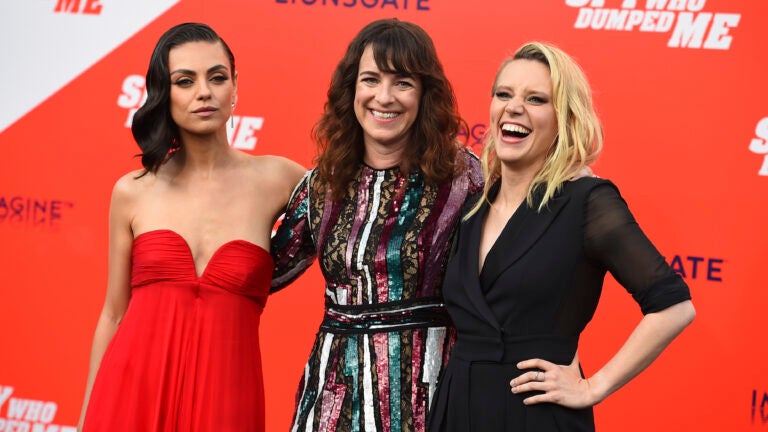
Kate McKinnon and Mila Kunis in “The Spy Who Dumped Me.”
The movie does see Audrey and Morgan end up in all sorts of absurd situations — from hijacking a manual transmission car when neither drives stick-shift to infiltrating a gala and impersonating a member of Cirque du Soleil — but they always have each other’s back.
“They can be dumb, they can have dumb comedy moments, but I just didn’t want unrealistically petty drama to be the nature of the dumbness,” Fogel said. “We felt their friendship was worth defending.”
Given the authentic connection between the two female protagonists, it’s somewhat surprising that Fogel co-wrote the screenplay for “The Spy Who Dumped Me” with a man, David Iserson.
“He just writes about emotional people of any gender, and I do the same thing,” Fogel said of her co-writer. “For us, it didn’t even cross our minds. I think we just wanted to write these two characters to react the way we would react in any situation.”
While Fogel said that she and Iserson viewed their writing process as genderless, she also said she recognizes that the issue of gender inclusion is a “third rail” that can be hard to discuss without eliciting an impassioned response.
For legions of angry fanboys online, making an all-female “Ghostbusters” reboot or adding women and people of color to big-budget Hollywood films can be a sign of political correctness run amok, the work of so-called “social justice warriors.” On the other end of the spectrum, Fogel said that in some instances, she has felt like she can’t praise the men in her life like Iserson without facing blowback.
“Some of the most supportive people I’ve worked with are men,” Fogel said. “And women as well, but it’s not the case that the men are oppressing me with their privilege. I hate that I can’t say that. I think everyone should be able to share their experience and speak their truth, whether that truth be ‘every man has oppressed me’ or ‘I’ve never experienced that,’ or something in between.”

Mila Kunis as Audrey and Kate McKinnon as Morgan in ‘The Spy Who Dumped Me.’
“The Spy Who Dumped Me” does have occasional jokes at the expense of its male characters (and males in general), but to put the film in a bucket — to call it “feminist propaganda,” for example — would be an extreme stretch.
Just as Fogel doesn’t want to put an entire gender into a box, she doesn’t want to be put in one either. Whether “The Spy Who Dumped Me” is a success or not, she wants to keep her career diverse, citing directors like Ridley Scott and Steven Soderbergh as models.
“Everyone gets pigeonholed in their way, but because there are fewer women [filmmakers], and also because of sexism, it happens more readily for us,” Fogel said. “Sometimes the last thing you did or the most prominent thing you did is who you are, and you have to write your way out of that box again and again.”
If Fogel gets offered the “right” film — big budget or small — she said she’ll do it. All she wants is to never be seen as someone incapable of making any given movie.
“The idea that big-budget comedies could be my ‘box’ is still insane at this point,” Fogel said. “So I want to keep enough balls in the air so that anytime someone looks at me, they don’t say, ‘Oh, she can’t do this.’”