
Sign up for the Today newsletter
Get everything you need to know to start your day, delivered right to your inbox every morning.
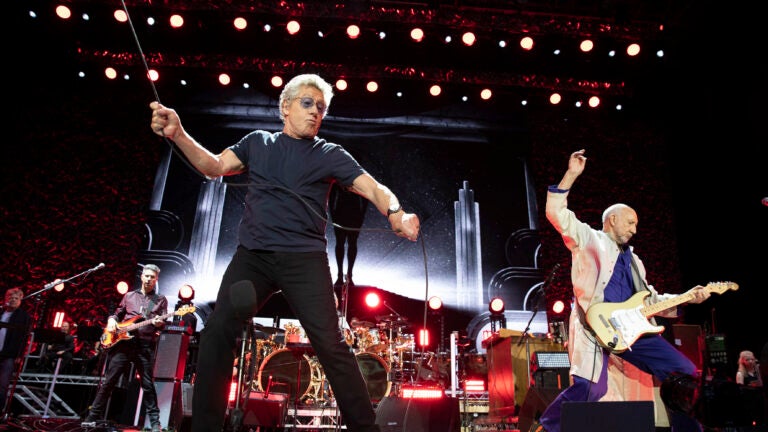
Roger Daltrey loves playing Fenway Park. And now it’s his final inning.
“I’m looking forward to seeing Fenway Park again. What a fabulous place to play. It might’ve been built for baseball, but it’s surely a great music venue,” Daltrey tells me with a laugh.
“It reminds me of what we used to have with football stadiums in the UK. Sadly, in London, there’s all these modern stadiums — they don’t carry the same atmosphere at all. So, Boston: you’re lucky to have it,” The Who frontman says in our recent phone call.
Proudly blue-collar, with a thick accent, the Rock and Roll Hall of Famer strikes me as a guy who could hold court at his local bar until closing time. Warm, down-to-earth and candid, he can tell you about getting expelled from school or undergoing an operation with a self-depreciating joke and hearty guffaw.
It feels on-the-nose that Daltrey, 81, would fall in love with the rustic old-school charm of Fenway. His final Boston at-bat is Aug. 26 at 7 p.m. That’s when Daltrey and Who co-founder/vocalist Pete Townshend, 80 — the last original band members standing — take the field on their “The Song is Over: North America Farewell Tour.”
I called Sir Roger Daltrey, CBE to talk last shows, Who roots, how Boston saved his career, his plans for a movie (don’t call it a biopic) on “the original rock and roll loon” Keith Moon — and why this final tour doesn’t mean the end of his singing.
Roger Daltrey: Definitely. The last tour of America. Definitely.
Well, it’s not the shows — I find the shows absolutely enjoyable — but the touring itself. I’ve had enough of it. [laughs]
Living out of suitcases becomes incredibly trying at this age. It’s never been easy. But I’d like to have the last few years of my life to just be. [laughs]
We’re not saying we won’t ever play together again. Obviously, if some big charity event came up and they thought we could help out, we’ll do it. But we want to stop touring. It’s grueling.
We were at Fenway Park [in 2019] with an orchestra and that was great, but now we’re getting back to the raw sound. Pete’s playing better than he has done for years. I feel my voice is as good as it’s ever been.
Who music certainly grows in its own furrow. [laughs] We plow our own. This is the last time you’ll get to hear it live in a touring situation. So make the most of it, guys! [laughs]
I wouldn’t be on stage if it wasn’t for my connection with Boston, through my voice surgeon [Steven Zeitels] at Mass General. He’s given me a remarkable voice for my age, and I can never thank Boston enough. I love the city. I love the people.
I didn’t know whether I would come out of Mass General that morning with a voice. That was scary. But it worked. And fortunately, worked beyond anything I could’ve wished for.
For a while I went back every year for a check-up. I haven’t been back now for five years. If my voice goes now, it will probably be permanent. I try not to think about it. Singing has been an absolute joy for the last [16] years.
Oh, yeah. It’s in the music. Once you start playing it, you’ve got to give it the energy it was originally created with. If that ever fails, we’ll just stop. There’s no point going on willy-nilly. You have to be fully committed. And I’m enjoying every second.
I felt that way, yes. It did become like a sacrificial lamb of the night. And we’re still trying to pay for them. [laughs]
It’s only Pete and I who are The Who. Everybody else there is a session man. They’re fabulous musicians, and they recreate what John [Enwistle] and Keith [Moon] created way back when this music was created.
That’s going very well. We have a film deal, we have a director lined up, and we’re in the early process now of finalizing the screenplay. So hopefully next spring, we’ll be in full production.
I don’t really want to say yet, until the i’s have been dotted and the t’s crossed, these can always change. But hopefully we’ll start filming in the spring.
No. That’s going to be the hardest bit. The mission has been to get a script.
It’s not a biopic. It’s a dramatization of episodes in his life. The last biopic I watched was on Amy Winehouse [2024’s “Back to Black”]. I thought the actress [Marisa Abela] did a very good job of playing Amy. But [it] lacked drama. All I know about Keith Moon’s life is it did not lack drama.
Yeah. Again, for me, it lacked drama. Very well performed — [Timothee Chalamet] could’ve have been Bob. I know people loved it. But it didn’t teach me anything I didn’t know about Bob.
Too many to mention in an article. He was the original rock and roll loon. Everything had to be fun, nothing could get too serious. He just wouldn’t allow it. Everything he did was hysterically funny. Most of the time, 99.999% of the time, he’d have you crying with laughter. Equally, he was an addict and subsequently paid the price. [Moon died of an overdose in 1978.]
You got to understand, I was born in the last year of the Second World War. Our teenage years in post-war Britain was virtually exactly the opposite standard-of-living you had in America at that time. [American] GIs stationed here brought blues music. We heard rock coming across our radio stations. It was every band’s dream in the UK to have a career in America. That was the dream of every musician.
And America has been so generous to The Who. You gave us everything. That’s why we feel it’s important to do a final farewell tour. And this is the last one. The last time we did a “final tour” in ’82 it was for other reasons. I made that decision off-the-cuff without even asking the others, because certain members of our band were having substance problems, and I felt that if we carried on going on the way we were, someone was going to end up dead.
We got back together 10 years later, never looked back. It’s been great. But it was good that we recognized the potential issue. I don’t think I could face another death on the road.
It is the icing on the cake. Our audiences go from age 8 up to people in their 80s. That’s what’s wonderful. This music we created has bridged age-gaps and brought people together. That’s what music should do: bring people together. There’s enough things in life dividing us.
Video courtesy of Live Nation
Mr. Kibblewhite was my headmaster at school. I got expelled because I was a bit of a loose cannon, as I think all the rock and roll people were. Didn’t like doing as we were told. We knew better. I ended up getting expelled, and I remember the last thing he said to me: “You’ll never make anything of your life, Daltrey.” Say that to a 15-year-old as they’re leaving your office, and it stays with them. That made my ears ring. I thought, “We’ll see about that.”
Looking back, it gave me that extra bit of oomph in my engine. I was going to make something of my life. If he hadn’t said that, I might have gone on being just a layabout.
We used to do Saturday morning jobs, get the work ethic in us. I’d go to the warehouse where my father worked and sweep up to earn a few shillings. Apart from love, very little was given to you for free in those days. You had to work for it.
The hardest job I’ve ever done in my life was working in a laundry with women pulling wet sheets out of laundry baskets. It was grueling. They got paid by the amount that they ironed. Needless to say, they were in a hurry all day.
I recognized them from school because they’re very individual-looking. I didn’t really know them. You couldn’t miss Pete in a crowd — a nose on a stick. [laughs] And John was tall with a John Wayne-walk, a particular gait. They stood out in the crowd, let’s put it that way. [laughs]
After two years of trying different drummers, this little brown-eyed boy turned up, and it was as though someone put the key in a dragster. Moon was the missing link. It was the chemistry. People forget that most good rock music is really good chemistry. It’s in the air. It’s why the musicians knit together.
Yes. We were playing a pub with a session drummer. Moon walked up and said, “I hear you’re looking for a drummer. I can do much better than him.” I said, “Have a go, then.” The session drummer agreed to let him use his drums. Keith broke his drum-pedal. So he started off wrecking our equipment! [laughs]
Instantly. The chemistry of the Who was there.
Probably “Behind Blue Eyes.”
I never say never to that.
To get the Keith Moon film made. And I do have my own solo band. We just play for fun. And I should keep enjoying myself and give as much work as I can to fellow musicians, because they’re all having a hard time of it at the moment. The record industry has been stolen from them. There’s no money left in that. The only thing left to put bread on the table is live shows. So that’s what I do — I’ve got a band, and we have an amazing amount of fun, hopefully bring some smiles to faces and some ringing in people’s ears in a good way, and long may that go on.
Probably not. Music isn’t the same thing to people now. It’s far more manufactured than grown. Ours was grown, we grew it from the small seeds of the clubs and the pubs up through the theaters, into the stadiums, into the arenas and onwards.
The Who, with special guest The Joe Perry Project, plays Fenway Park on Tuesday, Aug. 26. For details and tickets, visit MLB.com.
This interview has been edited and condensed. Lauren Daley can be reached at [email protected]. She tweets @laurendaley1, and Instagram at @laurendaley1. Read more stories on Facebook here.
Get everything you need to know to start your day, delivered right to your inbox every morning.



To comment, please create a screen name in your profile
To comment, please verify your email address
Conversation
This discussion has ended. Please join elsewhere on Boston.com