
Sign up for the Today newsletter
Get everything you need to know to start your day, delivered right to your inbox every morning.
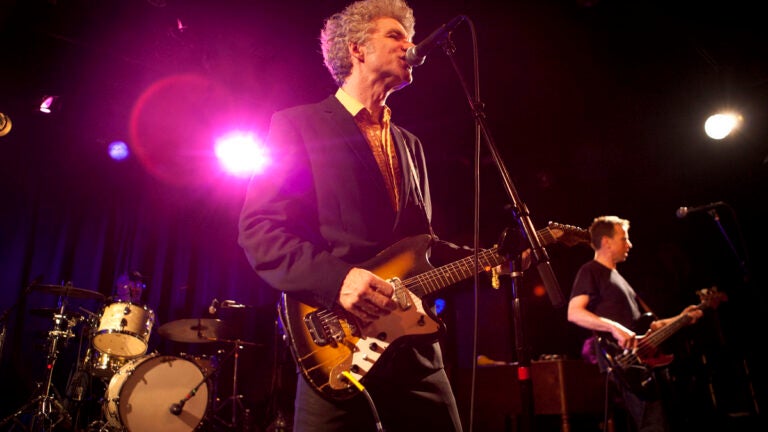
When I reach Warren Zanes, he happens to be in a New York City parking garage — but he’s not frustrated. He’s pumped.
The thrill of drinking up rock and roll on a film set each day “is definitely running through me as we go into these Del Fuegos reunion shows” in Boston, he said.
Del Fuego alum is leaving the Manhattan film set of the upcoming Bruce Springsteen biopic based on his book: “Deliver Me from Nowhere: The Making Of Bruce Springsteen’s Nebraska.” Directed by Scott Cooper, the cast includes Marc Maron, Gaby Hoffmann, and “The Bear’s” Jeremy Allen White as Springsteen.
They’d just closed down a Midtown block for a scene with Jeremy Strong as John Landau talking to David Krumholtz as Al Teller from CBS, Zanes said.
“Some days I go away from the set just in disbelief,” said Zanes, 59, quick to add that while he has a directors chair, “they spelled my name wrong.”
“One part of me is still the kid listening to Dan’s Springsteen records. That part of me is still alive. And if I do things right, I’ll keep that part of me alive,” said the Concord, N.H., native.
Big brother and bandmate Dan Zanes, 62, a Grammy-winning children’s music star, will soon play a holiday show at the Kennedy Center with his wife and musical partner, Claudia Zanes. The couple just released a record via Smithsonian Folkways: “Pieces of Home” boasts special guests including Steve Earle.
Meanwhile, the Del Fuegos drummer Woody Giessmann became an addictions specialist and founded the Watertown-based Right Turn, “currently in transition” from offering recovery services. Bassist Tom Lloyd, earned a PhD in environmental engineering from CalTech. Warren Zanes is also an NYU professor, Grammy-nominated documentary producer, former executive director of The Rock and Roll Forever Foundation, and a Tom Petty biographer.
It’s all one helluva second chapter for a band that “could’ve used a good sit-down with a therapist, a drug and alcohol counselor,” as Warren told me previously.
And it goes to show that when they say this might be their last Del Fuegos Boston reunion show, “it’s a fair thing to say,” Warren said.
“There’s so many variables that it’s almost odd that the City Winery lined up as easily as it did — which is, in and of itself, a sign to do it.”
After one reunion show in East Bridgewater in 2023, the Del Fuegos play two sets at City Winery in Boston on Dec. 21. As of this writing, there are still tickets for the 3 p.m. show.
The seminal Boston-based rock band, known for blistering shows and a tour with Tom Petty, broke up in ’89 after four albums. Their roots trace to Oberlin College, where Dan and Tom became friends. Warren, a “scholarship kid” at Phillips Andover Academy, joined as a teen.
And if you lived in Boston or Cambridge in the ’80s, there was a time where you could’ve seen them play five or six nights a week. They maintain a cult following in the Boston area — and in Spain.
“In my acknowledgments of the Springsteen book, I finally thanked the Del Fuegos. That was a long time coming,” Warren said previously.
Coming full circle, he said this week that he was talking to Springsteen on set: “I told him we’re doing this reunion show, and he said, ‘You guys were a good little rock and roll band.’”
I caught up with half of that little rock and roll band to talk reunions, reflections, Spain, Springsteen, dancing in the dark, and bringing all back home “where the sh— went down.”
DZ: Because City Winery called us. We have them to blame. Also, in the arc of music, this just feels like a good time for us to get together. It’s been so much fun reconnecting.
DZ: We thought it was our last.
DZ: So much fun. It showed us that we can come into it with a sense of enjoyment. There’s nothing riding on it. We don’t have to prove anything. The music feels like it stands the test of time, at least for us.
We saw so many of our old friends. A lot of people brought their kids — it felt communal. I loved that. I felt like we were appreciated in some way, like being an oldies act in the best possible sense. It’s an honor to get to that place in life, and I loved it.
DZ: It was out in a field behind a social club. There were tables and chairs in the field, folks hanging out in the club playing pool, there was a meat raffle — it couldn’t have been more perfect. [laughs] There was someone grilling hamburgers and hot dogs next to the stage. So the smoke was pouring over the stage.
DZ: [laughs] When you’re 20 years old, you take everything for granted. When you’re in this third act of life, you can’t take anything for granted.
DZ: I can’t remember. 15 years ago?
[Warren joins the phone call]
WZ: Accuracy is not really our thing.
WZ: We play together so infrequently that it’s always emotional. As you get older, you dip more frequently into your own past to measure who you became against who you were. And going back into the music — not just the music you played, but the music you loved — is a way of gauging who you became.
For the band and for the audience, music is the way we go back to look at who we were. And there’s nothing like the music of your late adolescence and early adulthood to really make that measurement.
WZ: Well, they were grilling hot dogs the whole time.
WZ: We used to get home from shows and our clothes would smell like cigarettes. Now they smell like hotdogs.
DZ: [laughs]
DZ: We wanted people to still have time to get to Filene’s.
DZ: A festival in Spain contacted us to see if we’d want to over in March. Spain was always the best country for us. Outside of the U.S., Spanish audiences were incredible. We felt like The Beatles going over there.
WZ: The biggest place we played in Boston was the Orpheum. In Barcelona, we could play a similar-sized room. It’s very hard to get to the understanding of why — why Spain in particular.
WZ: I’ve heard that from some other authors [and screenwriters.]
WZ: Well, I think once they realized all I’m thinking about was what was being served at craft services, they realized that I wasn’t going to be a problem.
DZ: [laughs]
WZ: It’s a really unexpected adventure. It gives me a whole new way of seeing Bruce Springsteen at work. As we’re preparing a Del Fuegos show, I go back to the idea that the most important training for what I’ve ended up doing, was being in the Del Fuegos. Being in band has allowed me to be much better at talking to the Tom Pettys and Bruce Springsteens of the world.
When I come back into being in a band, it’s with more knowledge about how delicate they are, how unique they are as a micro-community. They’re really hard.
WZ: Bands are all-encompassing. If friends talk about movies from the time when I was in the band, I don’t know those movies. My kids live in college dorms right now — I never lived in a dorm. There are things that are considered central to life between ages 17 and 24 that I know nothing of. That can be a loss. That said, I wouldn’t trade my experience.
DZ: I can totally appreciate what Warren just said. In a way, the experience is as hard as anyone wants to make it. In my case, I think I made it pretty hard, just because of bad lifestyle choices.
The thing I love: I got to do it with Warren, Tom, and Woody. I couldn’t think of three people I’d rather do it with. When we look at what everybody’s gone on to do, that just speaks to how incredible these people are. We had things go off the rails, for sure. But when I think about the people I got to have adventures with — I won the lottery.
DZ: We just talked about this. When we started out in places like The Rat and Cantone’s, it didn’t feel like a gig if people didn’t dance. I said to Warren, “Let’s get people dancing!” He said, “I think it’s tables and chairs.” So we’ll see. They can nod their heads politely.
DZ: But however it’s manifested, having a shared experience, that’s a beautiful thing.
WZ: But there is more to say on that: Dance goes through historical changes, but when I’d go see the Del Fuegos before I joined, the way you showed interest was dancing. Now, a couple people dance at shows. Something happened, I don’t know where, but for my kids, that dancing isn’t what they experience at concerts.
Back then, I’d have to have a few beers in me, but I went out on the dance floor all alone and looked like I was having some kind of seizure.
DZ: Claudia and I play for all-ages audiences, and it’s the very young who initiate dancing. It makes me respect that child-like feeling Warren’s talking about — almost an innocence, the ability to not be self-conscious, which I think is what happens to me: I get self-conscious. Which is why the stage is a good place.
WZ: [laughs] But the big difference between now and then, is that we were pre-internet. The means for crafting a local career were very clear. My students are trying to do a similar thing and it’s mostly web-based — which is the same place that Elton John is doing it.
DZ: Our goal was to play as much as possible. We felt: The more we play, the more we’ll reach people. And there were so many places — we could play Boston and Cambridge five, six nights a week.
WZ: Last year’s reunion was very much a suburban experience. It was nice, but there was a little tinge of melancholy that it wasn’t where we started out. We started out in Boston, playing for beer. It was messy, it was loud, it smelled like cigarettes and beer, and you couldn’t have asked for a better start. Going to City Winery gets us closer to the heart of the story. It’s not putting one show above the other, it’s just that City Winery is closer geographically to where the s*** went down.
I told him we’re going to do a cover of [1960s Boston-based band] The Remains’ cover of Charlie Rich’s “The Lonely Weekend.” Bruce knew it because his manager, John Landau, grew up in Boston and was a huge Remains fan. So there you are, talking to Bruce Springsteen, about a Boston band that opened for The Beatles, and you’re just so deep in the beautiful thick fabric of music. So when I pick up my guitar and I start going through my old band’s material— and I happen to be spending time with that guy — I feel like all of it is part of one, bigger, larger picture.
Get everything you need to know to start your day, delivered right to your inbox every morning.



To comment, please create a screen name in your profile
To comment, please verify your email address
Conversation
This discussion has ended. Please join elsewhere on Boston.com