

Newsletter Signup
Stay up to date on all the latest news from Boston.com
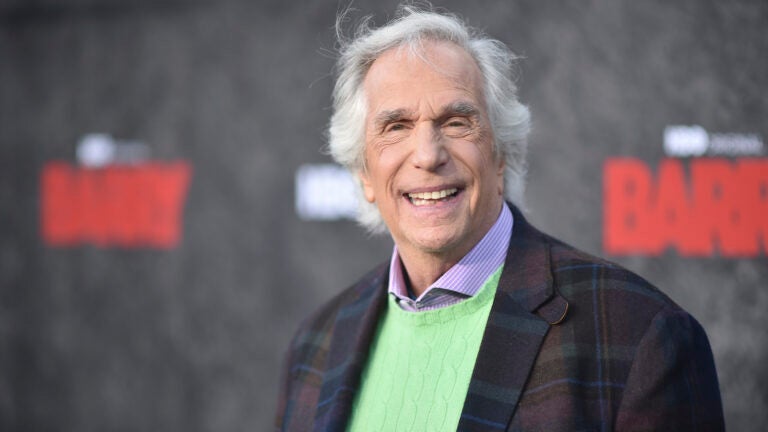
Henry Winkler is supposed to call me at 11 a.m., and at 10:59 — 7:59 his time in L.A. — he rings with a smile in his voice.
He tells me how difficult it is, being dyslexic, narrating this audiobook version of his upcoming memoir “Being Henry: The Fonz … and Beyond.”
“One of the most difficult things in my career,” he says. But he can do it. “It just takes me longer than everybody else. And it’s an amazing achievement when I’m done.”
You can’t help but smile.
Winkler just exudes warmth.
At 77, he holds some childlike quality — some purity born of sheer candor and plain-faced wonder.
You see it in his smile. His pure, childlike joy when he’s fly-fishing, whenever he pops up, so wholesome, on Instagram. Or in our conversation:
On being bullied: “Inside I was weeping. Of course you can’t show these guys.”
On his favorite characters: “I don’t have one. I’m telling you, Lauren, I am so grateful: I love them all.”
When I ask about his helping Sylvester Stallone sell “Rocky,” he’s like a kid, shocked at the coincidence of his lunch plans:
“Oh my God, I’m going to see him today! I’m having a slice of pizza with Sly today! Unbelievable.” (He did.)
Or about meeting Bostonians at events like the Fan Expo Boston, where Winkler will appear (along with a slew of other celebrities) Aug. 4-6:
“I cannot tell you what sheer delight it is to meet those human beings. People who come to my table leave with a picture or a book or a hug.”
He’s a joy to talk to, and you can this weekend. (And hug him.) We talked about “Barry,” fly-fishing with Jason Bateman, working with Adam Sandler — and why he doesn’t mind the phrase “Jump the Shark.”
Henry Winkler: It’s all a matter of age. They come for “Happy Days.” They come for “Scream.” “The Waterboy.” “Arrested Development.” “Parks and Rec.” Children come for the novels — I have my children’s books there [the Hank Zipzer kids’ series about a dyslexic boy, co-written with Lin Oliver]. They come for “Barry.” It’s an amazement. I am the beneficiary of the gift of warmth.
Ab-so-lutely. I’ve had about 14 or 15 [acting] teachers between Emerson and Yale Drama School. I absorbed the good and the bad. Then my imagination. The writers — Bill [Hader] and Alec [Berg] — wrote a man who was prominent here [in LA] in the ‘70s, ‘80s, ‘90s, who was a tyrant. I absorbed all of that and out came Gene.
That is true. I finally said to Bill and Alec: “Ooohhh. This guy’s an a—hole.” They went, “Well, I guess. But we see where you’re going.” And then they wrote to me. So we met in the middle. But I sure didn’t see where they were going in the fourth year. Holy mackerel. Bill said: “Hey, you want to know what happens?” I said, “Sure.” He told me and I said, “Okay, I have to go lie down now.” And I went and got an avocado toast and sat in the corner and shook.
I knew I wanted to be an actor, honestly, since I was old enough to reason. I don’t even know where it came from. Because I had no sense of self when I was younger. I’m telling you, I could kiss the ground because most people my age are sitting home, waiting for the phone to ring or have put the phone in the closet. And here I am.
Oh my God, absolutely. After a date, you’d go to Ken’s in Copley Square. Of course, Regina in the North End. My fraternity had meetings there with pizza and beer. I didn’t drink, so I had a glass of water. That was a big lesson in my life because I stuck to my guns. They ruthlessly made fun of me. And there was my glass of water along with all of the glasses of beer.
The first two times were tough. Especially since I took everything personally and inside I was weeping. Of course, you can’t show these guys.
Because I was not seen. I had very short German Jews as parents. They were only interested in me representing them by doing well. And there was no way in God’s green acre that I was going to do well in school. My brain didn’t function that way.
Right. When we had my stepson tested, everything they said about him, I went, “Oh my God, they’re talking about me.” That’s when I started to think, “Oh, I’m not stupid. I have something with a name.”
There are so many learning-challenged human beings who are lawyers and doctors and artists and painters and plumbers and actors. It doesn’t have to stop you.
I still cannot read very well. I’d memorize as much as I could, as quickly as I could. Then I’d improvise. The producer or director would say, “Excuse me, you’re not reading what we wrote.” I’d say, “I’m giving you the essence of the character.” It worked. I’m here talking to you.
That was an amazement. Because remember: I’ve got my low self-esteem. I’ve got my shortness. I go out to California and I’m thinking, “Everybody here is the handsomest person on earth.” I’m thinking, “What’s going to happen?”
I earned enough money to get my American Airlines ticket roundtrip. I had $1,000 cash to last me 30 days. In my second week in Hollywood, I auditioned for the Fonz. Just before my stay was over, I got a call: “Would you like to do this character?” It changed my life. I love him still.
That is exactly true. In my neighborhood, we’d have school dances on Friday nights. The same group of toughs would come and terrorize us other kids. And I’d pretend I was blind. They’d say “What are you looking at?” [I’d say] “I actually cannot see you, sir. I wish you a good evening. I was just looking for a water fountain, actually. So I’m just going to sidle up to the wall.”
[laughs] It’s true. Then I got to play a tough with a heart.
He drove me home — we were on location doing a two-parter. He had a VW bug. We were driving in silence. I said, “Ron, we got to talk about this. How do you feel?” We had a most wonderful, straightforward conversation about how he felt and what was happening and what he understood. He’s like my brother.
The cast was amazing. I love fly-fishing and we went to Idaho. So there I was with Jason Bateman along the Snake River. I’m telling you, it was just delightful.
My lawyer invited me to go fishing down the Smith River in Montana for five days, and no pun intended: I was hooked. We’ve gone once or twice a year since 1986. I love it so much.
I’m not a great athlete. I was okay with archery. But I could waterski. I became a waterski instructor at camp.
Yeah, my father kept saying [uses thick accent] “Tell Garry Marshall you waterski.” I said, “I’m not going to tell him that, Dad. That’s crazy.” He said, “Tell him you waterski.” I said, OK.
It took me a while. I finally said, “Garry, my father wants you to know that I waterski.” And bingo. There I am jumping the shark.
I don’t mean this to brag. But every time a newspaper mentioned “jumping the shark,” there was a picture of me waterskiing. And I must say, in all humility: I had great legs at that time. [laughs] So it never bothered me at all.
I called and thanked Adam because I thought: What a great compliment. Then I got it to be in “The Waterboy” and five movies after that with him. I was hoping you would write him and say it’s time to put Henry back in another movie.
I was naive — I thought I was going to beat the system. And here’s the lesson that slaps you in the psyche: There is no beating the system.
You wait it out. I’m telling you, it’s a lesson for any human being on the earth: If you want something, be tenacious. And eventually, as my name is Henry, you slip the elephant through the eye of the needle.
Oh, my God, absolutely. I love it every day. It’s like putting a jigsaw puzzle together where all the pieces are a shade of blue. And you have to create a complex human being out of what the other characters say, how you feel about what they say, what the writer wrote, what the director wants, and your imagination. Then you vacuum it in. Then you spit it out. And either the character stands straight, or you’ve made a calculated error.
[Sylvester Stallone] gave me the script. We sold it. They wanted to change the writer. He said [imitates Stallone] “Henry. You can’t let them do that to me.”
I went back to ABC and said, “I need it back.” They said “We don’t do that.” I said, “I know. I know you don’t. But you know what? There’s a first time for everything. And I really need it back. So here’s allll the money. Let me have the script.” A year or so later, “Rocky” was on the screen.
That’s how I got to play Mr. Rock. [Based on] the one teacher in my school who said, “I believe in you.” I say to every child I meet: No matter how you learn, no matter how difficult it might be, it has nothing to do with your brilliance.
This interview has been edited and condensed.
Lauren Daley can be reached at [email protected]. She tweets @laurendaley1.
Stay up to date on all the latest news from Boston.com




To comment, please create a screen name in your profile
To comment, please verify your email address
Conversation
This discussion has ended. Please join elsewhere on Boston.com