
Sign up for the Today newsletter
Get everything you need to know to start your day, delivered right to your inbox every morning.

Art rats and daydream believers: This one’s for us.
While Patti Smith has written about her remarkable life in previous memoirs — National Book Award-winning “Just Kids,” bestsellers “M Train” and “Year of the Monkey” — she’s never dug so deeply down into her early roots.
When the shovel strikes rock, we find that right down to her core, Smith is a Writer.
“Bread of Angels,” Smith’s new memoir, is a portrait of the artist as a young woman, from book-loving toddler to memoir-writing poet pushing 79.
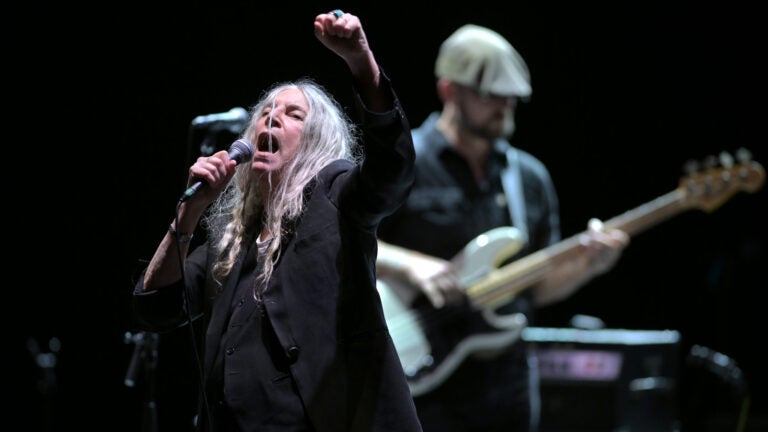
Smith will read from her memoir at a sold-out event at Chevalier Theatre in Medford Dec. 17. If you missed out on tickets, I got you covered.
“This is a book about a calling. About how we become who we are,” Smith tells me in our recent interview. The underlying sense of the book “is really gratitude for being born with a wondrous imagination.”
Born in 1946 in Chicago to two native New Englanders — Grant Smith and Beverly Williams, both from Connecticut — the family moved often in her early years.
Smith was “born coughing,” she writes, often isolated in her sickbed with her books and her imagination.
In kindergarten, Smith was “a bit of a loner,” she writes. “I preferred the company of my siblings and exploring my own thoughts … until I gradually developed the language to express them. And that language was poetry.”
Sentiments like this are threaded throughout Smith’s latest Künstlerroman.
Walking to kindergarten one day, little Patti becomes distracted by a giant tortoise by a pond. “I sat on a rock clutching my red plaid school bag, mesmerized. He was massive … surely a king,” she writes. “We communed just as I had with my siblings in our telepathic play. I entered his world, though I could hardly say where we went.”
She doesn’t arrive at school until lunchtime. Her teacher was upset, her mother frantic.
As a teenager, she feels things deeply. (When JFK was shot, she was so distraught she couldn’t eat. She eventually fainted, was hospitalized, and turned 17 in the hospital.)
Later, she arrives in New York, “single-minded in my pursuit to find work” as an artist, she writes.
Smith wrote constantly and began performing her poems. She teamed with musician Lenny Kaye, and the rest is rock history.
This sums up the underlying sentiment of the book well: When she married MC5 guitarist Fred “Sonic” Smith in 1980, the couple led a quiet life in Michigan. Fred attended flight school. She writes:
“I wrote, Fred flew, and I felt like I could live like that forever … I knew then with all my being that to be a writer was what I wanted more than anything.”
There is a Rilke quote that came to my mind while reading.
“[A]dmit to yourself whether you would die if it should be denied you to write … ask yourself in your night’s quietest hour: must I write? … And if it should be affirmative … then construct your life according to this necessity.”
This is the blood that pulses through “Bread of Angels.”
I called Smith — who turns 79 this month — at her home in New York as she prepares to read from her memoir and perform songs in Medford. We talked Boston, Bob Dylan, Ginsberg, “Horses” at 50, urban legends and lies, and discovering her birth father’s identity in recent years, and more.
Some responses have been edited and condensed.
Smith: I loved our Boston concert. I had so much fun in Boston. Boston, funny enough, was one of the most raucous shows. It’s the same material every night, but [the mood] shifts, according to the people, the venue, the city. I felt like it was the ’70s in Boston. People were yellin’ stuff and a little rowdy. I love that.
Isn’t that a nice feeling? I remember seeing “Pan’s Labyrinth,” and even the way the girl looked — dark hair, the somber, strange kid, communing with the other worlds — I so identified with her. That film really touched me deeply.
Because, if you’re an odd child, even if you’re loved, there’s a certain loneliness or estrangement that you always feel. Thank goodness that some of us are blessed with a calling. You feel: I have this other thing, perhaps that’s what makes me special, a slight outsider. Especially writers, because you can’t help but constantly observe what you’re going through.
It was really a book about a calling. How we become who we are. And it was the opportunity to show gratitude to my parents, my siblings, my mentors. Also to give people a sense of what my life was in Michigan, what my husband [Fred Smith] was like, because nobody really knew anything, we lived so privately. People wrote things that were sometimes cruel and so far from the truth. I just decided that’s not how I wanted my marriage, my husband, and our time together to be remembered.
So I was setting the record straight. And showing gratitude for still being alive. I would say 70 percent of the people I loved or were friends with are gone, some at a very young age.
Well, for instance, how I fell from the stage in 1977 [playing a double-bill with Bob Seger in Florida, suffering a skull fracture, a severe concussion, and four spinal fractures]. People speculated I was stoned. Believe me: I’m so afraid of heights, being on such a high stage, the last thing I’d want is to be intoxicated.
That made my brother Todd, the head of my crew, seem ineffectual. That [falsehood has] been written, rewritten, and now it’s become as if it’s truth. I wanted to lay out what really happened.
But setting the record straight, that alone wasn’t enough for me to write a book. The real motivation was to show gratitude. My husband died young. My brother died young. Robert [Mapplethorpe]. And who speaks for them?
Yes. I told that story mostly to show what kind of person he was. I protected him when he was a child — he was bullied. As adults, he was one of my great protectors. I just wanted people to get a sense of what a wonderful person he was.
But the greater sense of the book is really gratitude for being born with a wondrous imagination. I feel quite lucky. It’s never abandoned me. I still feel blessed with an imagination. And from that imagination comes so much of my work — endless stories and stage improvisation. I’m very grateful for that.
From age 12, I wanted to be an artist. And it’s not just that I just wanted to be — I felt that I was. I had no real proof. I wasn’t a prodigy. I wasn’t specifically gifted in anything.
Funny enough, I’d never thought of singing or recording. It never occurred to me. I spent a lot of my time doing that — but it’s writing that has been the most steadfast. Writing is the vocation that means the absolute most to me.
To this day, I still think it’s funny. There you have Bob Dylan coming to see you — which was a very rare thing. My [role models were] Bob Dylan, Rimbaud, and Picasso. And there’s Bob Dylan. And he says [in spot-on Dylan imitation] “Hey, any poets back heeere?” And immediately I went, “I hate poetry.” I don’t know why I said that. Of course, I don’t hate poetry.
He laughed. I think I said that because — just like him — I didn’t want to be pinpointed. Someone says, “You’ve written the greatest protest song!” And you go, “I don’t like protest songs.” He would do that.
But I hadn’t really thought it out. I don’t know why I said that. I liken it to when a boy at school likes you, so he throws a snowball or pulls your hair. He’s mean because he really likes you, but can’t express it.
It did and it didn’t, because in ’75 I was at this very pivotal moment. I was really feeling my strengths, filled with adrenaline. I didn’t feel like I needed Bob Dylan in 1975, even though I loved him.
It was more impactful for me when I toured with him in ’96 and we sang “Dark Eyes” together. That was more emotional because I was more fragile then. At that point, I did need support.
It’s true. I’ve never been a real singer.
I was writing poetry and it evolved into performance, but I didn’t have expectations of connecting outside our tribe. Whether it was at [legendary NYC club] CBGB or a bar, our tribe was strong, but seemingly small. It turned out that our tribe was much more far-reaching. That was gratifying.
There was a certain amount of sadness, because all of a sudden we were, by law and blood, half-sisters, although we could never be closer.
My father — who I admired so much and still do — I was sad not to have his blood, but I’ve modeled myself after him so much that he’s very much within me. There was a certain amount of sadness. But after that, gratitude for helping to bring me into the world. And a great respect for my mother’s decisions and what she had to do.
No, the paternity thing came later and actually held the book up for a couple of years, because it took me a couple of years to process it and figure how that fit with my vision of who I was.
It wasn’t a bad thing. I didn’t feel negative; I didn’t feel angry; I didn’t feel betrayed. I was confused about trying to write a book that encompasses truth to the best of my ability. Suddenly: what to do with this new information? If I didn’t write it, was it still a true book? If I did write it, how do I present this? So I shelved it for a while, and wrote “Year of the Monkey,” and put together “A Book of Days,” and then went back to this book. But I started it like 10 years ago.
The nice thing that you brought up was about you being a writer and having a similar kind of sensibility as a child. That’s a very special thing. We’re very lucky, both of us, to have found writing. I’m sure you’ve also found that it’s probably been a burden and a comfort, right?
Performing is a wondrous thing — but it’s a very social, extroverted thing. You’re collaborating with your band, your crew, you’re giving your energy and focusing on people. While exciting and rewarding, it’s not conducive to writing. I find it very difficult to write on the road. That’s another reason why I left public life at the end of the ’70s. I very seldom had any solitude where I could contemplate or edit or write or rewrite.
That’s one of the reasons why I wanted to do the recent “Horses” tour — to pay homage to 50 years of the record, but to let go of it and spend the lion’s share of the time I have left focused on writing. Because writing, words, are what I fell in love with at 3 years old. And I want to finish my life writing them.
Lauren Daley is a freelance culture writer. She can be reached at [email protected]. She tweets @laurendaley1, and Instagrams at @laurendaley1. Read more stories on Facebook here.
Get everything you need to know to start your day, delivered right to your inbox every morning.


To comment, please create a screen name in your profile
To comment, please verify your email address
Conversation
This discussion has ended. Please join elsewhere on Boston.com