
Sign up for Book Club
Stay up to date on local books news, events, and recommendations from Boston.com.
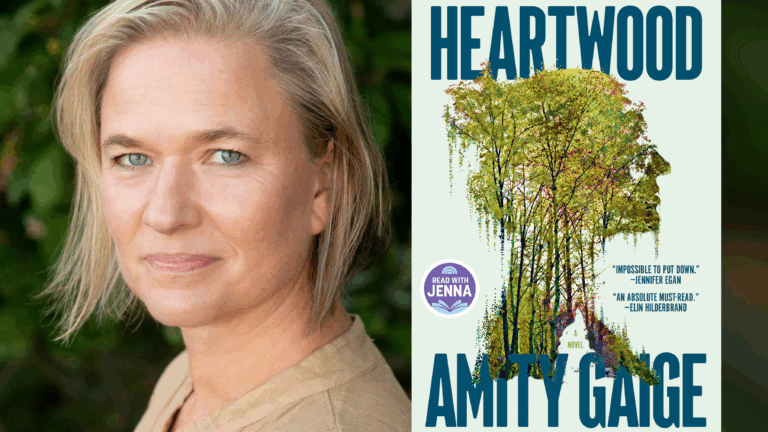
Every once in a while, I read a book so good I need to read it twice – immediately, back-to-back.
Such was the case with Amity Gaige’s literary thriller “Heartwood,” out this month.
So while I’m surprised to learn she never meant to write a thriller, I’m not surprised that when I catch up with the New Englander, she’s readying to appear on “The Today Show.”
“It’s very exciting and nerve-wracking,” Gaige, 52, tells me with a chuckle of her then-upcoming appearance on the NBC morning staple. (Crushed it.)
Gaige’s “Heartwood” – her fifth book– was named a “Read with Jenna” pick for April.
“Both my agent and my editor texted me to call. I thought: Well, this is either good news or bad news,” Gaige says with a laugh in our recent phone interview. “Also, I’m not a debut writer. I’ve been in the game awhile. So this has been a game-changer.”
Maine is itself a wild character in this Appalachian Trail-set page-turner. The nutshell: In the thick of the Maine woods, 42-year-old hiker Valerie Gillis has vanished some 200 miles from her final destination of Mount Katahdin. Leading the search is Lt. Bev, a Maine State Game Warden. Meanwhile, there’s Lena, a 76-year-old armchair detective, following the case from her Connecticut retirement community. What happened to Valerie? Foul play? Disorientation?
We hear directly from Valerie, a nurse, through her journals. She writes beautiful letters, goodbyes almost, to her mother, as she realizes the severity of her situation. Her poetic entries reminded me of Cheryl Strayed’s “Wild.”
As a thriller fan, this is my pick for the best of the year so far. Book clubs, there’s so much to discuss here, from the complexity of mother-daughter relationships to our relationship with Mother Nature.
Massachusetts readers will appreciate Bev, a Leominster native, who has to deal with being the sole woman and sole Massachusetts native in a troop of male Mainer wardens. She notes:
“Out of all the things that could make me unacceptable in the eyes of my community — that I’m a woman, the only female leadership in the entire Warden Service…nothing is as offensive as the fact that I’m a Masshole.”
At one point, her friend Mike ribs her: “Hey, Bev…what’s the penalty for drunk driving in Massachusetts? … Reelection to the Senate.”
Gaige laughs when I recount some of the jokes. “It’s a very New England-y book,” she says.
Born in North Carolina, Gaige moved to New England to attend Brown University, graduating in 1995. She later moved back to Providence, R.I., with her husband, where they lived for seven years before moving to Amherst. Gaige was the writer-in-residence at Amherst College.
Now in Connecticut, she lectures at Yale. “We’ve also spent every summer of our marriage on Squam Lake in New Hampshire and in Rochester, Vermont. So we make the rounds.”
I called Gaige ahead of events in Providence April 29, and May 8 in Cohassett to talk about her novel’s roots, hiking the AT, strong women and complex mothers.
Interview has been edited and condensed.
Gaige: Right. What really sparked this book was my love of writing about landscapes. My last three novels are rooted in place. I’ve been absolutely sustained, as I’ve gotten older, by nature. I decided around 2018 to feature an Appalachian Trail hiker, partly because trail is such a crucial part of our American imagination. More than 3 million people visit each year. More than 3,000 attempt to thru-hike.
Once I made that decision, I came upon this sad story: In 2013, a 66-year-old woman [Geraldine Largay] lost her life two miles off the trail. She’d become very disoriented around the same spot that I imagined this novel taking place.
Valerie is quite different. And I’m setting it in 2022 not 2013. But what I took as inspiration was the fact that once this hiker understood what was happening — that she was getting weaker and weaker— she wrote goodbye letters. That captured my imagination.
To me, that was poignant: She knew what was happening to her. I read a great book about it: “When You When You Find My Body,” by a Maine writer and guide, D. Dauphinee.
I also became friendly with a couple of wardens in the Maine Game Warden service. They were so generous with explaining what they do. So it wasn’t just [Largay’s] story [that inspired this] —it was the people I met, the stories they told, their adventures, rescues and losses.
Once I found that news story, the fact that she was a nurse was dropped in my lap. Then the pandemic hit. I was grateful to have that detail, because a nurse in 2022 would be dealing with trauma and fatigue. This book is infused with gratitude for first responders, for nature — for life, honestly.
I started by reading because that’s what you need first, and it’s also the easiest [laughs] I read first-person narratives, memoirs by Appalachian Trail hikers, hikers’ blogs, nature writers, online trail journals. I interviewed hikers.
Then I went out for four nights and five days with my husband to hike the New York section [of the AT.] We stayed in shelters for three nights. They’re literally open-air wooden structures. It was instructive to lay there, packed in with a bunch of strangers. Very noisy. I’m the lightest sleeper, so it was a nightmare. [laughs]
But I talked to hikers — they were very willing tell their life stories, and they’re all interesting, because everybody on the Appalachian Trail is in some kind of transition. You don’t [hike 2,190 miles] for nothing. You do it when you’re retired, or graduated, or divorced, or out of prison, or out of rehab. There’s some great stories out there.
We crashed in a hotel [laughs] Three days hiking with no shower is just long enough to stink.
It’s crazy. It’s not like a forest you or I would know — it’s jungle-like. It’s all sticky bushes, head-high saplings; the ground is a lot of rocks, broken sticks, what they call blow-down– just rotted wood. Even Appalachian Trail hikers who’ve seen a lot [since starting in Georgia] say when they get up to New Hampshire and Maine, it’s like starting over. Maine can be a little on the scary side.
They were so generous in answering my questions. I remember this detail so clearly: The female warden I was riding with didn’t have time to eat, so she just ate some tomatoes and cheese cubes from a Tupperware on the road. It’s that kind of detail I needed.
Not at all. I was surprised it ended up that way. It feels like good timing to have female heroes right now. Maybe that was a story I needed to write, as much as one I needed to read.
[laughs] One reason for Bev’s story is I’m not a Mainer. Maine isn’t a state I know well. I was intimidated. Making Bev from Massachusetts gave me more access to her character.
Mainers can be very — what’s a word I would carefully choose — proud. [laughs] I didn’t want to revert to any stereotypes, and I also know that, because people have lived there for generations, it takes a long time for people to feel like they’re really from Maine.
Once I realized Valerie was writing to her mother, that theme started to coalesce. There are as many kinds of mother/daughter relationships as there are mothers and daughters. Valerie has the dream mother-situation, but most mother/daughter relationships are complicated.
Whether she was wonderful or terrible, a mother is your origin and first home. I found the connection between lostness and mothers. When you’re born, you’re 100 percent located. As you go through life, there’s the dream of feeling that orientation.
Right. Bev’s mom is an addict, absent, immature. Bev has to grow up real fast. And there are other ways to have that mother relationship. Bev says the backcountry is my mother. Nature is my mother.
That’s so fascinating. Who knows? I read it in my research, and loved it. So maybe I borrowed some of her style. It’s quite possible. But I love the comparison. Strayed loved her mom. That’s special and rare—you don’t see an adoring mother/daughter relationship portrayed much. It definitely could’ve influenced Valerie.
[laughs] I don’t know. Santo was such a pleasure to write. I listened to a podcast with women talking about body diversity in hiking. One was a self-described “fat hiker” talking about how hard it was to buy clothing, how discouraging it is to feel a lack of representation. There’s a stereotype that hikers are all white thin people, and it’s not true.
You know, I didn’t set out to write a thriller/mystery. But I’m so glad I did. [laughs]
Lauren Daley is a freelance culture writer and regular Boston.com contributor. She can be reached at [email protected]. She tweets @laurendaley1, and Instagrams at @laurendaley1. Read more stories on Facebook here.
Stay up to date on local books news, events, and recommendations from Boston.com.



To comment, please create a screen name in your profile
To comment, please verify your email address
Conversation
This discussion has ended. Please join elsewhere on Boston.com