

Sign up for Book Club
Stay up to date on local books news, events, and recommendations from Boston.com.
In the arc of history, women haven’t had it so good. Just biologically, there are the crises of pregnancy, the miscarriages and the risks of maternal, fetal and infant mortality. Reproductive-health problems have taken a toll on many of us. Sovereignty over our own bodies has never seemed a sure thing in this country. Or if it has, it hasn’t been permanent.
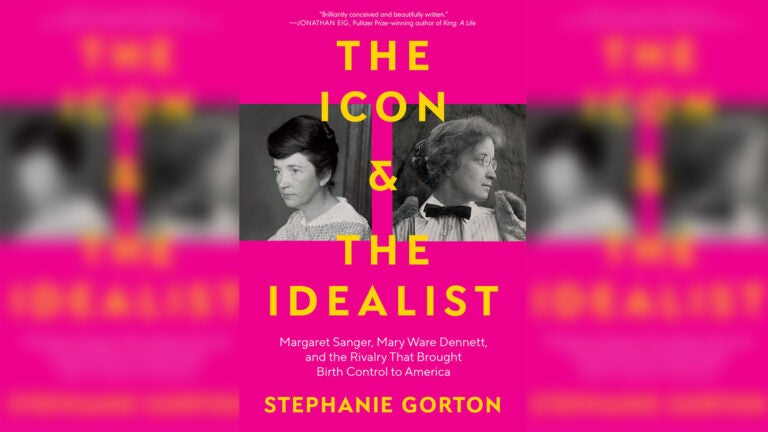
Providence-based author Stephanie Gorton takes the long view in her new dual biography of the two most important birth control activists in American history, Margaret Sanger and Mary Ware Dennett. In “The Icon and the Idealist,” she weaves a detailed account of these brave and stubborn visionaries, who fought the good fight for women while feuding with each other.
The one you’ve probably heard of is Sanger. She began her career as a visiting nurse in New York. Her path took a turn in 1912 when she was summoned to a tenement by the husband of Sadie Sachs, a woman who lay unconscious, surrounded by the couple’s three children. Sadie had tried to terminate a pregnancy herself. Sanger was able to get a doctor to come and revive her. When the same thing happened three months later, Sachs died. Sanger, according to her autobiography, wrote about this tragedy the next day. “I knew I could not go back merely to keeping people alive. … I would tell the world what was going on in the lives of these poor women. I would be heard. No matter what it should cost. I would be heard.”
Like Sanger, the much-lesser-known Dennett was born on the East Coast in the 1870s. An artist by training, she was engaged in the early 20th century in advocating for suffragism and other public-spirited causes. Giving birth to her children, she had excruciating labors and deliveries, which caused lifelong physical problems. Her middle son died in infancy. Her desire to help women emerged from her experience of not being able to practice birth control, amplified by her work as an activist. Dennett wrote that “three elements were necessary for a fair society: economic independence for women, the end of every privilege, and safe, reliable contraception.”
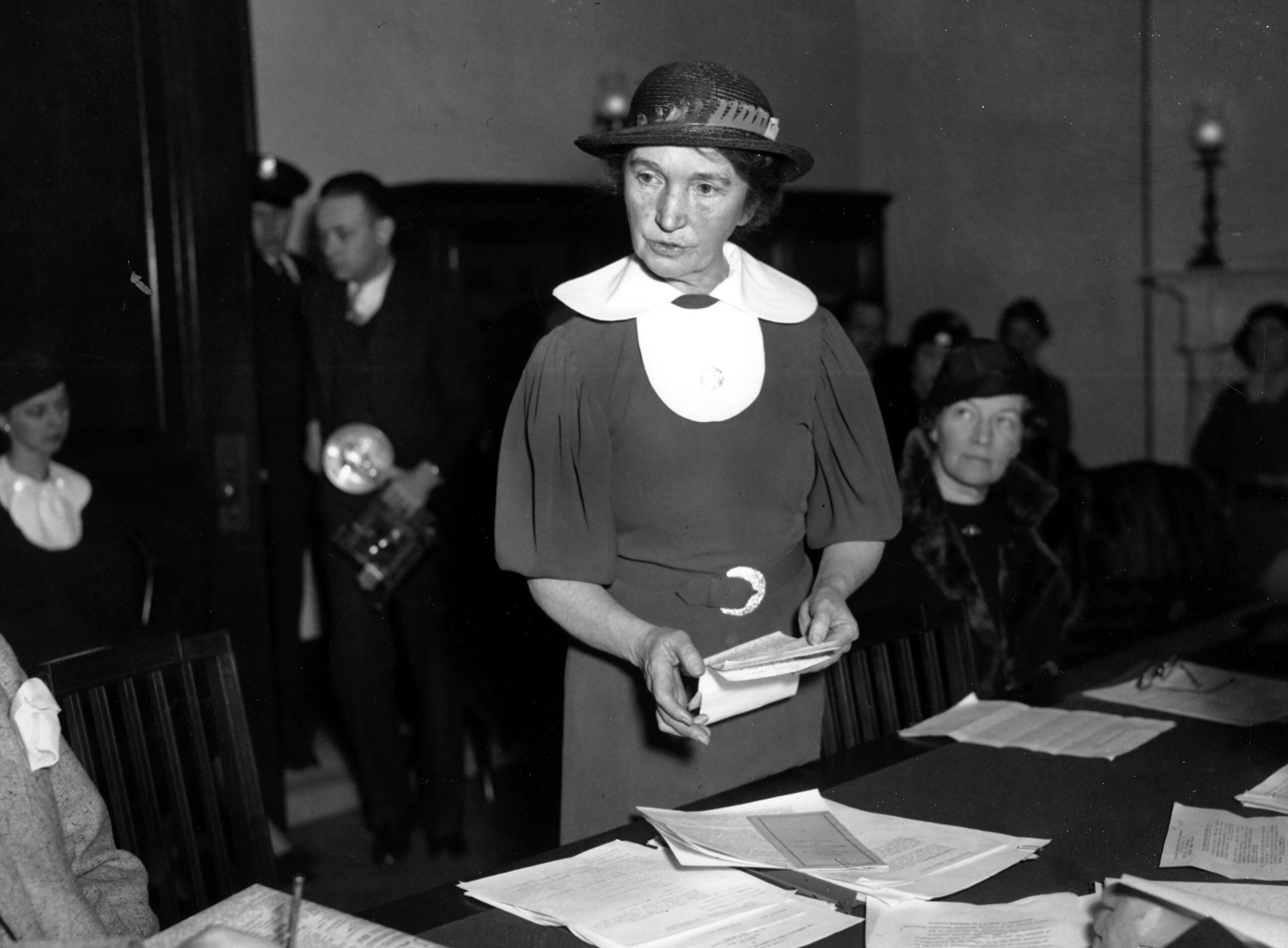
For two women who had the same overarching goal – to ensure safe and legal access to birth control for all women – they were oddly unwilling to work together. Each assumed the other would fold into her vision of the mission, but ultimately both were too territorial. Sanger shrewdly promoted herself and cozied up to wealthy and prominent supporters. Dennett was more plodding and exacting in her desire to change the laws, a behind-the-scenes-type.
Dennett often fruitlessly lobbied Congress, following protocols, while Sanger found success as a rule-breaker. She opened a birth control clinic in 1916, which was initially shut down by the police but laid the groundwork for what would later become Planned Parenthood clinics.
Dennett and Sanger believed that without learning about their own bodies and how to control their fertility by using the available contraceptives of the day (condoms, which were available but not easily, postcoital douching and withdrawal), women would be unable to thrive. Birth control was protection for the women who became pregnant every year and had exhausted their bodies, and who suffered emotionally from the plights of stillbirths and child care. Families were too large to function; they slid into poverty. Overpopulation was a problem; hunger was endemic. The middle and upper classes were able to manage with the help of private doctors, household staff and, always, fewer children. Larger, poorer families just sank further into the quicksand of despair.
Sanger and Dennett affiliated with many of the same supporters and over the course of their lives had a few personal meetings, all of which left them dissatisfied with each other. Through their work promoting “voluntary motherhood,” Dennett and Sanger received letters from women who were taught that preventing pregnancy was sinful but who begged for relief.
Both women wrote books, created committees, lobbied Congress and presidents, held conferences, imported devices from abroad, were arrested, were acquitted, and so led lives away from the families they had birthed. Both set their eyes on the Comstock Act, an 1873 law that prohibited the mailing of “obscene” materials within the United States, including pornography, contraceptives and information related to abortion. Was a pamphlet on human sexuality written clearly and without titillation an obscenity? Would one consider a note with the name of an abortifacient or the name of a practitioner who would try to help an obscenity?
Neither woman had a smooth personal life. Dennett, a short, bespectacled woman, found her husband mesmerized by the wife of a close friend. He moved in with the couple, and the tabloids of the era enjoyed the salacious details, to Mary’s chagrin. Long before it was socially acceptable, she divorced William Hartley Dennett and struggled thereafter to support her sons and herself. She was a workhorse.
Sanger lived more publicly, often away from her husband. She published a magazine, the Woman Rebel, in 1914. In it she wrote: “A woman’s body belongs to herself alone. It does not belong to the United States of America or to any other government.” It was sent to subscribers by mail. She was arrested by vice agents for violating the Comstock Act. Rather than face the trial, she spent a year in exile in Europe, writing, meeting the intelligentsia and taking lovers. The arrest made Sanger famous; hers was the public face of birth control.
While Sanger lived overseas, Dennett wrote her first book, “The Sex Side of Life: An Explanation for Young People,” which elevated her profile. She became a founder of the National Birth Control League, and her focus narrowed from all her “isms” to birth control.
Throughout her book, Gorton tilts slightly in favor of Dennett, portraying her aims as pure: She wanted her sons and all young people to have the knowledge that schools did not yet teach, and that parents were too ignorant or embarrassed to pass along. She wanted everyone to know that sex could be enjoyed by women as well as men – albeit within a marriage – without the thought of procreation.
On the other hand, the ever-pragmatic Sanger attached herself to the popular eugenics movement, which promoted an “ideal race” by advancing selective sterilizations for the “unfit.” From the outset, eugenics skirted dangerously close to white supremacy, but Sanger maintained that, to her, fitness was not about race but about intelligence and mental health. Indeed, the American Eugenics Society had an exhibit at the 1926 World’s Fair, held in Philadelphia. The racism of the movement rubbed off on her, though, leaving a lasting stain on her reputation. Gorton tries valiantly to give Sanger the benefit of the doubt, justifying her true belief in population control for “humanitarian and social justice,” but given the opportunity to eschew eugenics, Sanger did not.
Still, Sanger “navigated her time in Europe like a cool diplomat assigned a tricky set of international relationships. Some people she drew closer, ensuring steadfast loyalty. … Others, she began to freeze out.” She became irritated when anyone got more attention than she did or got in her way, including her husbands (she was married twice), Dennett, Emma Goldman and even her own sister Ethel Byrne, who was sentenced to 30 days in the workhouse for helping Margaret in her short-lived birth control clinic. “Sanger was flummoxed,” Gorton writes, “to find herself briefly replaced as birth control’s martyr figure.”
In 1934, there were about 200 birth control clinics throughout the United States. And by the end of the decade, approximately 300,000 women had paid one of them a visit. Sanger “won” the virtual race to be the very incarnation of the birth control movement. Her often-renamed organization was dubbed the Planned Parenthood Federation of America in 1942.
Gorton’s timely, if somewhat dense, cultural and biographical history gives us much to think about as the arc of history is poised to bend back to a pre-1920s set of regulations for reproductive health. Today, Planned Parenthood is thought of mostly as an abortion provider, though that is not its main enterprise. And the Comstock Act is still on the books.
Stay up to date on local books news, events, and recommendations from Boston.com.





To comment, please create a screen name in your profile
To comment, please verify your email address
Conversation
This discussion has ended. Please join elsewhere on Boston.com