
Sign up for the Today newsletter
Get everything you need to know to start your day, delivered right to your inbox every morning.
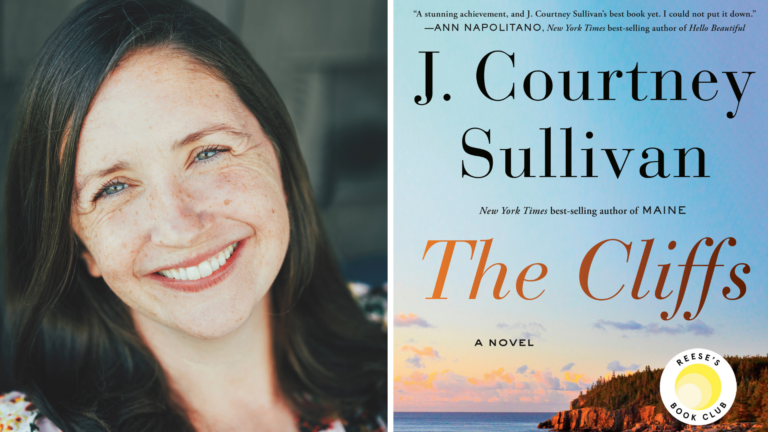
I call J. Courtney Sullivan on a recent sunny afternoon to find her at Wards Berry Farm in Sharon with her two kids.
Seven-year-old Leo wants to talk to me. (“I just want to say hi,” he pleads.)
“He’s drunk with power. He came to my book launch and asked three questions at the Q&A. He’s loving the spotlight,” Sullivan, 43, says with a laugh.
Leo’s pleas are eventually answered: I get to say hi to Leo and Stella, 5, before they scoot off to play.
“Please don’t write that my kids are monsters, even though they are,” Sullivan quips.
Actually, they’re awesome. Leo may have a future as a book critic, going by his summary of Mom’s latest bestseller, “The Cliffs.”
“My mom’s book is about an abandoned house, and people who build a mega mansion on top of ghosts. And how women’s power will kill you,” Sullivan tweeted.
(Leo, no notes.)
“I actually start all of my talks on with that now,” the Milton author and bestselling writer says with a laugh. “We were in the car after hockey camp. He told his friend in the backseat, ‘My mom writes books.’ His friend was like, ‘What’s the book about?’ And his answer was just perfect.”
Leo’s got the right to brag: Mom’s sixth novel, “The Cliffs” — a Reese Witherspoon pick for her book club, is a New England-centric page-turner that struck me in ways as a parallel to Daniel Mason’s brilliant Massachusetts-set “North Woods.” Both feature, at its center, an old New England home, generations of occupants, some who become lingering ghosts.
Sullivan’s tale begins with Jane, a precocious teen in fictional Awadapquit, Maine, who discovers an abandoned Victorian house, painted purple, on a sweeping swath by oceanside cliffs. Jane grows up to work at Schlesinger Library at the Harvard Radcliffe Institute, driven to uncover stories of women, and the indigenous peoples who lived in New England before it was so claimed and named.
When Jane’s drinking causes her to lose her job and husband, she returns tail between legs to her hometown to find that house gone. Wealthy summer people leveled it, and its on-site graveyard, to build their McMansion and pool.
There is a medium involved, and possible ghosts. We hear from Eliza, a Shaker who lived in the house decades earlier, and Kanti, an Abenaki woman who lived in that spot centuries earlier.
The book is ripe for your book club’s next read. There’s a lot to unpack — especially on the idea of who wrote New England’s early history (white men) and whose stories get preserved (ditto.)
After some 18 years living in New York, including time in a haunted Brooklyn apartment (I asked), the Milton native and bestselling author of “Maine” among others, moved back to her hometown in 2020.
“I always write about New England, but to write about it while I’m living here again has a heightened meaning,” Sullivan tells me. “Also, while writing about this haunted Victorian house, I bought an old Victorian house. I wish I had a ghost, as opposed to, like, a leaky roof.”
Ahead of talks at Wellesley Books Sept. 10 and Milton Public Library Sep. 17, I called Sullivan to talk sobriety, ghosts, “The Big Lebowski,” her meet-cute, and the most popular greeting card she ever wrote.
J. Courtney Sullivan: Oh my gosh, so excited. I had a Zoom call with my publisher; they’d found out the night before. They said, “We’ve made a change to the cover.” Then projected the cover with the Reese seal. I had subsequent calls with Reese’s people. They’re super lovely. She’d optioned my book “The Engagements” years ago; it never came to fruition, but it was a very interesting process.
This was inspired by a real abandoned house we’d found in Cape Neddick, Maine. It was just as it’s described in the book: on a cliff, this beautiful lawn rolling down to the ocean, a doll house inside, paintings on the walls.
The marbles are the only creation. [laughs] I was listening to a call-in radio show; they were talking about haunted houses. This caller said, “I have this old house and marbles appear. We have no explanation for how or why.”
I thought: Oh, that’s so good. So I kind of stole that.
Yes. My husband and I and our friends, Mike and Melissa, would go to Maine before we had kids. One summer, we discovered this abandoned house. It was so curious because it was clearly well-loved at some point. If you like Nancy Drew, or R.L. Stein or Scooby-Doo, you’re going to be curious about an abandoned house.
[laughs] We’d go back every summer. Then one year, it was demolished. In its place was the foundation for a very large house. We were devastated. So I wrote down everything I remembered about it, put that off to the side. I wasn’t sure what I was going to do with that. Later, I started reading about the Shakers, and mediums in Maine. I thought: the house could be the vessel for all these stories.
I don’t not believe in ghosts. My editor kept pitching this as a ghost story for people who don’t believe in ghosts. I like that because it’s about being a skeptic, but also believing. I think most people are that way. When I told people I was writing this, so many immediately said, “Oh, I don’t believe in ghosts.” Then within minutes, they’re telling me the story of how they saw once a ghost.
When COVID started, a family friend had a house in the suburbs of Albany; we stayed there a couple of months. Two places I could take my kids were a colonial cemetery and the Shaker village. I’d be reading every plaque. I remembered my mom took us to Sabbath Day Lake Shaker Village in Maine. I started reading about Shakers.
At the same time, I was reading “The In-Betweens,” by Mira Ptacin about Camp Etna. I’ve been to Camp Etna now a few times, it’s a fascinating place. I called it Camp Mira after Mira Ptacin. So I was escaping into both these worlds.
Oh, yeah. Two. [laughs] I had one excellent reading, and one that left me like, “Hmmm. That wasn’t quite right.”
I read about “evidential mediumship,” which is someone can produce hard evidence. Instead of: “Your grandma says she loves you,” they’d say: “Your grandma says she was never mad that you broke her glass animals.” There’s a place called Windbridge that certifies these mediums. I made an appointment with this woman who had a two-year waiting list.
I know. I said, “OK, that’s fine.” I had a feeling I was going to hear from my friend who died, and my grandfather. As the date got closer, I called to confirm my appointment, and the person said, “Well, that’s impossible. The medium died last week.” So my conduit to the dead died.
[laughs] It was crazy. I was bummed. Not to mention sad for the medium. There was one moment where I thought: “Should I try to find a medium to connect me with my medium?”
[laughs] But you have to draw the line.
Yes! So when my son was born, he had this rocker that was supposed to go back-and-forth, but for some reason, was also rocking side-to-side. Weird things would happen with the flickering lights. My son would babble at nothing.
We had this moment in our bedroom — lights are flickering, the baby is talking at nothing — I said, “If you are a ghost, turn off the lights.” And —poof — the lights went out.
Yes. So even my husband, a huge skeptic, was like, “Wow.” He said, “If you are a ghost, turn the lights back on.” And the lights didn’t go back on. Then we got into a little tiff where I was like, “We have already exhausted this ghost! Why are you asking for more? Do you know what it takes for a ghost to turn lights on?”
You got it. Ogunquit is my happy place. I’ve gone there every summer of my life.
I’d read in the process of my research that [that meaning] is a made-up thing, as often happens with Native American words and terms— they seem to translate directly to a perfect tourist-friendly slogan.
In the book, I was calling the town Ogunquit. But at the end of the day, I was not 100 percent sure if that [name story] was true or untrue. So I changed the town name.
I love the Schlesinger. In all my books, I return to this obsession: this idea that the moment a woman is born determines so much of who she’s allowed to become. That’s encapsulated so beautifully at the Schlesinger because they’re looking at contemporary women, historic women; they have the papers of Julia Child and Amelia Earhart, but also hundreds of women we’ve never heard of. Jane is obsessed with women in their moment, and the idea of stories that get lost to time.
Moving back to New England, I was surrounded by documentations of “firsts.” Everywhere you go, you see plaques: the first school, the first pub, the first library. In Milton, a proclaimed “first” is America’s first weather observatory. I laugh when I see that, because there was actually, like, 10,000 years of indigenous life lived right here and I’m pretty sure they were observing weather.
Definitely. I’m eight years sober. I started writing the book four years ago, the perfect time, because I felt on firm-footing with sobriety, but close enough to that I could still recall lots of cringey details. I’ve written many times about “the good girl” in a family of alcoholics, and I wanted to just finally write the truth: the good girl can also be an alcoholic.
[laughs]
[laughs] Oh my god. That’s hilarious. It wasn’t meant to be a reference, but I love that. I wonder if, deep down, subconsciously, I knew that. Oh my gosh, that’s great.
[laughs] You said your husband works in advertising. How did you meet?
We were both working for this website someecards. I’d written a story about it for the New York Times and ended up, afterwards, talking to the creators saying, “You guys are funny, but you need a woman writing.” They said, “OK, how about you?’ So I was secretly, anonymously writing these cards.
Then they brought on this guy, who turned out to be my husband, Kevin. We did branded cards together — one project was for the TV show Bridezillas, so that was the beginning of a beautiful union right there. [laughs]
But once we started dating, I was suddenly so happy and in love that the quality of my cards went down the tubes. They were not funny at all.
A year or two. We’re always laughing because my card that’s had the longest afterlife was one that said: “I’m outdoorsy in that I like getting drunk on patios.” We see it still everywhere.
Every time I go into a gift shop, I see it on a little pillow or a little wood block. Like, How come I don’t get residuals? [laughs] I’ve never told anybody this before. This is new information.
Lauren Daley is a freelance writer. She can be reached at [email protected]. She tweets @laurendaley1, and Instagrams at @laurendaley1. Read more stories on Facebook here.
Get everything you need to know to start your day, delivered right to your inbox every morning.



To comment, please create a screen name in your profile
To comment, please verify your email address
Conversation
This discussion has ended. Please join elsewhere on Boston.com