
Sign up for Book Club
Stay up to date on local books news, events, and recommendations from Boston.com.
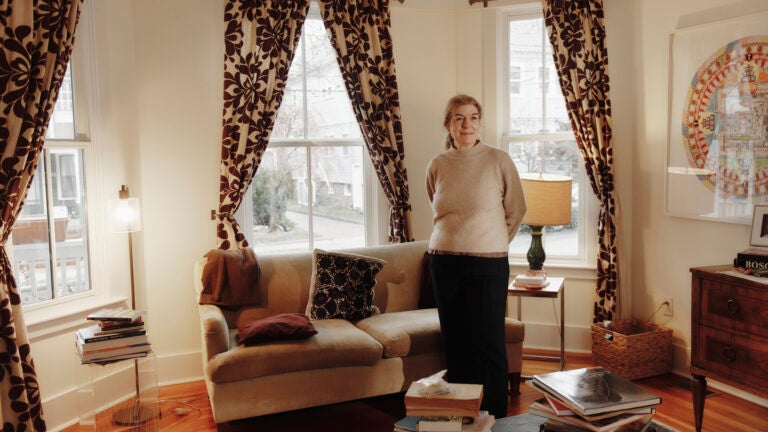
CAMBRIDGE, Mass. – The home library that novelist Claire Messud was about to show me, she joked, was sort of a “Potemkin village.” She and her husband, New Yorker critic James Wood, were mid-move – starting the long process of packing up the home where their family has lived since 2008.
All the titles lingering in the “to be read” pile had been boxed up – if they got mixed in with the other books, she would never get around to them – as had most of the extra copies and translations of Messud’s and Wood’s past works. In that sense, she said, moving was a revealing process: “There’s so much that’s already packed up, and in a funny way, this is sort of the core, or underpinning.”
The couple was closing on the new place – farther outside Boston, and with a less-generous acreage of shelves – shortly before the publication of Messud’s new book, whose plot happens to involve a lot of moves. “This Strange Eventful History” follows a family across seven decades and all their attendant upheaval. The characters often find themselves weighing what’s precious – a doll in a damask dress; shoe boxes stuffed with postcards – and what can be abandoned.

Messud still has the books given to her as prizes for having the highest marks in the third and fourth grades: one on sea mammals and another on reptiles and amphibians. “And then we left Australia, so that’s it. But what would I have got next? Maybe moving on to land mammals…”

When she pulled out another treasure from childhood, a collection of stories by Eleanor Farjeon given to her by her parents, she warned, “I’m a crier.” Her favorite of the stories was “Elsie Piddock Skips in Her Sleep,” about a poor child in rural England with a talent for skipping and a magical rope given to her by the fairies. When a wealthy landlord starts buying up land and enclosing the common ways, the village holds one final skipping contest, stipulating that he can lay the first brick only after the last villager stumbles. Elsie, now elderly, steps up. The story concludes, “She’s still skipping.”
“It was about battling injustice,” Messud said. “It was about sort of the most ordinary little person saving the world. She was a child who had nothing. Sorry – every time,” she said, blinking back tears. “You know, I used to read ‘The Little Prince’ to my kids, and they’d say, ‘Just don’t, Mommy.’ But I can cry at the TV ads.”

When Messud and Wood met at Cambridge University, their early courtship involved a lot of literary exchange. These days, though they have books they keep for work in their separate offices, the lines of ownership get fuzzy on the family shelves. “Nothing’s in any very sensible order … things get moved around,” she said. “How did we get more Middle East here? And, weirdly, more food. I feel there’s some small chaos, and the junk gets mixed in between.”

Theirs is a house awash in books – sent as thanks from past students; or for reviews, blurbs or awards consideration; or simply because a publicist hadn’t clocked that three copies of a given title had already landed on their doorstep. “You cannot keep them all,” Messud stage-whispered, as if she were afraid of hurting the volumes’ feelings. Many were treated with cheery unsentimentality: A couple were deployed to help support a pet gate between the den and the living room; others were piled near the front staircase, skirted nimbly by the two family dogs – a dachshund and a terrier mix – who greeted us hysterically, paws scrabbling, as Wood took them out for a rainy spring walk.
From a high shelf, Messud took down an early romantic token – a first edition of “Beloved,” by Toni Morrison. “The first year we were going out, he gave me this and took me to hear her read on Valentine’s Day.”

The modernist writer Jane Bowles was not at all prolific – “This is the collected works,” Messud said, holding up a single volume. “This is it!” – but her oeuvre, in its various editions, takes up a disproportionate amount of shelf space. “It’s funny – she’s one of those people I think that keeps being rediscovered and sort of slightly forgotten again.”
“Two Serious Ladies,” which Messud has described as “almost my blood relation,” came into her life by accident, when she was a college student browsing at the Yale Co-Op. “It was on the remainder table, and I picked it up entirely for the cover. That cover is distinctively ugly, you might say. But it totally caught my eye.” Messud wound up writing her college thesis on the author, “so I spent a year intensely living with Jane Bowles. She was a big figure for me.”

In “Two Serious Ladies,” Bowles follows the title characters as they make a break from their bourgeois lives, and you can see the seeds of the interests that went on to shape much of Messud’s fiction. Her novels “The Burning Girl,” “The Woman Upstairs” and “When the World Was Steady” also focus on pairs of women – and the innermost discontent and passion that emerge most clearly in the intense, even obsessive dynamics of sisterhood, best friendship and rivalry.

“This Strange Eventful History,” Messud’s eighth book, is her most closely autobiographical. The journey of a pied-noir family, the Cassars – starting in French colonial Lebanon and Algiers, then unspooling to Switzerland and France, ultimately reaching Argentina and Australia, Canada and the United States – mirrors her own family’s scattering around the globe. Late in the book, a character visits her grandfather’s old apartment and gazes at a shelf of fat red binders, containing his memoirs: “a trove beyond my reach but that I knew one day I’d read entire – it was our inheritance, after all, addressed to us.”

The patriarch, Gaston Cassar, is modeled on Messud’s grandfather, who served as the French naval attaché in Beirut before World War II – and who, in the 1970s, wrote a 1,500-page family history intended for Messud and her sister. Messud is the custodian of the six volumes.
“He was very tidy,” she noted, leafing through pages pasted with old letters, passports, visas, food ration cards and photographs. One letter regretfully informed her grandfather that the ship carrying all of the family’s belongings from their apartment in Salonika, Greece, had been torpedoed; he kept the ship’s manifest, detailing the inventory of what had been lost. “I shouldn’t laugh,” Messud said to herself, translating the message aloud from French.
“I keep thinking somebody, some archive, surely would want them, but I’ve spoken to a few people, and it doesn’t seem like people…” she trailed off. “I don’t know that my children want to keep them.”


Messud has also kept many of her father’s old math notebooks from his schoolboy days, along with antique histories of the Middle East from his graduate studies at Harvard. Partly through him, she has amassed a small collection of books by and about Albert Camus: his early essay collection “Noces,” published in Algiers in a small run of around 1,000 (“it’s a little foxed”); a special issue of La Nouvelle Revue Francaise published after the author’s death; a coffee-table book by his daughter, Catherine Camus. Her father also collected Pléiade editions (“too precious to throw away, certainly”), which Messud keeps in her office.
Both of Messud’s parents were “huge readers,” and the shelves in their home in Canada were crammed two layers deep with books. “The great challenge after their deaths” was getting rid of the volumes, she said. “One of the things we know is that nobody wants the books.” She looked at her own shelves, appraising. “Can we get rid of some of them before we die, so that the children are not lumbered with dealing with them?”

Stay up to date on local books news, events, and recommendations from Boston.com.





To comment, please create a screen name in your profile
To comment, please verify your email address
Conversation
This discussion has ended. Please join elsewhere on Boston.com