
A classic, tragic account of American incarceration
"The Other Side of Prospect," by Nicholas Dawidoff, tells the story of how a manifestly not-guilty 16-year-old confessed to the murder-robbery of an elderly Black man in the Newhallville neighborhood of New Haven, Conn.
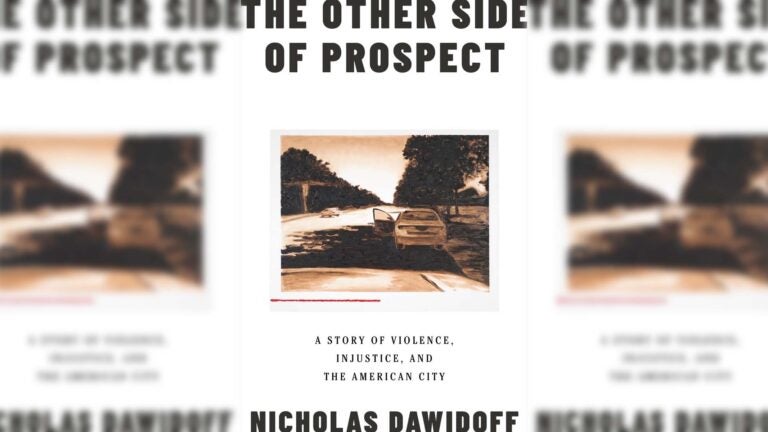
“The Other Side of Prospect: A Story of Violence, Injustice, and the American City”
By Nicholas Dawidoff
Norton. 442 pp. $32.50
—
Everybody knew Bobby Johnson was no killer. His friends knew he was innocent, his mother knew he was innocent, his nine siblings knew he was innocent, the other Black teenagers who hung out with him on the corner in front of the Dix Deli knew he was innocent. Word of his innocence followed him into prison. “When I first came here,” Johnson would say of the near decade he spent incarcerated, “a lot of older guys from my neighborhood were yelling at me: ‘Why you in here for something you didn’t do?'” When he was exonerated in 2015, even the daughter of the man he was alleged to have murdered agreed that he was innocent.
“The Other Side of Prospect,” by journalist Nicholas Dawidoff, tells the story of how a manifestly not-guilty 16-year-old confessed to the murder-robbery of an elderly Black man in the Newhallville neighborhood of New Haven, Conn., blocks from where Johnson lived. It’s the story of how the justice system handed a good kid a 38-year sentence, of which he served nine years before a skilled, obsessive defense attorney took his case and got him out. Johnson reentered society grateful but overwhelmed, and when the book ends he is still looking for meaningful work, and for meaning.
Books

Dawidoff, who grew up in New Haven and returned to live there in middle age, has written a great American book. But I was 226 pages in, just over halfway, when I realized how great it was shaping up to be. The book takes a long time to go from 0 to 65. It’s bigger than it has to be, and it’s not a model of elegant design; it reminds me of my clunky 2004 minivan, roomy and comfy, with poor steering and iffy brakes, always a little out of control. But then again, I love my minivan.
On Aug. 1, 2006, 70-year-old Herbert “Pete” Fields was shot in his parked Chrysler on West Ivy Street. Fields had grown up in Newhallville, where his family had arrived as part of the mid-century Great Migration, when Black Americans from the South moved north in large waves to places like New Haven, where factory jobs were plentiful. Fields prospered enough to move to the suburbs, but he regularly returned to the old neighborhood for his fix of card games, drink and nostalgia. Fields was a respectable, middle-class sort, not the typical victim of gang violence or a neighborhood beef; his was not a murder that the community could allow to go unsolved. For reasons that were unclear, the police fixed on Johnson and his friend as the culprits, while a far more likely suspect, who had a vicious rap sheet and a clear connection to the murder weapon, and whose good friend’s palm print was found in the victim’s car, was never even questioned (and was soon murdered himself).
Using news reports, his own interviews and court documents, including Johnson’s signed confession, Dawidoff reconstructs the interrogation, during which a big, tough homicide detective named Clarence Willoughby – an older Black authority figure, interrogating a boy who had few such men in his life – browbeat a confession out of the terrified, confused Johnson. I’ll never forget these 30 or so pages; reading them, I felt trapped in a hellscape equal parts “The Trial” and “The Shining.” Dawidoff writes that of all American prisoners freed by DNA evidence, 29 percent had given false confessions. I’m now surprised the number is that low.
When Johnson goes to prison, the book gets even better. Dawidoff’s portrait of prison life, its pointless mix of boredom, sadness and stress, is an important corrective to the more sensational television fare – “Orange Is the New Black,” “Oz” – that has helped form my impressions, and maybe yours. In the Cheshire prison, 20 miles north of New Haven, Johnson read James Baldwin and Richard Wright in a book club. He got his G.E.D. He kept his resolution never to cry, even as another day would pass with no mail and no visitors. The section on Johnson’s incarceration is, once again, a mere 30 pages, but it’s enough to place this book alongside Ted Conover’s “Newjack” (2000), Albert Woodfox’s “Solitary” (2019) and Heather Ann Thompson’s “Blood in the Water” (2016), about the Attica prison uprising, on a shelf that might be titled “Classic Books About America’s Failed Prisons.”
Johnson got lucky – very, very lucky – when a lawyer named Ken Rosenthal took his case on appeal. There are very few attorneys as smart and dogged as Rosenthal, and most innocent people never get one. Rosenthal, who “didn’t care what he drove or ate or wore,” and who “submitted” to the occasional family vacation, found enough exculpatory evidence that the New Haven prosecutor made a motion to vacate the conviction.
Dawidoff follows Johnson for five years after his release, a disjointed and dispiriting period. Even with a hefty settlement from the state, Johnson had trouble finding his way. There were jobs, and there were women, but there was no real life. And that’s how the book ends.
I wish Dawidoff had been content to write Johnson’s story. His confession, his brave recanting of that confession when asked to testify against his supposed accomplice (a friend every bit as innocent as Johnson), his incarceration, his troubled journey after getting out – it has the oomph of a classic American novel, one that sucker-punches you every time you remember that it’s all true.
But the first four chapters – lengthy ones – are given over to the story of Fields, the victim, and the history of the Great Migration. Men came north to work in munitions factories; the Winchester gun factory was in Newhallville, a block from where my daughter’s climbing gym is today. The jobs eventually disappeared, but the guns stayed. The Great Migration has been covered elsewhere, in classics like Nicholas Lemann’s “The Promised Land” (1991) and Isabel Wilkerson’s “The Warmth of Other Suns” (2010), and Dawidoff didn’t need to recount so much of it here. But he’s right to highlight the irony that guns were Newhallville’s fortune, until they were its misfortune.
Dawidoff also finds deep resonance in the way the past haunts Newhallville today. For example, Fields never forgot how a White sheriff had swindled his family out of land back in South Carolina. Dawidoff wants to sketch the long shadow of dispossession, how it affected Black people’s ability to create wealth, making them renters in the poor neighborhoods to which redlining banks consigned them.
But facts sometimes complicate the story. For example, Dawidoff writes that by 1980, Newhallville “became the neighborhood with the largest Black housing ownership in the state.” At other times, he writes about Newhallville as if it’s a lawless killing field: “Bobby had no after-school activities in his neighborhood, no tutoring sessions, no open gyms, no library.” But that depends on how you define “in his neighborhood.” The Stetson branch of the New Haven Free Public Library, while technically in the adjacent Dixwell neighborhood, is a mile, give or take, from most points in Newhallville, a five-minute bike ride from Johnson’s favorite corner hangout.
And despite Newhallville’s gun violence – still a major problem – it is a culturally rich area, dense and homey, barely more than a square half-mile, with churches, schools and small businesses. There are after-school programs, youth groups and city-run summer camps.
Johnson was never a gangbanger; he was one of those unsupervised boys who was “just around,” spending his time on the corner of Bassett and Dixwell, the center of his world. “But to be just around in a neighborhood like Newhallville,” Dawidoff writes, made it much easier for police “to assume you were involved in a serious crime, and more difficult for you to prove you weren’t there. Because you were always there.”
So why did Johnson end up on the corners, when some of his peers were reading or at practice? One running theme of the book is fatherlessness; everywhere Johnson goes, the absence of fathers is a very real presence. “It was more than women that attracted Bobby to the corner,” Dawidoff writes. “It was also the company of men. Bobby coveted the lessons about manhood that he worried he’d missed out on by growing up in a fatherless home, and he wasn’t alone in this.” And elsewhere he writes: “Almost every son whose background Bobby knew at prison had no father in his life. Almost every father, so far as Bobby knew, wasn’t married.”
But it’s all intertwined: the dispossession, the unemployment, the broken homes, the social divisions. The book’s title refers to the street that separates Newhallville from the East Rock neighborhood, where so many Yale-affiliated elites live in million-dollar homes. It’s where a young Bobby would ride his bike to get a few minutes of quiet, away from the chaos on his side of Prospect. Why do people on one side care so little about how people live on the other side? To that question, Dawidoff wisely proffers no answers, just as he does not attempt to solve the problem of fractured families or the vanishing high-wage urban job.
If we ever solve those problems, perhaps fewer innocent people will go to prison, and perhaps young men like Johnson won’t have to get jailed to get educated. At age 11, Johnson was given an I.Q. score of 69, but in prison he read more good literature than the average student at Yale University, a mile and a half from his boyhood home. He cooperated extensively with Dawidoff, giving us a book that, had life gone otherwise, Johnson might have written about someone else.
Reading “The Other Side of Prospect,” I thought of Jill Leovy’s classic “Ghettoside” (2015), about homicide police in Los Angeles. Both books show the devastating effects of bad policing, including deep mistrust. Herbert Fields was murdered in front of numerous witnesses, but none of them would talk. None of them came forward after Johnson confessed; none of them said, “But I saw who did it.” Today, out of prison, Johnson still bumps into people who let him get sent away. But he doesn’t blame them. Nor does he seem to blame the paid informant who, as it came out during the appeals process, mistakenly fingered him in the first place. Blame isn’t Bobby Johnson’s thing, even if it should be. “I always knew I was a good person,” he said at his getting-out-of-jail party. In that, he wasn’t alone: Everybody knew he was a good person, but somehow it didn’t matter.
Mark Oppenheimer is the author of “Squirrel Hill: The Tree of Life Synagogue Shooting and the Soul of a Neighborhood.” From 2004 to 2006, he was the editor of the weekly New Haven Advocate.




To comment, please create a screen name in your profile
To comment, please verify your email address
Conversation
This discussion has ended. Please join elsewhere on Boston.com