
Great thrillers abound this month. Here are five of the best.
Escape into the twisty tales by Joseph Kanon, Calla Henkel, Bonnie Kistler, Lan Samantha Change and Danya Kukafka.
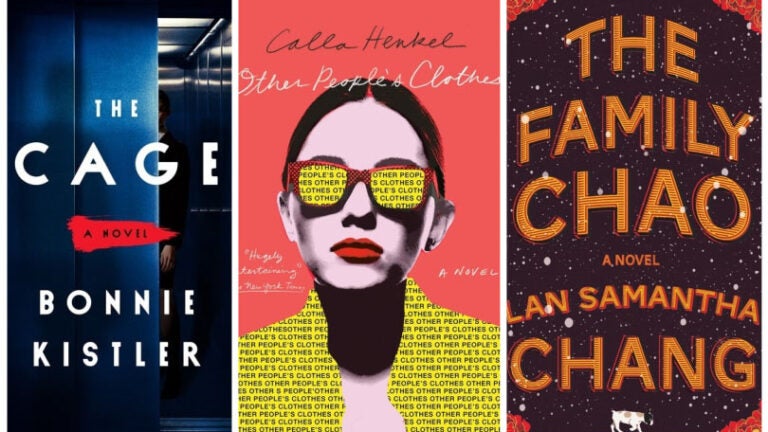
Variety is the name of the game with five superb midwinter mysteries and thrillers, with settings across North America — also twice in Berlin. Choose your geographical poison.
“The Berlin Exchange,” by Joseph Kanon
When nuclear physicist Martin Keller is freed from a U.K. prison and returned to East Germany in a 1963 spy swap, he’s happy to reconnect with his terminally ill ex-wife and their 11-year-old son, a popular actor on a hit TV show. But Keller soon comes to loathe the police state demanding he build East Germany’s first atomic bomb. In Joseph Kanon’s skillful telling, Keller’s elaborate scheme for escaping with his family to the West is heart-poundingly suspenseful. Indirectly, it involves the then-common East German practice of selling political prisoners to the West for, among other items, oranges. (Scribner, Feb. 22)
“The Cage,” by Bonnie Kistler
A suburban New York City corporate executive shoots herself in the head while stuck in a stuck elevator. The other passenger in the stranded lift (“the cage”), an ambitious but emotionally insecure lawyer named Shay Lambert, is accused of murder. The twisty plot of Bonnie Kistler’s brisk, well-researched legal thriller delves into the misdeeds of a fashion conglomerate as well as the personal woes of its heroine, a woman at the mercy of a husband gone to seed with booze and surliness. The sections on corporate callousness in Southeast Asia are especially infuriating. (Harper, Feb. 15)
“The Family Chao,” by Lan Samantha Chang
The cracked radishes in hot oil aren’t all that’s sizzling in this bravely unsentimental murder mystery about a Chinese American family in small-town Wisconsin whose restaurant, Fine Chao, is the site of owner Leo Chao’s chilly demise – somebody locks him in the walk-in freezer. A crook and a bully, Chao is hated by his three sons, each “full of passion and inner chaos.” Conflicts over assimilation roil the family and put them at odds with the town’s numerous racist jerks. Author Lan Samantha Chang is the first female director of the Iowa Writers’ Workshop. She plainly has plenty to teach about the art of fiction. (Norton, Feb. 1)
“Notes on an Execution,” by Danya Kukafka
I’ve read too many recent mysteries that should have been cut by 50 pages – or, in one notorious instance, about 200. Not so with Danya Kukafka’s perfectly constructed and exquisitely written suspense novel about serial killer Ansel Packer’s final 12 hours on Texas’s death row – and, even more interestingly, the luckless teenage girls he murdered, and the other complicated women left in his wake. Packer is wearisome dolt, but not so Lavender, the mother who abandoned him when he was 4, or Saffron Singh, the childhood pal who grows up to be the police detective who terminates Packer’s miserable existence. This is a serial killer novel that’s more Dostoyevsky than Lars Keplar – rich, anguished, brilliant. (Morrow, Jan. 25)
“Other People’s Clothes,” by Calla Henkel
You wonder at first if Calla Henkel’s gleefully raunchy novel about Zoe and Hailey, two New York art students and their college year in Berlin, is really a mystery. It is; early clues are frequent mentions of Amanda Knox, the real-life American wrongly convicted in Italy of the stabbing death of her roommate. When their weird landlady Beatrice seems to be plagiarizing the young women’s lives for her pulp novels, they put on debauched parties to control the narrative. Says Hailey: “We need a literary-worthy conflict, we need a love triangle or murder or incest.” Stunningly, she gets her wish. (Doubleday, Feb. 1)
Richard Lipez writes the Donald Strachey PI novels under the name Richard Stevenson.



To comment, please create a screen name in your profile
To comment, please verify your email address
Conversation
This discussion has ended. Please join elsewhere on Boston.com