
New Market Basket book slips business lessons into a beach read
A year later, the authors answer the key question: Who really owned Market Basket?
Commentary
When the 200-odd UMass Lowell freshmen business majors arrive on campus this fall, each will be assigned to read a new book fresh off the shelves: We Are Market Basket.
It’s the first time UMass Lowell’s business school assigned a “common book’’ for all freshmen, said Scott Latham, the Dean of the Business School.
“The book really gives us a chance to peel back the onion,’’ he said. “It so reflects how complex business is on a day-to-day basis.’’

That’s just what the book’s authors Grant Welker and Daniel Korschun were going for in writing a compelling — if not particularly groundbreaking — read on the ups, downs, and underlying business decisions of the biggest supermarket saga in recent history.
The book isn’t just for business students, though, Korschun said.
“I would be my happiest if someone reads this on the beach at the Cape this summer, and that we’re able to sneak in this management theory,’’ Korschun said.
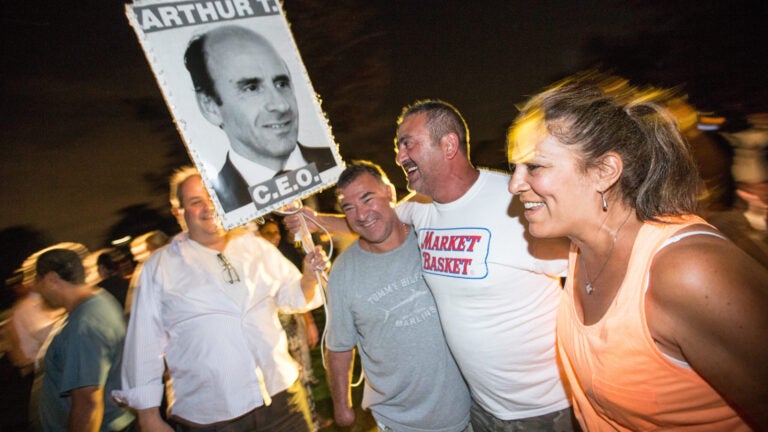
A quick refresher on Market Basket’s story, which remains incredible to recount a full year later. After years of drama among the family that owned Market Basket, Arthur S. Demoulas and his allies took power of the company’s board of directors from his cousin and longtime CEO Arthur T. Demoulas. The beloved Arthur T. was then dramatically fired, leading to warehouse worker walkouts, customer boycotts, empty shelves, and nationwide attention.
Finally, after weeks of protests by employees, vendors, and even customers, Arthur T. was reinstalled as chief. Employees had their man back in charge.
At the book’s best, it uses a Malcolm Gladwell-like frame for positioning Market Basket in the modern business environment. Most businesses believe that X is the best way to do things. But Market Basket employees believe Y works better. What does Market Basket know that we don’t?
Welker and Korschun deftly show why Arthur T.’s people-centric management style resonated so closely with the community. Welker, a reporter for The Lowell Sun, provides much of the interviews, history, and anecdotes of the company. Korschun, an associate professor of marketing at Drexel University, provides outlines of the business practices that make Arthur T.’s leadership so unusual.
In particular, We Are Market Basket revolves around one key question in its introduction: “Who really owns a company and who gets to decide how it is run?’’
“The typical view is its shareholders,’’ Welker said, “and technically, sure they do. But as this case showed us, they didn’t really own much of anything.’’
Korschun said he teaches the Market Basket story as a case study for his business students because people are “floored’’ by what it says about business.
“Many people have argued over the years that the Board of Directors’ primary responsibility is to the same shareholders who elected them,’’ he said. “This is the case that really exposes the flaw of that idea.’’
We Are Market Basket is in stores now.
Photos: The Market Basket feud.
[bdc-gallery id=”120352″]



To comment, please create a screen name in your profile
To comment, please verify your email address
Conversation
This discussion has ended. Please join elsewhere on Boston.com