
Children’s Library at BPL Expands, Along With Children’s Publishing
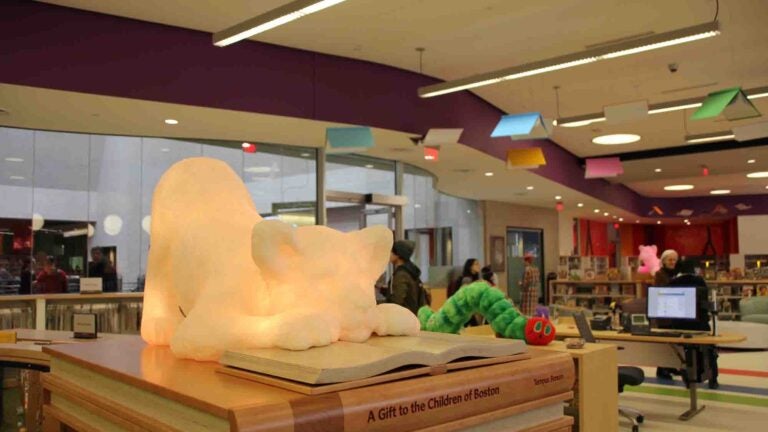
The Boston Public Library recently unveiled the renovated Children’s Library, a colorful and literary wonderland that includes areas for all ages, from “early readers’’ to Teen Central. Central Library Children’s Services team leader Laura Koenig, an energetic woman with rainbow-dyed short hair that fits in with the bright walls and color block carpeting, is excited about how the children will use the room.
The room was designed so kids would feel like it belongs to them, like it’s their space, with books on the floor at kid-level and a sensory wall designed to get young kids ready to read, said Koenig. She said their eyes open wide when they first see the room, and hers do the same as she talked about the renovations.
Take a look inside the renovated Children’s Library here.
The reopening of the second floor, including an updated reading room within the general nonfiction section, aligns with Read Across America, an annual reading initiative by the National Education Association. Read Across America is celebrated on March 2 for Dr. Seuss’s birthday, and the Children’s Library will have Dr. Seuss-related crafting and extra copies of this year’s selected book, Oh, the Places You’ll Go! for families to read together.
“It’s about getting people excited and talking about children’s books,’’ Koenig said, of both Read Across America and the library’s renovations. “There’s a lot of joy to be found in children’s books, even if you don’t work with kids.’’
The world is constantly expanding for children with each new book, Koenig said. And in recent years, the world of children’s literature has expanded sharply as well, especially when it comes to picture books and titles for young readers.
“A lot of people have heard about the explosion of YA [young adult] recently, but I think that in the last five years, picture book production has just been exceptional,’’ Koenig said. “I think we’re seeing a golden age of picture books right now.’’
To Koenig, picture books are works of art that even adults can appreciate, but they aren’t the only area of children’s books that have been expanding. The library gets about 150 new children’s books every month and even more in weeks leading up to high-demand periods, such as when schools release summer reading lists, according to BPL spokesperson Rosemary Lavery. The renovation made space for the rapidly growing collection; the Children’s Library is now twice as big as it used to be.
Booksellers have also adjusted to handle the explosion in children’s literature. For kid readers, there’s more variety than ever, according to Alex Schaffner, children’s bookseller at Brookline Booksmith.
At the Booksmith, Schaffner said that they redistribute shelf space based on what people want to read, and “young adult’’ is now the largest section, followed by “early readers.’’
“It’s a vibrant place for variety. There are books about people doing all kinds of things,’’ Schaffner said. “There’s diversity of characters and writers, and it’s exciting.’’
The Booksmith gets newly published books each week, and kids are reading more than ever.
“It isn’t necessarily about parents wanting their kids to read more, but about kids’ books being treated as something that has value, rather than something you throw at children,’’ Schaffner said. “Real literature for kids doesn’t stop being literature when you’re an adult.’’
It’s not just kids devouring these titles. The adult audience for YA novels is a real phenomenon in the bookselling world, to the consternation of some critics. Last year, Ruth Graham wrote an article for Slate titled “Against YA,’’ saying, “Read whatever you want. But you should feel embarrassed when what you’re reading was written for children.’’
But for many involved in children’s books—whether bookstore workers or children’s librarians – they’re not embarrassed about reading children’s literature. They’re excited about the stories.
“There’s a reason I ended up working with children’s books, and that’s because I find them genuinely compelling,’’ Schaffner said. “You get voices and attitudes in kids’ books that you don’t find in adults. People who write about and for children work from the assumption that children are interesting, and so you don’t spend a lot of time talking over your audience, when you assume anyone reading what you have to say is a worthwhile listener.’’
Terri Schmitz, owner of The Children’s Book Shop, was one of those readers who was hungry for good stories as a child. Now, she owns the oldest independent children’s bookstore in Greater Boston, and helps adults and kids navigate the exploding market.
“There’s so much, and it’s so rich, but once people get beyond [reading children’s books as a child], they don’t see that. They don’t realize what’s happening until they have kids and grandkids,’’ Schmitz said. “Then they come back and find that everything has blossomed. People are overwhelmed at the amount of books we have.’’
The Horn Book Guide, a 91-year-old publication that puts out bi-annual issues reviewing new children’s books, covers over 2,000 new titles published in a six-month period for each edition. The number of children’s books published in the United States reaches six figures, according to editor-in-chief Roger Sutton. That means there’s something for everyone, even adults.
“What I would do is find out what kind of books an adult liked reading for his or her own pleasure, because there really is a children’s book that will match them,’’ Sutton said. “That’s how to convince an adult of the value of children’s books.’’
Sutton said that he’s been able to fill a bookshelf for his grandchildren, because he knows what’s out there. But for parents who want to share their classic childhood books with their own kids, Sutton said those books are still being read, and reread.
“The great thing about children’s books is it’s not so best-seller dependent,’’ Sutton said. “Adult readers don’t maintain the same breadth. They read what’s hot.’’
There’s a reason these booksellers and librarians have stayed in the world of children’s literature. Sutton said he revisited his childhood books as an adult and still got something from the stories. Schaffner said that at the Booksmith, she sees adults selling back or getting rid of books they’ve read once—something that wouldn’t cross a kid’s mind.
“Kids reread, and one of the reasons kids’ books matter is that you latch onto them and revisit them over and over again,’’ Schaffner said. “They become about you, and if a book can become the center of someone like that, it has to have value as literature.’’
Correction: A previous version of this article stated that Laura Koenig is the children’s librarian at Boston Public Library. She is in fact the library’s Central Library Children’s Services Team Leader.



To comment, please create a screen name in your profile
To comment, please verify your email address
Conversation
This discussion has ended. Please join elsewhere on Boston.com