
Best books of the decade
-

Harry Potter did not make my list. There. I said it. I read every last one of the wizard’s adventures, I swear, but now the whole experience is kind of a blur of Quidditch and complicated potions. And while there is no denying their influence on book publishing, I can’t very well list books I can barely remember. There are, undoubtedly, plenty of other books I have forgotten, or just never got around to reading. Some I couldn’t shoehorn in; several books of poetry I remembered came just before the new decade, so there’s no verse on my list. And, so: no more equivocating, no more excuses. This is my list of books from the past 10 years – in chronological order – that I can’t forget.
-
‘White Teeth’

Zadie Smith
(2000)
An epic novel about race, class, and gender seemed the perfect way to start the decade (the century even!) in publishing. Despite its astounding geographic, historical, and cultural range this debut novel is most remarkable for the affection with which the author treats all of her characters and which, in turn, makes them so delightfully human.
-
‘Interpreter of Maladies’

Jhumpa Lahiri
(2000)
Before American readers were treated to a welcome deluge of Indian and Indian-American fiction, there was Lahiri’s exquisite collection of stories of immigration and assimilation. Many of the stories take place in Boston and Cambridge; after reading Lahiri’s story “Sexy’’ I took my husband to the Mapparium at the Christian Science Center and asked him to whisper to me from across the bridge.
-
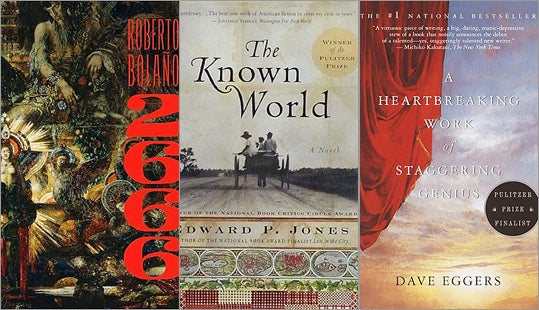
‘A HeartbreakingWork of Staggering Genius’

Dave Eggers
(2001)
Before James Frey and company sullied the reputation of the whole genre, Eggers strove for painstaking authenticity in his hyperbolically titled memoir. The book’s success launched Eggers and his literary magazine McSweeney’s into a different orbit. Eggers opened writing and tutoring centers for children around the country, including one here in Boston, started a fantastically imaginative publishing imprint, and just this year two of his screenplays made it to film — “Away We Go’’ and “Where the Wild Things Are.’’ On newsstands now (if you can find a copy): McSweeney’s version of an old-fashioned broadsheet, the “San Francisco Panorama.’’
-
‘The Amazing Adventures of Kavalier & Clay’

Michael Chabon
(2001)
This big, juicy historical novel has it all — war, romance, magic, superheroes. Cousins Joe Kavalier and Sam Clay team up to create a comic book hero, the Escapist, who, among other feats, pummels Hitler. Chabon’s novel certainly had a hand in lifting comic books and graphic novels out of geekdom and into the realm of literature.
-
‘A Problem from Hell: America and the Age of Genocide’

Samantha Power
(2002)
In this powerful call to action, Power examines the history of genocides in the 20th century and condemns the United States for failing to act. Her stern interventionist talk stirred controversy and led, eventually, to an advisory spot on the Obama campaign. Her political career was temporarily derailed after she called Hillary Clinton a “monster.’’ Power apologized and this year joined the White House, where she now sits on the National Security Council.
-
‘My Name is Red’

Orhan Pamuk, translated by Erdag Goknar
(2002)
This murder mystery, set in 16th-century Istanbul and narrated by some unlikely characters – among them a tree, a gold coin, red ink – opened Americans’ eyes to Turkish luminary Pamuk before he won the Nobel Prize in 2006. In 2005 Pamuk emerged as an important political voice after he spoke frankly about the Armenian genocide and subsequently faced criminal charges in Turkey.
-
‘The Known World’

Edward P. Jones
(2003)
In the tradition of artists with mind-numbing day jobs (like Wallace Stevens, the insurance agent-poet), Jones was an editor at a tax journal for almost 20 years. After Jones lost his job in 2002 he began to write this gorgeously stylized novel about slavery full time. Thank God he was fired.
-
‘Gilead’

Marilynne Robinson
(2004)
During the 25 years between the publication of her first luminous novel, “Housekeeping,’’ and this, her second novel, the gossip was that Robinson was blocked and obsessively revising her first. This book, an epistolary novel written from an aging father to his young son, quieted the rumors immediately.
-
‘The Omnivore’s Dilemma: A Natural History of Four Meals’

Michael Pollan
(2006)
Without stunts or scolding Michael Pollan changed the way (some) Americans look at frozen dinners and Chicken McNuggets. At least until their next road trip.
-
‘2666’

Robert Bolaño, translated by Natasha Wimmer
(2008)
Divided into five sections and just shy of 1,000 pages — “2666’’ is the funniest and most tender apocalyptic book you’ll ever read. The tortuous paths in the labyrinthine plot all lead to a brutal center — a collection of unsolved murders based on real serial killings in Mexico. Readers should cherish every page; Bolaño, a Chilean ex-pat, died in 2003 at age 50.




To comment, please create a screen name in your profile
To comment, please verify your email address
Conversation
This discussion has ended. Please join elsewhere on Boston.com