
Down two paths with Paterno
Biography of coach begun before scandal struggles with legacy
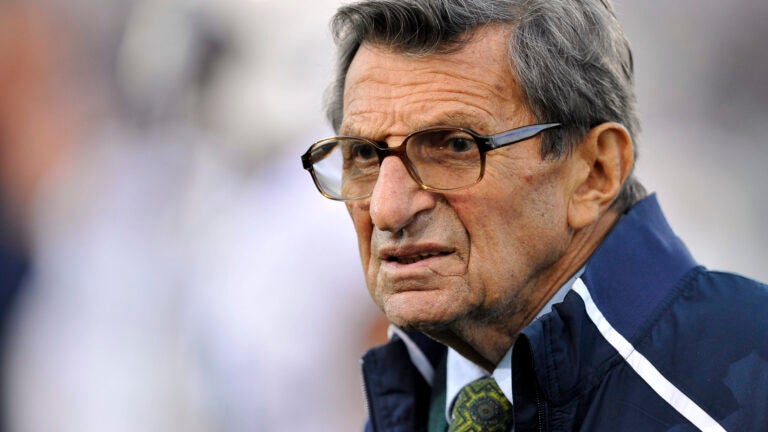
In 1993, Joe Paterno addressed a gathering of high school football coaches. He told them that teaching “an academic subject is certainly not easy, but compared to coaching, it is.’’
There is a good deal of evidence in Joe Posnanski’s biography of Paterno that the late legendary head coach of Penn State University’s football team took both his work and himself very seriously. Paterno was more successful than any other Division I coach at winning football games and, until the final years of his six-decade career, he ran a program that appeared to be singularly honorable.
Then came the news about his former assistant Jerry Sandusky’s crimes, upending Paterno’s career, the college and team he loved — and Posnanski’s book.
Obviously Posnanski’s intent was to celebrate Paterno when he began work on this project in 2011 before the Sandusky scandal became public. He was apparently thrilled that the octogenarian Nittany Lions coach had “allowed’’ him to write it.
Still Posnanski, a former Sports Illustrated senior writer who now works for the Sports on Earth website, appears to have struggled mightily.
The book begins with what Posnanski calls an “overture,’’ in which Paterno sits at his kitchen table, reluctantly reading about Sandusky’s crimes. Shortly thereafter, Posnanski gives us Paterno as a star quarterback at Brooklyn Prep, where he was as concerned about encouraging his teammates as he was about scoring touchdowns. Then on to Brown where he played quarterback and cornerback and finally the fateful move to Penn State to become a coach. The book includes half a century’s worth of football stories and presents tales of generations of once-young men who see Paterno, who died this past January, as a welcome and powerful force for good in their lives.
As Paterno’s success and reputation grew, though, Posnanski hints at a dark side to the coach’s often fanatical dedication to his job: He apparently came to believe that nobody else could do it.
He became so popular that he could ignore — sometimes contemptuously — efforts by the university president and others to unseat him. His charisma was such that crowds of students rallied on his behalf, even as the news of the criminal depredations of Sandusky were making national headlines.
Posnanski tries to distance his hero from the scandal by establishing that Paterno didn’t like — in fact, never liked — his assistant, even when they were still working together and winning games. Further, Paterno figured any responsibility he might have had for Sandusky when he was employed at Penn State ended when the assistant coach left the team.
Beyond that, Posnanski contends that Paterno was fooled. If the professionals associated with Sandusky’s charity, The Second Mile, couldn’t recognize that Sandusky was a sexual predator, Posnanski asks, how could a humble football coach be expected to?
Posnanski’s characterization of Paterno as a kind of naif contrasts with the conclusions in the Freeh Report, which, as Posnanski reluctantly acknowledges, found that Paterno was among the officials at Penn State who failed to protect children from Sandusky’s predations over a period of many years.
The crimes of Sandusky have been thoroughly documented. Unlike former Penn State athletic director Tim Curley and former university vice president Gary Schultz, Paterno was not charged with perjury or failure to report a crime, though Paterno himself acknowledged that when a graduate assistant told him he’d seen Sandusky naked with a child in the showers at Penn State, Paterno should have done more than pass the information up the chain of command.
At worst, he was among those whose failure to act decisively and appropriately and then to follow up on that action enabled Sandusky to continue sexually abusing children. At best he was the sort of fool who could — and did — put off his son when Scott Paterno tried to get the elderly coach to focus on the storm just before the specifics of Sandusky’s depredations became public in the fall of 2011. Posnanski recounts one conversation between the two that ends with this exchange: “I’ve got Nebraska to think about,’’ Paterno told his son. “I can’t worry about this.’’
Unhappily for Paterno’s legacy, that contention may ring more loudly than the numerous celebrations of Paterno’s influence on his former players with which Posnanski concludes his book.




To comment, please create a screen name in your profile
To comment, please verify your email address
Conversation
This discussion has ended. Please join elsewhere on Boston.com