
A white woman and a black man speak for each other to call attention to privilege
This spoken word poem was a powerful commentary on the different experiences people face.
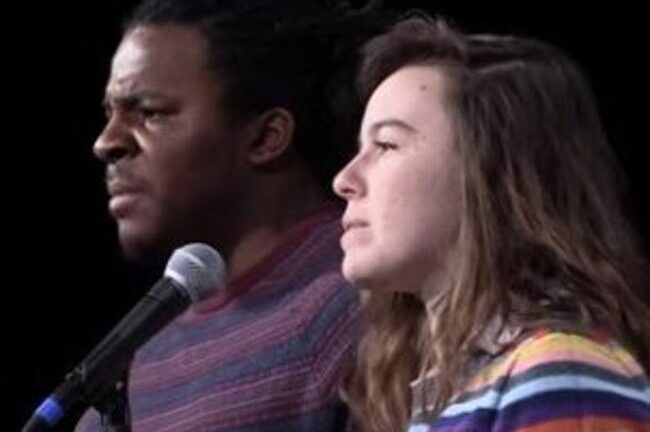
“The first day I realized I was black…’’ starts Scout Bostley—a white woman.
No, she’s not the next Rachel Dolezal. She’s a spoken word artist who, with Darius Simpson, recently performed a poem called “Lost Voices’’ to discuss white and male privilege.
But instead of sharing stories from their own lives, Bostley and Simpson speak for each other, allowing them to say more than they would usually, blatantly be able to. It’s a powerful commentary on privilege as Bostley and Simpson silently mouth along to their own stories.
In the video, Simpson and Bostley stand on stage at the 2015 College Unions Poetry Slam Invitational and each take a deep breath before switching mics and speaking for the other. Bostley speaks for Simpson, sharing his experience as a young black man.
“The first day I realized I was black it was 2000,’’ she says. “We had just learned about blacks for the first time in second grade, at recess all the white kids chased me into the woods chanting ‘slave.’’’
Simpson tells Bostley’s story of what it’s like to be a woman.
“As a woman I’ve learned to answer to everything except my name,’’ Simpson says, while Bostley mouths his words. “‘Little Lady’ is not said to mean equal, but to make sure I remember my place. I battle between wanting to own my body and accepting there is a one in four chance a man will lay claim to my skin.’’
Throughout the performance, they speak together to punctate certain lines. But at the end, they finally speak for themselves.
“I fight so my voice can be heard,’’ Bostley says. “I fight for the voices you silence all in the name of what is right.’’
Summer TV shows worth the hype
[bdc-gallery id=”319348″]




To comment, please create a screen name in your profile
To comment, please verify your email address
Conversation
This discussion has ended. Please join elsewhere on Boston.com