How to deal when your dog is terrorizing the neighborhood
"Letting your dog loose in a park or in your neighborhood is really the equivalent of letting your 2-year-old play in traffic."
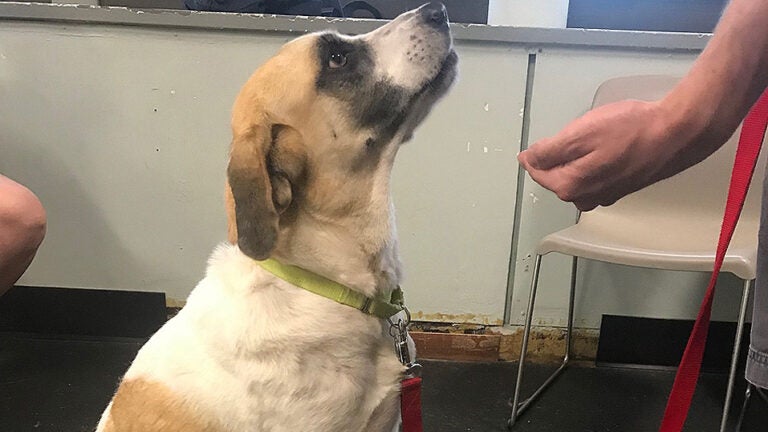
Is your pup terrorizing your neighborhood?
If so, it’s your job to get your animal under control, said Terri Bright, director of behavior services at MSPCA-Angell in Boston.
“You’re the pilot for that dog,” Bright said. “You’re in charge of that dog’s behavior. A good metaphor is to say that a dog is like a 2 year-old child — forever. You don’t let a 2-year-old child just run around. You arrange their behavior. You keep them safe.”
MSPCA-Angell offers about 50 dog classes a week at its Boston and Waltham locations on topics such as obedience, agility, and puppy socialization. Bright offered the following four tips for improving your dog’s behavior.
1. Examine your own behavior.
Sometimes a dog’s bad behavior is the result of its owner’s bad decisions, Bright said.
For example, do you let your dog run free around your neighborhood?
“Having your dog loose and not under your control is the absolute worst thing that you can do in your community,” Bright said. “Letting your dog loose in a park or in your neighborhood is really the equivalent of letting your 2-year-old play in traffic.”
Dogs should always be on a leash, she said.
Also, you should read the body language of your neighbors when out in the neighborhood with your dog, Bright said.
“As you’re walking your dog, is that person who is six to 10 feet away from you, are they looking at your dog like, ‘Oh I love dogs and I want to pet that dog’? If that person’s eyes are wide and they look kind of scared, then do not inflict your dog upon them. Cross the street or have your dog sit when they walk by.”
Also, make sure you pick up after your dog when it defecates and don’t let it urinate on someone’s lawn, Bright said. These are all ways you can help your dog be a better neighbor.
2. Figure out whether your dog is a candidate for obedience class.
How do you know if your dog needs an obedience class?
“If you’re walking down the street with your dog and they’re basically pulling your arm out of the socket, then you could really use a class,” Bright said. “Because the teacher is going to tell you, ‘Here’s what you should do to make your dog pay attention to you, to make you more important to your dog than what’s in the rest of the world.'”
But is your dog a good candidate for a class?
“Every dog can enjoy training,” Bright said. “The only dogs that are not well suited for the classroom are dogs that are very fearful of new situations and are fearful or aggressive toward other dogs or people. People with dogs like that should call and make an appointment with one of our qualified behaviorists.”
Obedience classes will teach your dog how to stay, come when called, lie down, sit, and more, Bright said. Dogs also learn things like the “gracious greeting,” which is how to stay seated if they want to be petted by someone, she said, and how to “leave it,” which means a dog disengages from whatever it currently wants and focuses on its owner instead.
3. Know dog park etiquette.
When you go to a dog park, you need to get to know the people and dogs around you, Bright said. Make note of who controls their dogs and whose dogs are problems, she said. You need to make sure your dog will come to you when you call it, she said.
“Go in with some skills,” she said.
And examine whether your dog even belongs in a dog park, Bright said.
“If your dog has been in a dog fight, your dog should not be in a dog park,” she said.
Always stay alert while at a park, Bright said.
“I call dog parks ‘crime school’ because so many dogs learn to defend themselves and to fight with other dogs,” Bright said. “Because the dog parks are overcrowded, the dogs are doing things they shouldn’t, and the people are on their phone or talking to each other. So, again, you need to control your dog and your dog’s behavior and that includes watching the entire environment around them at all times and getting them out of trouble.”
4. Don’t ignore your dog’s incessant barking.
“If your dog is barking in the back yard, please go bring your dog inside,” Bright said.
If your neighbors report that your dog is barking all day while you aren’t home, your dog may have separation anxiety, Bright said, and you should consult a behaviorist.
It’s a good idea to record your dog while you aren’t home so you have details for the behaviorist, she said. For example, you may discover that your dog is crying, trying to escape, panting, or drooling, all of which are evidence of anxiety, Bright said.
You can call a behaviorist and he or she will ask questions that help to discern whether your dog has separation anxiety, Bright said. Your neighbors will thank you for it, she said.
“It’s just so unfair to have to listen to another dog bark,” Bright said. “It shows that the dog is not being cared for as well as it should.”