
Sign up for the Today newsletter
Get everything you need to know to start your day, delivered right to your inbox every morning.
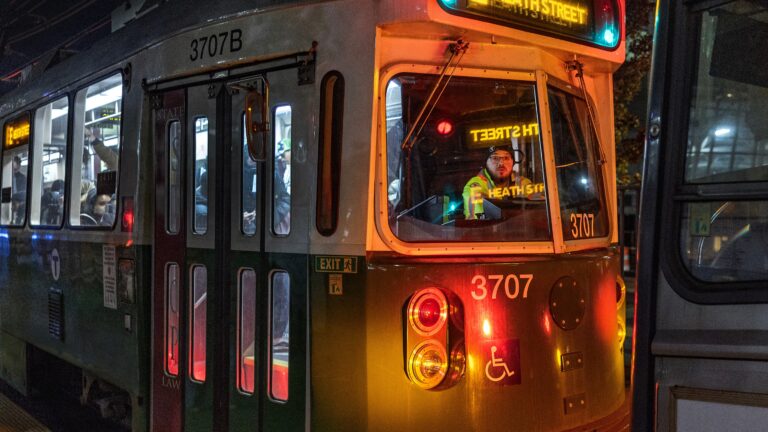
The Green Line is notorious for its piercing screech — a sound so quintessentially Boston that everyone loves to hate it.
In March, a Boston Globe report found that some stations hit over 115 decibels, which is on par with sandblasting or a loud rock concert. The worst offenders were Boylston Station, Government Center, and Park Street, which all are on the Green Line. In addition to being annoying, those noise levels can trigger stress responses and hearing loss.
While riders might agree the T could stand to be quieter, the solution isn’t so straightforward. The MBTA has tried lubrication and new technology, yet no single solution can dissolve the Green Line’s sound.
The MBTA follows federal OSHA hearing-protection standards (29 CFR 1910.95) and offers a Hearing Conservation Program for employees, MBTA communications manager Maya Bingaman told Boston.com in a statement. “We recognize that some stations can be loud, especially at stations with sharp curves,” Bingaman said, noting that the MBTA’s track infrastructure was designed and built over a century ago. The MBTA, after all, launched the country’s first subway in 1897.
Noise levels vary widely by train and station, and is caused by a number of factors, says Caitlin Allen-Connelly, executive director of advocacy group Transit Matters. She laid out five main factors that contribute to the noise:
Noise levels are intensified in crowded underground stations like Boylston, Haymarket, and Park Street. More trains mean tighter space, sharper turns, and additional guardrails., all of which increase squeaking, MBTA’s chief engineer Erik Stoothoff told GBH in 2022.
The physical design of Green Line train stations also plays a big part in increasing noise. The infrastructure dates back more than a century and the Green Line specifically is the oldest in the country, which makes substantial changes difficult beyond lubrication.
Increasing track lubrication and water sprayers can dampen the noise. “We encourage the MBTA to immediately prioritize the expansion and consistent maintenance of track lubrication systems, a simple, cost-effective solution that will significantly reduce noise and improve the quality of life for everyone who relies on the T,” Allen-Connelly wrote in an e-mail.
The T has also installed sound-dampening technology and greasers to its newer cars, according to a statement from Bingaman. She encouraged riders to share feedback and concerns through the MBTA’s online customer support portals on mbta.com and the MBTA See Say App.
Get everything you need to know to start your day, delivered right to your inbox every morning.





To comment, please create a screen name in your profile
To comment, please verify your email address
Conversation
This discussion has ended. Please join elsewhere on Boston.com