
Get the latest Boston sports news
Receive updates on your favorite Boston teams, straight from our newsroom to your inbox.
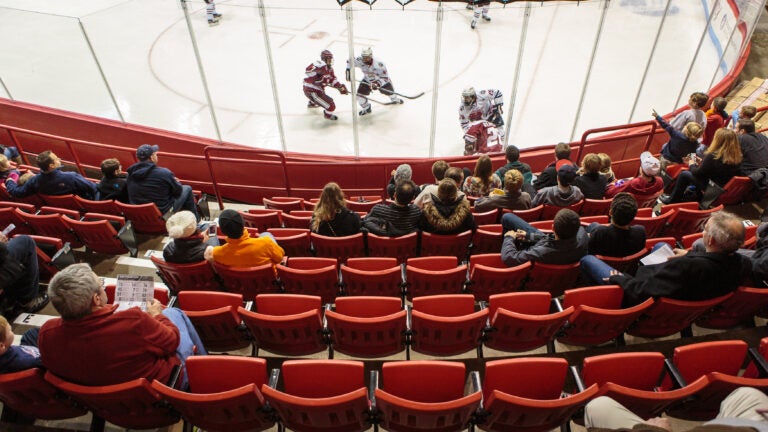
Boston is a college hockey town, one of the biggest in America. Its legacy is as old as some of the universities themselves, but how did one city produce some of the best college hockey programs in the country — and how was it all under one rink?
Hockey’s roots in Boston date back to the 1880s, when locals played early versions of the sport known as roller polo, and then ice polo. By the late 1890s, the ice polo was growing in popularity at area high schools, Harvard, MIT, Tufts University and Boston College.
The hockey style that’s played today then took root, according to Stephen Hardy, author of “How Boston played: Sport, recreation, and community, 1865-1915.” The “Montreal” version introduced face-offs, offsides rules, and more puck control.
In 1897, Boston’s first organized hockey players — graduates of Harvard, MIT, and Brown University— formed the Cambridge Ice Polo and Hockey team. They played both outside and indoor games, a more “scientific” evolution of the ice polo style, Hardy said.
The transition from ice polo to hockey was “just sort of a natural evolution,” said Tom Burke, author of “Tales from the Boston College Hockey Locker Room.” Burke also happens to be the nephew of former Boston Bruins owner original Boston Celtics owner Walter Brown and grandson of original Boston Arena manager George V. Brown.
As outdoor play proved limiting, demand grew for an indoor rink. By 1909, construction began on Boston Arena (now Matthews Arena), designed by Brookline native George C. Funk. Despite the arena burning down in 1918, its rebuild was a priority for Boston given its popularity. “It was seen as an important civic project,” said Burke.
With the largest ice surface of its time, Funk later went on to design the Boston Garden and has been credited for helping grow ice hockey’s popularity in the United States.
As hockey took off in Boston, the arena booked up with games from high school, recreational, professional, and collegiate teams. It meant that the college teams practiced together and, at points, there were even double booked games. This meant that two teams would play the first period of one game, then another two teams would play their game’s first period so as to maximize time on the ice.
“I wouldn’t have wanted to be George V. Brown,” said Hardy, referring to Burke’s grandfather and the original manager of the Boston Arena.
By 1929, Harvard University, Boston College, Boston University and Northeastern University all called the arena home. Collegiate hockey rivalries flourished as the four Boston teams practiced on top of each at odd times of the night.
In 1952, in an effort to boost ticket sales over the winter break, the arena hosted the first ever Beanpot. The tournament was eventually named after Tony Nota, the arena’s timekeeper, found a beanpot at a local store to use as a trophy, Burke said.
“The Beanpot was never on TV. And it was probably the toughest ticket in Boston. Because if you were going to see a Beanpot, you had to be there,” Burke said.
In 1962, Boston Arena also hosted the first ever Eastern College Athletic Conference championship. And in 1979, Northeastern bought the arena and later named it Matthews Arena after George and Hope Matthews.
It was the packed rink that eventually led the college teams to build rinks closer to home. Harvard University, the first one to call it home, left in 1956, followed by Boston College in 1958, and Boston University in 1971. Now, Northeastern will officially be the last host of the storied hall.
In May 2024, the university announced plans to close the arena and build a new multi-purpose athletics facility in the same location that will open summer of 2028. In response to a Boston.com inquiry, Northeastern said it had not yet confirmed the date that Matthews Arena will be taken down, but the last scheduled game in the arena is Dec. 13.
“It’s the last arena of its type. We will never see its like again. You’re never going to see an arena built like that,” Burke said.
Boston’s deep history as a university and college town created the perfect environment for college hockey to thrive, according to Hardy. Hockey has just been around for a long time in the city, he said.
Matthews Arena is hosting its final season starting in October. Each of the four original college programs will be returning to the ice one last time.
Correction: This story previously misstated when Boston College and Boston University departed the Boston Arena. They left in 1958 and 1971, respectively. We regret the errors.
Receive updates on your favorite Boston teams, straight from our newsroom to your inbox.




To comment, please create a screen name in your profile
To comment, please verify your email address
Conversation
This discussion has ended. Please join elsewhere on Boston.com