
Tell us: Should Boston have a guaranteed basic income program?
Boston officials proposed a program that would provide a temporary guaranteed income program for low-income residents.
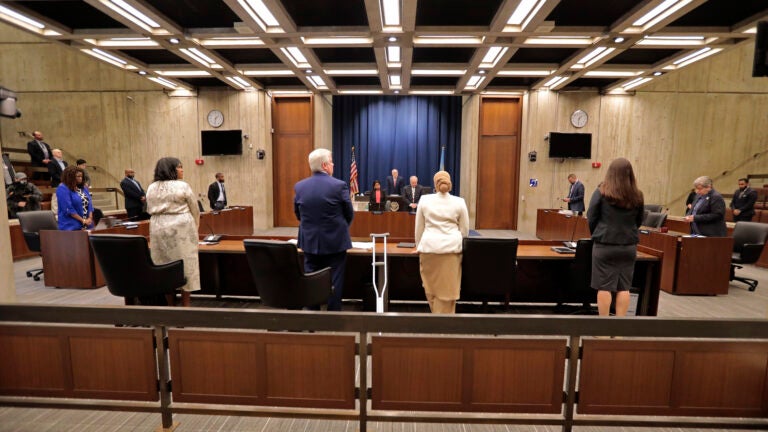
Last week, Boston city councilors and officials from Mayor Michelle Wu’s administration held a hearing to discuss a guaranteed basic income pilot program for low-income Bostonians.
Guaranteed income involves “routine cash payments that are often unconditional or with very limited conditions,” according to Elijah Miller, the director of policy for the city’s Office of Economic Opportunity and Inclusion, who spoke at the hearing.
“The goal is to get people the cash they need on a regular basis where it’s predictable, it’s reliable and allows people to improve their situations,” he said.
The proposal is still in the early stages of consideration, but it would help the nearly one in five Boston residents who are living below the poverty line.
Just under 19% of Boston residents are living in poverty, and the child poverty rate is 27.7%, according to Boston City Councilor Kendra Lara, who sponsored the hearing. Women between the ages of 18 and 24 are the largest demographic living in poverty in the city, and most of those living in poverty are people of color.
“We know that poverty is a policy failure, as we have seen so many times, that requires a policy solution,” Lara said Wednesday. “I think that, as a council, and as a city, we have a responsibility to ensure that we’re taking care of our most vulnerable residents.”
Similar programs have been piloted in two Greater Boston cities, and have shown promising results. In 2020, more than 2,200 households facing food insecurity in Chelsea were selected by lottery to receive $400 a month for nine months. Sixty-five percent of the funds were spent on food and the program “largely achieved its goals,” a 2022 report from the Harvard Kennedy School found. The city continued the program from January through March 2023.
And in Cambridge, a pilot program sent direct payments of $500 to 130 single-parent, low-income families. The program, which started in 2021, continued in 2023 and is set to cover roughly 2,000 low-income families.
“The program has been really successful so far. We’ve been hearing from other cities around Massachusetts asking for advice for starting their own program,” Cambridge Mayor Sumbul Siddiqui said at the hearing.
However, the proposal has faced skepticism from local officials like City Council President Ed Flynn.
Flynn said Boston needs “to ensure that we provide basic city services and public safety for our constituents,” and that the “city needs to prioritize paying better salaries for our city employees in order for us to find and maintain talent” before putting funding toward a guaranteed income program.
“We would need significant funds for a universal basic income program. At this time, I don’t think we should experiment with the program,” he said.
Meanwhile, Mayor Wu has expressed concern that the proposed pilot doesn’t go far enough. In appearances on WBUR’s “Radio Boston” and B87FM’s “Notorious in the Morning,” Wu questioned the need to run a pilot program at all, given the proven success of the Chelsea and Cambridge programs.
“Of course, people use money on things that they need in their daily lives. We know that. We don’t need to test it anymore, we don’t need to pilot this or that,” Wu said on B87FM.
“How do we get something that we can actually sustain and scale and touch everyone? For me, I want to make sure that’s actually infrastructure building rather than dropping in some resources which will be very, very helpful for those small groups of families who can access it but then evaporate because the pilot ends,” Wu said on WBUR’s “Radio Boston.”
Proponents of the program said funding could come from philanthropic partners, nonprofits, and contributions from universities and medical facilities in Boston, though there are questions about how sustainable long-term funding would be.
Should Boston have a guaranteed basic income program? Tell us by filling out the form or e-mailing us at [email protected], and your response may appear in a future Boston.com article.
Sorry. This form is no longer available.



Be civil. Be kind.
Read our full community guidelines.To comment, please create a screen name in your profile
To comment, please verify your email address