
Sign up for the Today newsletter
Get everything you need to know to start your day, delivered right to your inbox every morning.
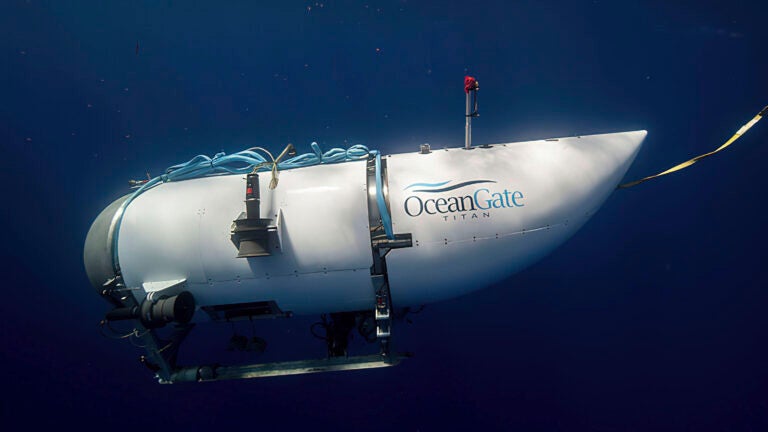
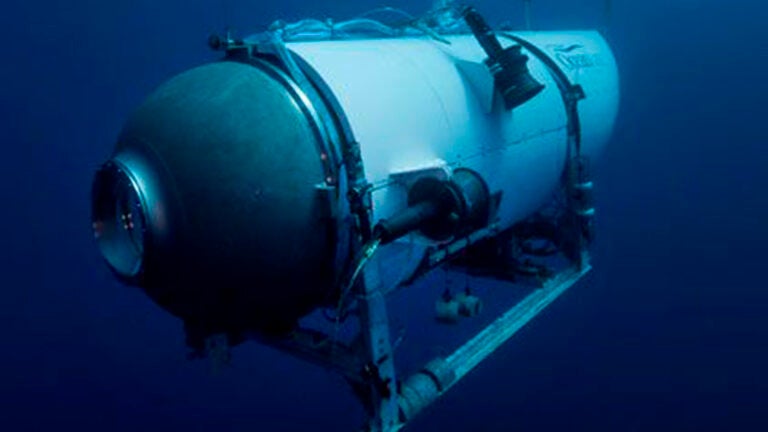
The remains of the Titan submersible, which was the subject of a days-long search, were found on the ocean floor 1,600 feet from the bow of the Titanic on Thursday.
Experts from the U.S. Coast Guard, Canada, Britain, and France searched a swath of the North Atlantic the size of Connecticut for the missing submersible. The Titan disappeared an hour and 45 minutes into a dive to the Titanic wreckage, 13,000 feet below sea level, on Sunday.
Paul Hankins, a salvage expert for the U.S. Navy, said that finding the debris indicated there was a “catastrophic event.”
On Thursday, OceanGate, the company behind the Titan, said it believed the five people on board the sub were dead.
“We now believe that our CEO Stockton Rush, Shahzada Dawood and his son Suleman Dawood, Hamish Harding, and Paul-Henri Nargeolet, have sadly been lost,” the company said in a statement. “Our hearts are with these five souls and every member of their families during this tragic time. We grieve the loss of life and joy they brought to everyone they knew.”
The disappearance has brought attention to an industry of deep sea tourism that is as dangerous as it is expensive. Since the discovery of the Titanic wreckage in 1985, there have been countless trips by researchers and salvagers to its location on the ocean floor, and increasingly, the ultra-wealthy have made the journey as well. The trip, which costs $250,000 and takes eight hours, has raised safety and ethical concerns.
OceanGate had been flagged by industry leaders over concerns about the development of the sub and planned expeditions. The sub hadn’t been independently assessed by industry regulators or risk assessors and previous crew members describe issues with communication during their journeys.
Despite these concerns, OceanGate previously conducted successful expeditions in 2021 and 2022 and had 18 planned for 2023, according to Forbes.
Also of concern to Titanic experts is the damage expeditions like this can do to the wreck. The increased deep sea visits have sped up the deterioration of the century-old ship. Visitors litter the area with trash and sometimes crash into the ship, furthering the damage.
Robert Ballard, the ocean explorer who discovered the Titanic, urged that the site be treated as a memorial and opposed salvage efforts.
“The Titanic lies now in 13,000 feet of water on a gently sloping alpine-like countryside overlooking a small canyon below,” he said in a press conference after the discovery. “There is no light at this great depth and little life can be found. It is a quiet and peaceful place — and a fitting place for the remains of this greatest of sea tragedies to rest. Forever may it remain that way.”
Is it right for companies to lead private expeditions to the Titanic? Those in support of deep sea tourism argue that these trips foster scientific innovation and educate more people on the importance of caring for the ocean, but the risk and moral concerns remain.
Tell us what you think about deep sea tourism by filling out the survey below or emailing us your thoughts at [email protected] and we may feature your response in a future Boston.com article or on our social media platforms.
Sorry. This form is no longer available.

Get everything you need to know to start your day, delivered right to your inbox every morning.




Be civil. Be kind.
Read our full community guidelines.To comment, please create a screen name in your profile
To comment, please verify your email address