
Sign up for the Today newsletter
Get everything you need to know to start your day, delivered right to your inbox every morning.
The Democratic party in 2025 has been notably less combative than during Donald Trump’s first term as president; while there has certainly been pushback to his policies, there’s also a certain calculated restraint this time around.
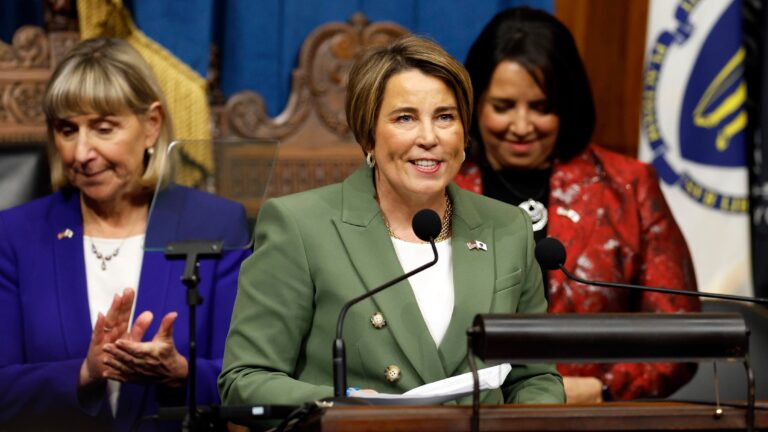
Is it an identity crisis? A reckoning? A “brand problem,” to use Governor Maura Healey’s words in a recent New York Times Magazine interview? Perhaps. But it’s also more complicated than that.
On Tuesday, Trump will address a joint session of Congress, the first in his second term. It’s not a State of the Union speech, although it looks a lot like one. And unlike during Trump’s first State of the Union in 2020, Democratic leaders are opting for a more subtle kind of resistance, in comparison to 2020’s spectacle, according to Politico’s Nicholas Wu.
During Trump’s 2020 State of the Union address, Democratic resistance was undeniably clear: some leaders booed or walked out, while others chose to display their resistance through carefully chosen clothing, and perhaps most notably, Nancy Pelosi ripped up his speech from the podium behind him.
But this time, Democratic leaders aren’t going to take the bait, and said they will focus the attention back on Trump’s policies and their fallout – by inviting guests who have been directly impacted by his policies to attend the address, according to Politico.
The Democratic party’s new approach isn’t a failure, a fear of Trump or the Republican party, or simply an indifference toward the Democratic base; Rather, it’s a new sense of direction, several lawmakers told Politico. Striking the right balance between resistance and collaboration with the president is a tall order, and one Healey said she and other Democratic leaders are grappling with.
“If the president is going to work and support the state of Massachusetts, I will work with the president and the federal administration. When he is not, then I will be the first to stand up and fight for the people of Massachusetts. I think that is probably the attitude of most Democratic governors,” she told New York Times Magazine.
When asked about the party’s brand at large, after losing the election and as frustration sows from the party’s base, Healey didn’t balk from realities the party is facing: “There’s definitely a brand problem. There’s a big brand problem,” she said.
To counter this, she said she’s going to drive home a “Democratic message” to redefine the brand:
“To me, the Democratic brand should be about delivering for everyday Americans. We have the chance to do that, with the foil of Donald Trump cutting all these programs, cutting our military for God’s sake, to free up funding that will pay for the tax cuts he wants to give to billionaires. So what can we do as Democrats? Where do I think we need to go? If I was going to offer advice, it’s to every day, have your north star be: What am I doing for everyday Americans?”
As Trump’s address to Congress and the American people approaches, we want to know: Do you think the Democratic party has a brand problem?
If yes, how should Democratic leaders address or redefine it? What should the party’s posturing be when it comes to resistance and collaboration with Trump?
Tell us by filling out the form or e-mailing us at [email protected], and your response may appear in a future Boston.com article.

Get everything you need to know to start your day, delivered right to your inbox every morning.




To comment, please create a screen name in your profile
To comment, please verify your email address
Conversation
This discussion has ended. Please join elsewhere on Boston.com