
Sign up for the Today newsletter
Get everything you need to know to start your day, delivered right to your inbox every morning.
If you’ve spent any time at all out in Boston’s suburbs, you’ve probably seen them: Sad looking men bent over a rake, facing down a great expanse of lawn strewn with what used to be lush, abundant foliage, but is now just refuse discarded by the empty branches that taunt him from above. He used to have friends, a spouse, perhaps children … He can’t quite recall, because now all he knows is leaves, as far as his watery eyes can see.
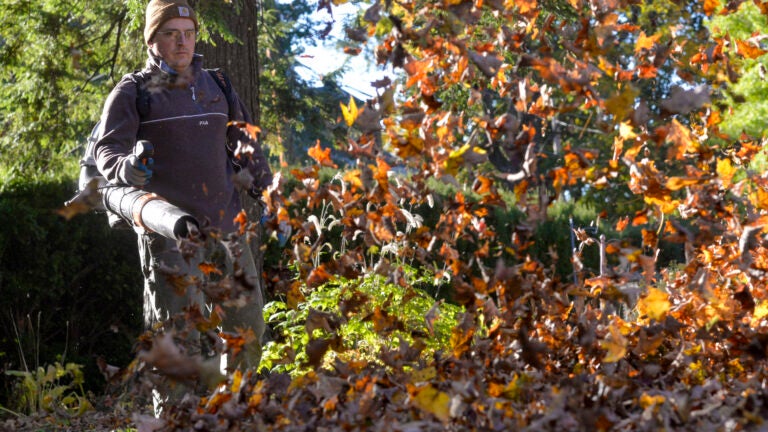
Granted, this scenario might not be entirely universal — there are plenty of sad looking women who rake, for instance, and a sizable number of lawn-owners who take on the task not with a rake, but with a 700 CFM backpack leaf blower, herding leaves like Ghostbusters sucking up spirits with a proton pack. (And drowning out howling dogs, passing trucks, and planes flying overhead while they do.)
And not only that, some of them follow up by bagging, burning, and/or tossing said leaves — these are people who once had weekends! Where they did things! Fun things!

So what’s a poor homeowner to do? Well, don’t worry, we have your back — or at least the Massachusetts Division of Fisheries and Wildlife does. The division has gone out of its way this fall to promote “Leave the Leaves,” its program meant to educate the commonwealth’s rakers that picking up after your trees is a fool’s errand. (We’re paraphrasing but that’s the general idea.)
“Allowing some leaves to remain in your yard can provide benefits for plants and local wildlife,” according to the Division of Fisheries and Wildlife. “When they decompose, leaves return nutrients to the soil. In addition, fallen leaves provide cover and insulation to overwintering insects including many types of moths and butterflies.” You like butterflies, right?
OK, they don’t advocate that you do absolutely nothing, necessarily. Underlying plants and grass can be smothered by too many leaves, they note, so if you’re really inundated you may want to use a rake to spread them out a bit. You can also mow them over and use them as mulch. But picking them all up and carrying them away is really unnecessary, no matter what your neighbors think.
After all, as the Division of Fisheries and Wildlife points out, “Leaving leaves in your yard can save you time in the fall, reduce the need for mulch in the spring, and keeps leaves out of landfills.” They had us with that first part.
How about you? What’s your leaf strategy? Take the Boston.com poll below, or email [email protected], and we may feature your response in an upcoming article.

Get everything you need to know to start your day, delivered right to your inbox every morning.





To comment, please create a screen name in your profile
To comment, please verify your email address
Conversation
This discussion has ended. Please join elsewhere on Boston.com