
More than 2,800 readers voted, here’s why student protestors should be granted amnesty
Readers and experts weighed in on what should come next for student protestors.
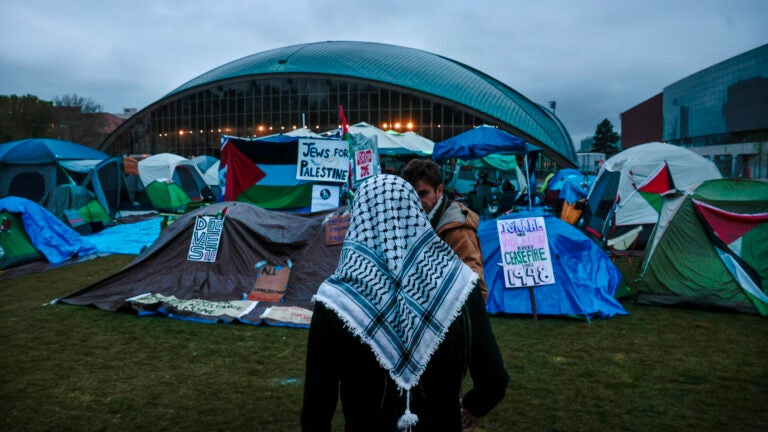
Student encampments of pro-Palestinian protesters on college campuses across the country in recent weeks have left several schools in Greater Boston grappling with the arrest and suspension of students.
Encampments at Northeastern and Emerson College were shut down by the university and Boston Police last week, with 100 people arrested at Emerson and 100 detained at Northeastern.
Harvard, Tufts, and MIT encampments currently remain active, although university officials have said students at the respective schools must take down their encampments as commencement approaches.
While Emerson will not bring disciplinary action against the protestors and encouraged the district attorney not to pursue charges, some other local schools have indicated disciplinary action, which include suspension, ban from graduation ceremonies, and administrative sanctions.
What should happen next for student protestors?
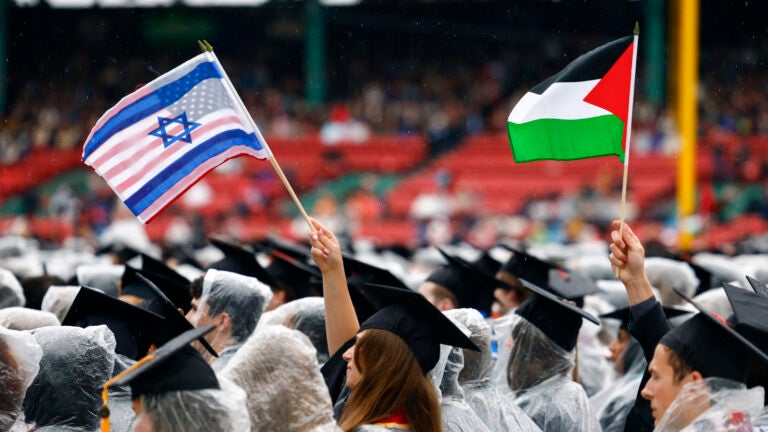
Some protesters are calling for amnesty, fearing that their arrest or suspension could impact their academic and professional futures. And an overwhelming majority of Boston.com readers agree.
When we asked readers if the protestors should have their arrests and suspensions scrubbed from their record, the overwhelming majority (91%) of the more than 2,800 respondents to our poll voted “yes.”
Many Boston.com readers in support of amnesty for protesters said they shouldn’t face repercussions for exercising their Constitutional rights to freedom of speech.
“Students should not be penalized for exercising their right to free speech and protest as long as their actions are peaceful. They shouldn’t be punished for their political views that may be unpopular or controversial,” reader Sandy from Salem said.
Sarah from Fenway agreed, saying the protesters are “engaged in deeply ethical acts of civil disobedience to express their disagreement with the government,” adding that she believes “universities turning against their own students is a dereliction of duty.”
What does the First Amendment mean for campus protesters?
When it comes to protesting on college campuses, freedom of speech protections exist, but they can get murky – especially here in Massachusetts.
If a student was on public land and wasn’t threatening anyone, they would often be protected under the First Amendment, according to Andrew Sellars, a clinical professor of law at Boston University and a former First Amendment fellow at Harvard Law School.
Where free speech protections get much more complicated is speech that’s being conducted on private land, and speech that involves encampment, he told Boston.com in an interview.
“We can extract away ‘place’ and just think about what they’re doing: calling for political reform, calling for divestment of universities from military groups that are supporting Israel in the war. That’s all protected speech, in pretty much every case we can think of, even if it may shock or concern or offend the people around them,” he said.
The trickiness of free speech protections gets even more complicated on urban campuses like those in Boston, where the lines between private and public spaces can become blurred. “You’re going to have a lot of mixed land, land that is city owned and land that is privately owned,” Sellars said.
This blurriness came to light last week at Emerson College when Boston Police arrested 118 protesters at an encampment set up in Boylston Place Alley. The move was harshly criticized by the student body, with the Student Government Association issuing a vote of no confidence in the school’s president and calling for his resignation.
Emerson College President Jay Bernhardt said in a statement that the alley encampment was cleared because it was “not solely owned by the college, has a public right-of-way requirement to access non-Emerson buildings, including the State Transportation Center, and is a fire alley that is under the jurisdiction of the Boston Police Department.”
To make matters more complicated, the public or private status of a university is also a factor when it comes to protected speech. State actors – such as public universities – are bound by the First Amendment, meaning their ability to deter speech is going to be more limited than at a private university, which often has its own freedom of expression limitations and protections in their governance documents.
Should universities drop disciplinary actions for student protesters who were engaged in lawful speech activity? Sellars said he “feels strongly” yes.
“I, for one, hope my students grow up to be very active voices on social issues that define our time. Here’s a group of students that are doing exactly that. They’re challenging the institutions around them, they’re calling for a better world. Why wouldn’t we encourage that?”
Lara Jirmanus, a member of the Harvard University chapter of the national network of Faculty and Staff for Justice in Palestine and a clinical instructor at Harvard Medical School, agreed. She said protesters who have been arrested or face disciplinary actions deserve not only amnesty, but also respect for their civil disobedience.
“This is not a bunch of kids milling around in front of a concert. These are very serious demands that they’re having. And, to be frank, the students are actually teaching us a lesson about how to hold elected leaders accountable,” she told Boston.com in an interview.
To those critical or skeptical of calls for amnesty, Jirmanus said she believes the protesters are being unfairly vilified for their actions – while our democracy hangs in the balance.
“When your democracy fails, you and your institutions fail you, sometimes you have to walk outside of normal pathways to achieve social change. And that’s what the students are doing,” she added.
Should student protesters be granted amnesty? Here’s what readers said.
Below see a sampling of readers sharing their thoughts on student protestors and being granted amnesty. Responses have been lightly edited for grammar and clarity.
‘They should be applauded for their bravery and perseverance’
“Freedom of speech and peaceful protest are not crimes. They should not be punished for speaking truth to power.” – Nathaniel H., Brighton
“These students are peacefully protesting to bring attention to the grave injustice that is happening in Palestine. They should be applauded for their bravery and perseverance. Students should not be punished or put in harms way for standing up for a just cause.” – Iman M., East Boston
“Freedom of speech is a fundamental right guaranteed by the First Amendment. You may agree or disagree with the students’ way of protesting and what they have to say, but still you have to listen and respect them. As long as there is no violence and no serious threat to the community, they have the right to express their opinions. Universities should stick to academics and not go after students.” – Emad A., Boston
“When I was at UMass Amherst in the spring of 1970, there was a student strike to protest the Vietnam War which the administration encouraged by allowing classes to be canceled and a ‘pass’ instead of a letter grade could be given. There were no threats of police actions, expulsion, etc. as there are now. These students should be praised for their actions!” – Nancy G., Cambridge
“The school administrations, in every case, have escalated rather than defused the situations. They shouldn’t compound their mistakes by pursuing disciplinary action.” – Sebastian S., Cambridge
“Protesters are pushing for divestment from their administrations (among other demands), and the administration won’t even negotiate. The very least administration can do after calling police to arrest their own students is clear the student records of suspensions and arrests. This should also extend to the non-student community members who have been supporting the student protests.” – Anna H., Boston
“The demonstrations for Palestine have been peaceful, inspiring, and welcoming to all. The students do not deserve to lose their access to the school because they’ve been standing up for human rights. Universities can’t expect to teach their students to stand up for what is right and speak out against oppression and then get mad when the students follow their teachings.” – Kristen C., Jamaica Plain
“Peaceful protest is the foundation of our country, dating back to the American Revolution. My own time in college was marked by anti-war protests against the wars in Iraq and Afghanistan. We must nurture the voice of young adults who are standing up for their beliefs.” – Huma F., Needham
“The students should be able to exercise their first amendment rights without fear of expulsion or lasting legal ramifications. Silencing the protesters will cause more dissent and making people feel othered. If we want our young people to understand and listen to other viewpoints then we should listen to theirs.” – R., Needham
“This country was born through protest & nonviolent civil disobedience, a sacred tradition in our history and culture along with the expectation not only if freedom of expression but also academic freedom to explore and embrace unpopular and new opinions. These practices should not be repressed. Universities have a moral obligation to enter into dialog with their constituent students and faculties and to exhaust good-faith negotiations that include seriously exploring their concerns before they become demands by being ignored, devalued, dismissed.” – Linden J., Cambridge
‘They are on private property and must abide by the rules of the universities’
“If you ignore the warnings to vacate and don’t follow through, you get what you get. Welcome to the real world.” – Dan, Boston
“They are adults, and these colleges are private universities, not public ones. As such they are on private property and must abide by the rules of the universities. No one expunged those arrested in the Vietnam riots.” – Anthony P., Medford
“They are adults. Actions have consequences. As Martin Luther King wrote from the Birmingham jail regarding civil disobedience: “One who breaks an unjust law must do it openly, lovingly, and with a willingness to accept the penalty.” They are now at the penalty part.” – Brian, South Boston
“Warnings were given in advance of arrests. The students ignorantly assumed there would be no consequences for their actions and refused to listen. If they believe strongly enough in their actions they should be willing to accept the results.” – Alex, Roxbury
“If a student chooses to participate in a protest/ civil disobedience they should be prepared to accept the consequences of their actions. All the protesters were give ample time to clear the area.” – Jennifer D., Southborough
Boston.com occasionally interacts with readers by conducting informal polls and surveys. These results should be read as an unscientific gauge of readers’ opinion.




Be civil. Be kind.
Read our full community guidelines.To comment, please create a screen name in your profile
To comment, please verify your email address