
‘They deserve a fair and level playing field at the negotiation table’
Fifty percent of readers think teachers "deserve a fair and level playing field at the negotiation table."
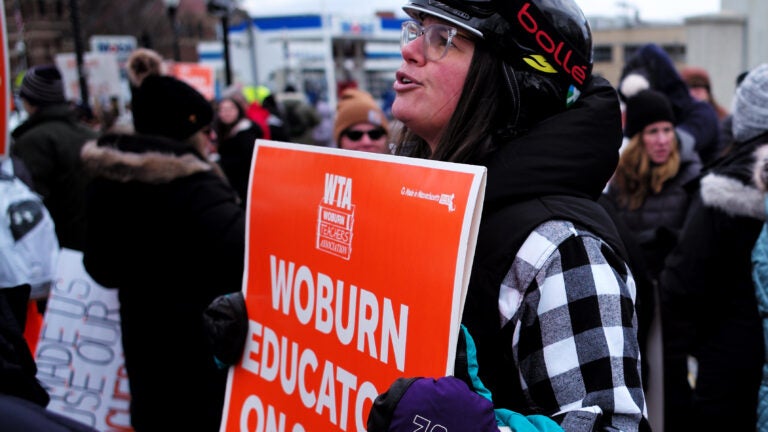
Teachers across the state are pushing for public employees to have the legal right to strike, and Boston.com readers are just about evenly torn about whether the Bay State should let that happen.
“The right to strike is one of the most fundamental, central rights of workers, collective action by workers that we have,” State Sen. Becca Rausch told Boston.com. “And [we’re] seeing that importance play out recently where results are swifter and more effective and more beneficial to students and families where strikes have occurred or where strikes have been voted on to occur and then a negotiated result happens very quickly.”
At the start of the year, a teacher strike in Woburn caused schools to shut down for five days. The teachers made the decision to strike after more than a year of failed negotiations. Because the strike was illegal, the union is now facing $85,000 in fines from the state, plus $225,000 in damages to the city over four years, according to the Boston Herald.
The Massachusetts legislature is currently considering a proposal that would make the actions of the teachers in Wobrun, and elsewhere in the state, legal. The legislation would allow unions to legally strike after six months of failed negotiations with their employers and is backed by the Massachusetts Teachers Association, which has made the right to strike one of its legislative priorities for 2023-2024.
We asked Boston.com readers if they think public employees should have the right to strike, and 50% of the 210 readers polled said yes across the board. A small handful of people said that public employees, excluding teachers, should be allowed to strike, and another 47% believe that it should remain illegal for public employees to strike.
Those against giving public employees like teachers the right to strike say doing so would go against the best interests of the public, particularly parents and children. Both the Massachusetts Association of School Committees, State Education Commissioner Jeffrey Riley, and Gov. Maura Healy are opposed to the idea.
Supporters, however, have emphasized that public employees deserve the same work protections and fair wages as private-sector workers. They’ve also rejected the idea that a teacher strike would be bad for families.
Below you’ll find a sampling of responses from readers sharing why they think teachers and other public employees should or shouldn’t be allowed to strike.
Responses have been lightly edited for length and clarity.
Do you think Massachusetts should legalize the right to strike for teachers and other public employees?
Yes for everyone.
“Teachers should teach. But if teachers are going to be held hostage by legislation, then they need to have some leverage. They are already abused and treated horribly by town administrations and superintendents who believe they have them over a barrel.” — E.D., Taunton
“If an agreement has not been made after six months, I struggle to believe those negotiating against the union are doing so in good faith. If the union can’t legally strike, it opens the door to string along the negotiations with an outdated collective bargaining agreement. Making strikes illegal tips the scales of power in one direction when the whole intent of the union is to have an even playing field at the negotiation table.” — Sean, Boston
“We the nurses understand and stand with the teachers! Teachers are an under-appreciated and vital part of our society. Pay them what they deserve for all they endure. With all the school violence reports, they put their lives on the line every single day just like policemen minus the protection of weapons just to help our children toward a better future. And no teacher should have to use their own money to ensure the classroom has adequate supplies. Give our teachers and children what they need for success.” — Krystina, Norwood
“Today, teachers are so undervalued in the U.S. Once, it was one of the only professions women could easily join. Also, it matched with their own kids’ holidays. It provided schedule flexibility. The teaching profession depended on well-educated bright women who worked for low pay. Times have changed. Women have many other options today. In the U.S., teaching does not command decent pay. It does not command respect. Compare the teachers’ position in the U.S. with that in Finland. Unfortunately, the US is a culture that equates salary with respect and appreciation.” — Katherine S.
“They deserve a fair and level playing field at the negotiation table. Their contracts are well below the cost of living increases and other benefits that non-public employees enjoy. Time to pay up and treat them with respect!” — Jen, Attleboro
“Without the right to strike, teachers’ unions have no real bargaining power. Arguments against providing the right to strike are fallacious. Of course, students and parents would be affected in the short term were teachers to actually go out on strike but not in the long run. With a right to strike, teachers will be able to negotiate better contracts and more appropriate salaries, better working conditions, and class sizes, which in turn will attract and retain better teachers to the benefit of students and parents. Should a strike occur, teachers are no more responsible than school committees for interrupting the educational process.” — David G.K., Camden
“If districts were amenable to open bargaining where negotiations take place in a public forum, community members and taxpayers would see just how reasonable most teachers’ contractual asks are. Basic amenities, supplies and time to design quality curriculum for our students are not big asks. Compensation that approximates the cost of living is not a big ask. And most importantly, the right to strike when there are programs and structures in place that are harming students and families and dissuading educators from remaining in the profession is integral to maintaining and attracting talented and dedicated people in a job no one seems to want to engage in after COVID. The fact is, a strike is the closest thing to open bargaining, in that the community actually learns about the working conditions and issues affecting, in the words of the Supreme Court, the single most important function of government: education.” — Liz D., Woburn
“Parents want teachers to somehow teach their students with no funds, no adequate coverage, and for extremely low pay. The pandemic showed parents just how difficult it is to teach children, and it’s mind-boggling they STILL don’t want teachers to be fairly compensated. Teachers usually take multiple jobs to break even. They buy their supplies and room equipment from their own paychecks or create Donors Choose pages for them. That’s absolutely criminal. Stop demanding the most from people while paying them poverty wages. This is the reason teachers are quitting.” — Cassie, Framingham
No.
“It is always about more money. Striking after the government forced lockdown is holding the taxpayers and more importantly the students hostage. This is a greedy deplorable action and is illegal!” — Jim, Boston
“Teacher strikes impact poor families the most. Parents who are first responders or healthcare workers or in service jobs would suffer greatly.” — Steve M., Canton
“There are industries and situations in which striking makes sense — jobs that are hazardous and have low pay. However, when an industry like teaching is supported by public tax dollars but negotiated by others, then the strike hurts a third party that has no voice in the negotiations. A teacher’s strike is not “in the interest of children.” They do not teach better when they are paid a higher salary. Striking is disruptive and confusing for children and should not be legal.” — J.M., Melrose
“By allowing striking, we allow the teachers to hold the gun to the head not just of the people they are bargaining with — the district — but also to all of the parents and children in the district. If the voters of the district are uniformly supportive of teachers’ demands in a dispute, then it is incumbent on the district to serve those constituents as they were elected to do. Of course, it is possible that the degree of support is overstated once the costs are known, in which case the district can handle that as well.” — Rian W., Chelmsford
“Because they don’t care about the kids. Children should come first. Why do we always put the kids last?” — John S., Boston
“Public employees should not even be allowed to form unions. It yields corruption. Public employee unions fund and support politicians who are supposed to negotiate with them on behalf of taxpayers, not the unions. They don’t. They carry the water for the unions. FDR was opposed to public employee unionization for similar reasons.” — Chris, Boston
Boston.com occasionally interacts with readers by conducting informal polls and surveys. These results should be read as an unscientific gauge of readers’ opinion.




Be civil. Be kind.
Read our full community guidelines.To comment, please create a screen name in your profile
To comment, please verify your email address