
Was the city right to clear the tents at Mass. and Cass? Readers say yes.
More than 600 readers voted. Here’s why they said the city was right to clear the tents at Mass. and Cass.
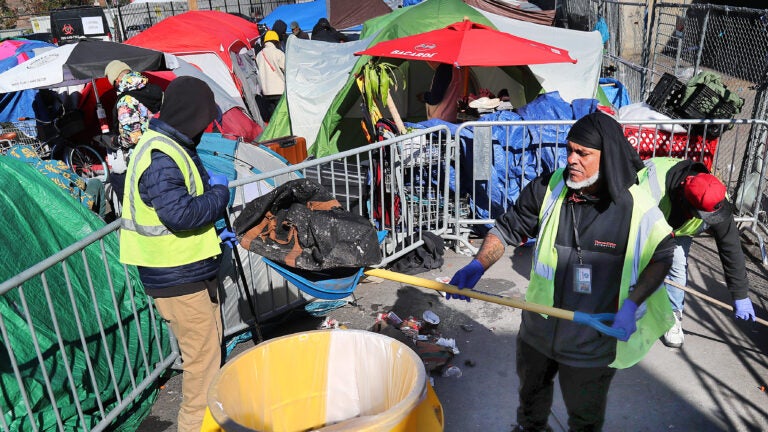
The city has removed the tents at the intersection of Massachusetts Avenue and Melnea Cass Boulevard, an area that has long been plagued by open-air drug use, human trafficking, and violence. Housing has been provided to dozens of people who have been living in the encampments.
Some of the 102 people who had been living in the area were moved out and accepted the city’s offer to be placed in low-threshold shelter beds at 727 Massachusetts Avenue — where 30 transitional beds were made available — while others decided to stay with family, according to WCVB.
The clearing of tents was part of Mayor Michelle Wu’s plan, filed as an amended ordinance, to make Atkinson Street a functioning roadway again. The ordinance allows police to clear the structures after individuals are offered a place to store their belongings, and allocates shelter beds for people being displaced.
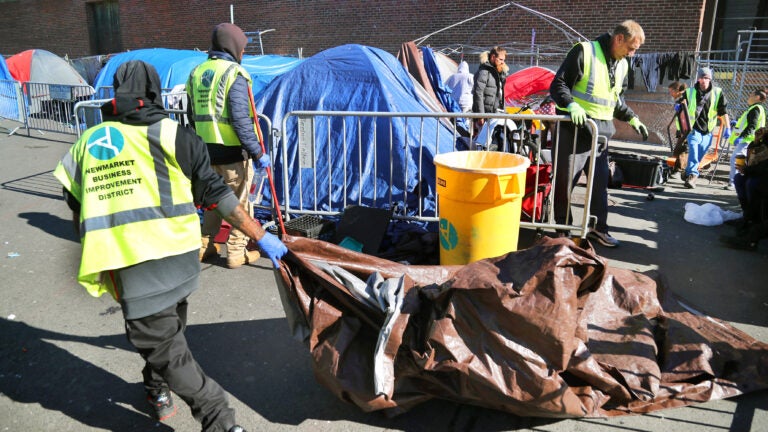
Wu, Police Commissioner Michael Cox, and other officials said that the plan was a response to a surge in public safety concerns at Mass. and Cass that began over the summer.
“We have been committed since November 2021 to trying to show that a different way is possible,” Wu said. “We’ve made progress at every phase, and today will hopefully be the next step that we’re taking, a big one, for the city.”
But there has been long-standing criticism of the removal of tents at Mass. and Cass. In 2021, a coalition of public health, addiction, housing, and civil liberties experts called on Mayor Michelle Wu to take a “health-centered approach” to Mass. and Cass, arguing that “requiring tent removal of the area will cause displacement from services, belongings, peers, medical providers, temporary shelters, and more.”
That same year, the American Civil Liberties Union of Massachusetts filed a suit against the city alleging the tents near Mass. and Cass were unlawfully removed without making sure people had adequate housing options.
“The City’s ongoing displacement actions — which are driving unhoused persons from Mass & Cass — fail to address the immediate and urgent needs of unsheltered residents, and put the health and safety of an already vulnerable population at even greater risk,” the lawsuit read.
We asked our readers if the city was right to remove the tents at Mass. and Cass. Of the more than 600 respondents to our poll, the majority (89%) said the city was in the right and 10% said the city was in the wrong.
Some of those who said yes, such as Ethel A. from Dedham, echoed Mayor Wu’s concerns about the public health and safety of the area. “For the safety of the community at large, yes it is right to clean up the area, rather than continue to enable homelessness and drug use.”
An anonymous reader agreed, emphasizing that by clearing the tents, the residents of the encampments are taken out of an often violent and unsafe environment.
“People in the encampment were suffering from violence and people preying on them. The city is right to provide shelter for them and help them escape the situation,” they said.
And with the winter months approaching, Boston.com reader Tiffany said the efforts to move people into shelters are especially needed and important. “People deserve proper shelter, especially in the cooler months.”
Many of those who voted no said the city needs to address the underlying problems that lead people to become unhoused and experience substance abuse first before removing tents. Otherwise, the same problems will persist and the encampments will reappear.
“[People living at Mass. and Cass] need to get help dealing with their addictions or mental health issues or financial issues or whatever brought them here, so they can move beyond them, get jobs, find housing, find a better life. Otherwise, you are just pushing them from one place to another without giving them any support,” reader Adrienne from Lowell said.
Even with support from the city to move into temporary, low-threshold shelter housing, reader R.A. from Boston pointed out that the shelter system itself does not always provide unhoused people or those experiencing substance abuse with the right solutions.
“Some local homeless shelters only provide a bed one night at a time, meaning every day is a crisis of potentially being not only without a bed but without supplies and support to survive outside on the street for the night because you often can only take very limited belongings into a shelter,” they said. “Restrictive rules in some shelters, such as needing to arrive by the afternoon or early evening, can create barriers for people working, taking classes, or trying to attend medical appointments or 12-step meetings. For people trying to get clean and sober, being in shelters that do not require sobriety can put their own recovery at risk,” they added.
Below you’ll find a sampling of readers sharing their thoughts about the tent removal at Mass. and Cass.
Some responses have been lightly edited for clarity.
Is the city right to clear tents around Mass. and Cass?
Yes
“Other cities in the U.S. have suffered because they have not removed [their] encampments. We don’t want to become another San Francisco or Portland, Oregon.” — Mike L., Danvers
“People in the encampment were suffering from violence and people preying on them. The city is right to provide shelter for them and help them escape the situation.” — Anonymous reader, Boston
“For years the city has done little to address this problem and for years Mass. and Cass has been a hub for open-air drug use, human trafficking, and violence. By forcing its closure, it is helping break the cycle and forcing people who are stuck in addiction to reevaluate their circumstances. While I do not think this would by any means stop addiction, and acknowledge it could hurt some of the people of this population in the short term, I firmly believe the city should not be enabling it to exist and has been making the problem for this community much worse through inaction and constantly looking the other way.” — Jonathan, Holbrook
“I feel for those who genuinely lack the support they need at Mass. and Cass, but the reality is that a city cannot allow encampments like this to take over an entire area of the city without consequences. The thousands of people who drive through the intersection daily are at high risk of hitting the people who wander into the street constantly, it is unsafe for workers at the industrial plants surrounding the intersection and the residents near the BMC. They should be moved to a place where they cannot easily access drugs and other bad influences and receive the support they need, but that cannot happen at Mass and Cass, and they can no longer inconvenience and threaten the area.” — Mike, South Boston
“Years ago, my son-in-law found sobriety on Long Island. He formed friendships that help him stay clean. Has anyone found sobriety at Mass. and Cass? Is that even anyone’s intention? Bring back the Long Island Shelter now!” — Mary F., Cape Cod
“Mass. and Cass invites crime, abets users, and is a threat to public health. Those who live at Mass and Cass should receive medical help and those who complete treatment should be placed in housing, with ongoing support services.” — Cary, Milton
No
“In the midst of a shelter crisis, we’re removing people from their encampments and sending them to find alternate means of shelter? Insanity.” — Christine, Holbrook
“This is inhumane and it’s literally a housing crisis. Clearing their only place of residence isn’t going to stop the homelessness problem, it’s only sweeping it under the rug. Why isn’t there affordable (like actually affordable) housing for people who need help getting off the streets? The city should actually tackle the problem by the roots instead of abandoning people who need support.” — Koko S., Dorchester
“As someone who works in the field of mental health and addiction, I have advocated multiple times and reached out to Mayor Wu’s office multiple times, to explain why this is wrong. So many people within the field have. This displacement will never solve the issue. If anything, it will make the overdoses increase in rapid numbers as we know changing settings can sometimes impact the way the body responds to substance use…it also disconnects a substance user from trusted dealers and it spreads the individuals across the city, making it a more widespread concern and harder for care to access them and them to access care.
“Uprooting individuals while defunding programs and refusing to convert available buildings and areas to shelters and programs is only going to continue to add to the problem and exacerbate the extensive need for care as well as burnout and turmoil within the healthcare system. Stop treating people with substance use disorders like criminals and start treating them as people who need help and care. Addiction is a disease. Not a crime.” — Sam, Back Bay
“This strategy has been tried before and proven ineffective, both in other U.S. cities including Portland, Los Angeles, San Francisco, and Denver as well as right here in Boston with Operation Clean Sweep and former Mayor Janey’s executive order banning tents. All evidence shows camping bans and criminalization do not end homelessness and will not resolve the city-created crisis and circumstances people are surviving in the Mass. and Cass area, and across Boston.
“Mayor Wu should make other strategic divestments including removing the police from what should be a public health plan and instead truly ‘double down’ on evidence-based public health approaches to homelessness and substance use – truly low-threshold affordable housing, community-based harm reduction services including the expansion of syringe service programs and opening of overdose prevention centers, and collaborate with the state to develop evidence-based treatment on demand.” – Cassie H., Allston
“The city could have experimented with enacting a universal basic income pilot program at Mass. and Cass and paying residents of the tents to move. This would’ve been better and more dignity-affirming than using government actors to seize their property, possibly violating their Fourth Amendment rights under the U.S. Constitution. Similarly, acceptance of these relocation stipends could have accompanied a signed agreement with tent encampment residents, stipulating that they would 1) not erect tents and other temporary structures on the public ways of Boston 2) would not return to the area to camp on the streets, but only to seek services, care, and resources located in the Mass. and Cass corridor.” – Mink S., Dorchester
Boston.com occasionally interacts with readers by conducting informal polls and surveys. These results should be read as an unscientific gauge of readers’ opinion.




Be civil. Be kind.
Read our full community guidelines.To comment, please create a screen name in your profile
To comment, please verify your email address