
Sign up for the Today newsletter
Get everything you need to know to start your day, delivered right to your inbox every morning.
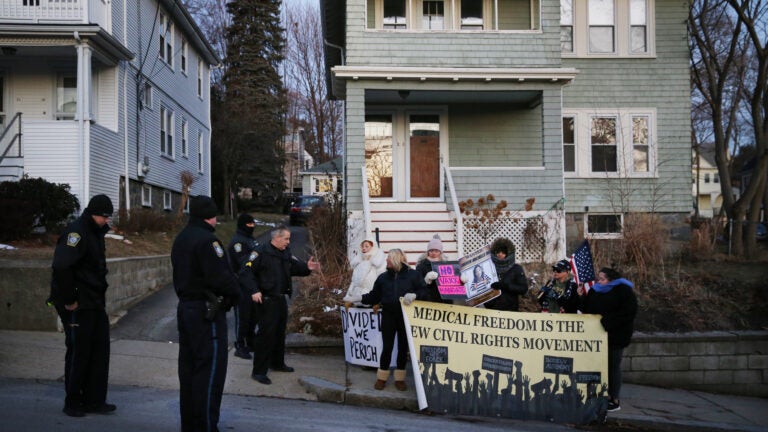
Last week, Boston Mayor Michelle Wu faced pushback for compiling a list of people who have allegedly threatened the mayor.
Wu’s office said the list of 15 names was created in response to a request from the Boston Police Department after an incident at the Dorchester Day parade last year, in which protesters followed the mayor and her family the entire length of the parade harassing and physically intimidating her, according to her press secretary, Ricardo Patrón.
Patrón said the people named on the list weren’t merely critics, but threatened the safety of the mayor, her family, and the public.
“These are people with a long and documented series of violent behavior. Not just critics, or people who disagree with the mayor’s policies,” Patron said.
He objected to calling the list a grouping of “critics,” saying that it’s more than just people disagreeing with her policies or politics.
“This is a list of people who, over the course of several months last year, harassed and physically intimidated the mayor and her family on a near daily basis at their home, at public events, at city events, at parades,” he said. “I just don’t think that calling them critics here fully encapsulates the degree of harassment and intimidation.”
According to The Boston Herald, the list has 15 names, including protesters who picketed in front of Wu’s house in opposition to her COVID-19 policies for several months last year, City Council candidate Christine Vitale, and Patrick Mendoza, a North End restaurant wanted for charges in connection to a recent shooting outside of Modern Pastry Shop.
Some news outlets have criticized Wu for the list, raising concerns that the list infringes on the First Amendment and “crosses the line into using Nixonian tactics to suppress people’s rights to protest,” the Herald wrote.
But findings show that, although political violence against mayors is common, women mayors and mayors of color face more frequent and acute incidents of political violence.
A survey conducted in the fall of 2021 by the Mayor’s Innovation Project found that a whopping 94.5% of all mayors reported psychological violence at least once, with 24.2% reporting at least one threat, and 15.8% suffering physical violence.
Among women mayors of color, 45.7% reported they were harassed at least monthly, compared to 39.7% of non-Hispanic white women, 36.2% of men of color, and 23.4% of non-Hispanic white men mayors.
“As a national network for mayors, this is very concerning – both because it’s a threat to mayors’ personal safety and because of the potential to increase the already striking gender and racial parity gap present among executive elected officials,” Katya Spear, managing director for the Mayors Innovation Project, said in the report.
But some say Wu was wrong to agree to compiling the list, even though it was at the request of the Boston Police Department.
“She should have said, ‘This is not how we’re going to do this. We’re going to do this by rule of law, and we’re going to have an open conversation of transparency with the police department about my safety and my children’s safety and my husband’s safety,'” Jacquetta Van Zandt, a political analyst, told WCVB.
“People have the right to protest. It’s about how the staff went about it, I think is the issue and it’s unfortunate,” Van Zandt said.
We asked Boston.com readers if they thought Wu was being unfairly targeted for sharing a list of names with Boston police. Sixty-three percent of 117 readers who responded said no, she is not being unfairly targeted by opponents, with 37% saying she is being unfairly targeted.
Below you’ll find a sampling of responses from readers sharing why they voted the way they did, and if they have concerns about harassment against elected officials.
Responses have been lightly edited for clarity.
“When you make bold changes in policy, there will be blowback.” – Robert R., Roslindale
“I don’t like the way she has been targeted; however, she is taking the city in a direction most don’t want to go. Bike lanes are more important to her than potholes.” – Philip W.
“It becomes a matter of perspective. What some people like is free speech. What others don’t like is harassment. As a public figure she has to take the good and the bad. The courts are the only ones who can decide if a line has been crossed.” – R.D., Medford
“As an elected official she is in the public eye. As long as the people picketing are not breaking the law, they should be protected by the First Amendment.” – Paul P., Bedford
“You wanted to be mayor. That comes with accolades and criticism. Not everyone is going to agree that you are doing a great job.” – Bill, Charlestown
“Unless protestors are actually physically violent, they are entitled to protest. Yelling at the mayor is an act of peaceful protest.” – G.W.P., Seaport
“Mayor Wu will not listen to anyone who doesn’t agree with her 100 percent. She is too set in her ways.” – K., North End
“It is always wrong to harass and intimidate another person for not sharing your views politically or otherwise.” – Susan K., Assonet
“It’s fine to disagree with an elected official’s policies or their opinion, but there’s a limit. This article is painting a disturbing picture that in today’s society we should not tolerate. Do you allow one of these people to do harm to Mayor [Wu] or her family, or do you keep an eye on people who are crossing lines of what is acceptable?” – Barton S., Pepperell
“Everyone is allowed to protest but if these people took it too far she is allowed to protect herself and her family.” – Julio R., Somerville
“The mayor has been elected by the voting citizens of Boston. It is with certainty that the position empowers the mayor to make and/or effect decisions for the residents of the city that are not agreeable to all. People who are in disagreement with particular laws and conditions have a right to protest but they are not allowed to endanger the mayor’s livelihood nor are they permitted to bother her neighbors.” – Yvonne B., Boston
“The right to protest peacefully is not a license to harass and intimidate. The right to disturb the peace ends where the right to peaceful enjoyment of domicile and its environs begins.” – Al G., Hartford, Conn.
“I don’t recall any other recent candidates or elected officials dealing with these sort of protests in front of their homes as those endured by Mayor Wu.” – Anonymous reader
“In a political climate that fosters and condones aggression, every precaution should be taken to protect our civil servants regardless of political ideology.” – Tom F.
Boston.com occasionally interacts with readers by conducting informal polls and surveys. These results should be read as an unscientific gauge of readers’ opinion.

Get everything you need to know to start your day, delivered right to your inbox every morning.




Be civil. Be kind.
Read our full community guidelines.To comment, please create a screen name in your profile
To comment, please verify your email address