
Readers are concerned about attacks on free speech. Here’s why.
Readers said attacks on free speech have become an issue on both the right and the left.
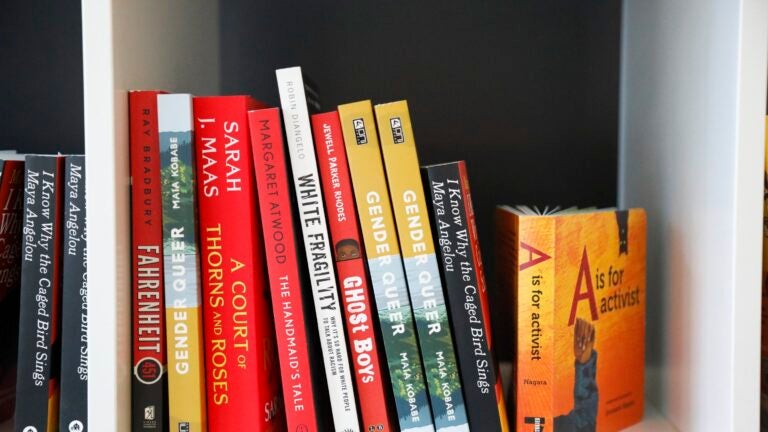
School is in session for students across Massachusetts but as they embark on a new year of learning, many readers — including parents, educators, and other concerned citizens — are worried about rising attacks on free speech and growing polarization in the country.
Seventy readers responded to a recent Boston.com poll asking about their concern over rising attacks against free speech. The majority (86%) said they were concerned about rising attacks on free speech and told us they are concerned about book bans in schools, as well as attacks against free speech on both the left and the right.
These concerns from readers don’t exist in a vacuum. They’re part of a growing movement across the country to limit free speech in schools through state-wide legislation, according to Ken Paulson, the director of the Free Speech Center at Middle Tennessee State University.
“State governments in many parts of this country have declared all-out war on academic freedom and the right of professors to teach what they wish,” Paulson said. He added that such legislation can be seen particularly in Florida, Tennessee, and Texas.
Ranging from grade school all the way through college, Paulson said attacks on free speech in schools take on many forms: for grade school children, it’s book bans in libraries. For high school students, it often means limiting or punishing students for content posted online and on social media. For college students, it often consists of limiting discussions about race and taking tenure away from professors, as well as complaints that professors are indoctrinating students to a specific point of view, Paulson said.
Paulson is the former dean of Middle Tennessee State University’s College of Media and Entertainment, as well as the former editor-in-chief of USA Today. Having worked as a professor for a decade, he said such complaints of indoctrination by college professors are unfounded.
“The notion that professors have some hidden agenda is absolute nonsense,” he said. “Many teachers have four and five courses, they are overworked and underpaid, and they do everything they can to serve their students well. There’s no indoctrination.”
Take it from Flynn Cratty, a Harvard professor of early modern France and Britain, who now serves as the executive director for the Council on Academic Freedom.
The faculty-led group consists of 137 professors from a broad spectrum of academic disciplines and political perspectives, Cratty said, who are “dedicated to promoting free inquiry, intellectual diversity, and civil discourse at Harvard,” according to their website.
The group was organized formally in March to address what Cratty called the “state of repression at Harvard,” which he said includes self-censorship on campus, faculty members feeling constrained on how they can talk in and outside of the classroom, and the inability to converse across differences.
He said a healthier kind of intellectual or academic culture would allow for “some risk-taking, some kind of conversation across difference without the risk of having your career derailed or being subjected to intense social pressure.”
‘There’s a lot of finger-pointing’
Readers seem to agree with Cratty’s desire for more conversations across differences. Many on either side of the aisle (and in between) feel they are not being heard by the other, and expressed a desire for more open and thoughtful conversation.
“Thinking has become so polarized today that few people will even listen to the opposite side’s point of view,” an anonymous reader from Allston said. “It is a shame that people trying to find themselves and what they believe in can’t even discuss their opinions without provoking hostility and sometimes violence.”
Paulson, too, said much of the controversy around free speech comes down to finger-pointing. “There’s been this generalization about suppression of free speech across America and the left describes it as censorship by the right, the right tends to describe it as political correctness and cancel culture,” he said. “There’s a lot of finger-pointing.”
Thomas M. from the South End said attacks on free speech are happening to both liberals and conservatives, adding that the right to free speech applies to both the speaker and the listener: “If you don’t like what is being said, that is your right, but it is also the right of the person who is speaking to have their rights also to say what they believe.”
The conservative-backed nonprofit organization Foundation for Individual Rights and Expression conducted a recent study of more than 55,000 students across the country and found that more than half of students (56%) expressed worry about damaging their reputation because of someone misunderstanding what they have said or done. One in three conservative students (37%) reported feeling pressure to avoid discussing certain controversial topics due to fear of being “canceled.”
Readers, like J.C. from Jamaica Plain, however, cautioned against conflating self-censorship with legislation censoring expression.
“Censorship by the government of say, Florida, is not in the same vein as a handful of young GOPers feeling shy about spouting off something that is likely racist they can’t defend in mixed company. The First Amendment should protect us from this harm caused by the state of Florida trying to rewrite history. No one’s First Amendment rights are shattered by being scared to speak up,” she said. “I went to a liberal-leaning Midwest state university and it would have been fine for young GOPers to stand up and share their thoughts, so long as they weren’t racist, sexist, or xenophobic,” she added.
‘Full-scale assaults on the right to learn’
Attacks against free speech are on the rise across the country, according to a report by PBS, where many state lawmakers have put book bans in place, among other legislation, to curb free expression.
The number of books permanently removed from U.S. school libraries and classrooms has quadrupled to 1,263 books in the last school year from 333 the year before, according to a new report from the free speech group PEN America. Over 40 percent of all book bans occurred in school districts in Florida.
Kathy O., a Boston.com reader who currently lives in Ocala, Florida, is a former resident of Methuen and a retired teacher. She said Florida has “become a disgrace” due to “banning books we read in school, [and] whitewashing history to please the far right.”
Jennifer from Peabody said that the environment around free speech in America is “quickly headed to a repeat of the McCarthy era of the 1950s,” a point echoed by Paulson in relation to book bans.
“The real battlefield in primary grades is the school library,” he said. “By and large, those battles are not about the classroom. They are about the school library. It’s directly reminiscent of the 1950s,” he added.
For college students like Sean Waddington, the issue is personal. As the president of the BU College Democrats and the son of a public school teacher, he said he is angered by the vitriol directed toward educators.
“The attacks on free speech we’re seeing across the country amount to full-scale assaults on the right to learn,” he said. “Whether it be a watered-down version of history or strict restriction on the teaching of empathy, the path states are taking to undermine educators is appalling.”
What comes next for free speech in America?
What are the solutions to safeguard free speech in America? An anonymous reader called on “more civility in our society” and opening up students to a diversity of opinion as a start.
“Students need to be exposed to many different cultures and thoughts and to be able to express their own feelings and thoughts. We need more civility in our society and students will learn how to be civil in both their homes and schools,” they said.
At Harvard, efforts are being made by the Council on Academic Freedom to establish a university-wide statement on academic freedom, which Cratty said the group hopes to make public in the spring.
In addition, Cratty said the group is working on developing courses to prepare students to think across differences, as well as providing “comfort and advice in solidarity” with Harvard faculty who find themselves facing professional or social sanction because of speech.
Despite the inroads being made to protect free speech by Cratty and others, Paulson predicts there will be continued efforts to limit academic freedom ahead of the upcoming elections via political grandstanding.
“There will be many more efforts to ban books. Ron DeSantis has really broken new ground in terms of trying to limit academic freedom and he’s still pursuing the presidency. All these efforts to limit education and information on American schools and colleges will continue until they stop polling well,” Paulson said.
Students like Waddington, the president of BU College Democrats, said he will remain steadfast in the face of attacks on free speech and continue to “move forward with [his] education and activism to hopefully undo policies that hold back the potential of our young people.”
“As a student leader, I feel welcome to voice dissent and speak truth to power. I’m hopeful that our young people can stop this radical attack on education and fight for a better future,” he said.




Be civil. Be kind.
Read our full community guidelines.To comment, please create a screen name in your profile
To comment, please verify your email address