
‘She made too many mistakes to continue’: Readers approve of Claudine Gay’s resignation
A majority of the nearly 2,000 readers polled said they agreed with Gay's resignation as president of Harvard. Here's why.
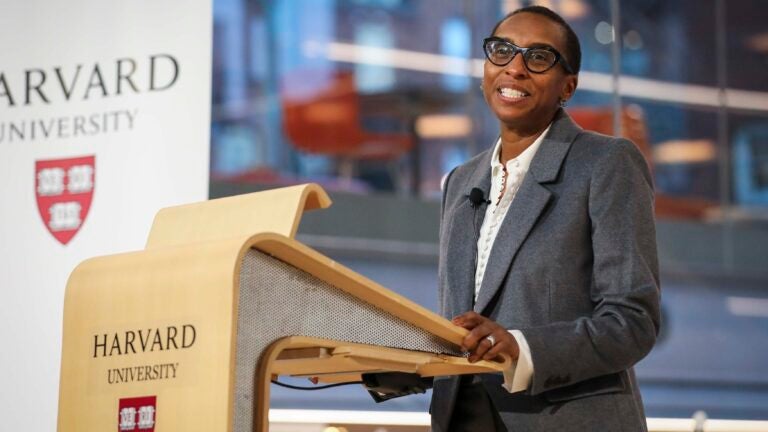
Former Harvard president Claudine Gay resigned on Tuesday after facing intense criticism over the university’s response to the Israel-Hamas war, backlash over her comments at a congressional hearing on campus antisemitism, and most recently, a spate of plagiarism accusations.
We asked Boston.com readers if they agreed with Gay’s resignation, and of the 1,942 people who responded to our survey, 82% said it was right for Gay to step down, arguing that the controversies that plagued her short tenure have tarnished Harvard’s reputation.
“Leadership is about how you represent the brand, institution, or organization you are designated to help succeed,” reader Chris S. from Gloucester said. “When you are in the headlines for all the wrong reasons, whether warranted or not, you have an obligation to double down on the strengths of your institution and find a way to remove your profile from the media mix.”
“It may be tough, unfair, and perhaps ultimately prove untrue, but Gay should have done this a lot sooner as Harvard’s reputation has lessened as a result of this ordeal,” he added.
Many readers cited the university’s slow response to condemn the Oct. 7 attack by Hamas and Gay’s “disgraceful” testimony at the congressional hearing on antisemitism as reasons why they agreed with her choice to resign. But one ordeal stood out for readers among the many Gay has encountered in her tenure: the deluge of plagiarism accusations.
“Dr. Gay probably would have survived her testimony to Congress fiasco but the constant examination of her published work and the drip, drip effect it had on Harvard made her continued stay untenable,” reader Michael I. from Princeton, Mass. said.
‘Harvard should hold their president to a higher standard’
The plagiarism allegations against Gay were first brought forward by Christopher F. Rufo, a right-wing activist, in a Substack post on Dec. 10. In the post, he accused Gay of plagiarizing portions of her doctoral dissertation. The next day, The Washington Free Beacon, a conservative news outlet, published an analysis alleging that Gay used language and improperly cited ideas from other scholars four other papers, in addition to her dissertation.
The Harvard Corporation, Harvard’s highest governing board, conducted an “independent review” of Gay’s published work and “found no violation of Harvard’s standards for research misconduct” under the Faculty of Arts and Science’s policy, but did say Gay would make corrections to a few citations. Notably, several academics Gay is accused of plagiarizing have disputed the allegations, according to the Chronicle of Higher Education.
“I am not at all concerned about the passages,” David Canon, a political science professor at the University of Wisconsin whom Gay cited in her published work, told the Washington Free Beacon. “This isn’t even close to an example of academic plagiarism.”
Gay has stood by her scholarship, writing in an op-ed in the New York Times on Wednesday that she “[has] never misrepresented my research findings, nor have I ever claimed credit for the research of others.”
Many readers, however, said they believe the plagiarism accusations against Gay to be true, and called for her to be held to the same academic honor standards as the student body she led.
“Harvard should hold their president to a higher standard, as they hold their undergraduate students, not a lower standard,” reader Robert B. from Danvers said. He said he believes “Gay was guilty of extreme plagiarism.”
Reader Michael V. from Westwood agreed, arguing that students at Harvard would be expelled if they were found guilty of plagiarism under the school’s policy.
“Why should it be any different for a university president?” he asked.
‘She missed an opportunity to make a strong statement against antisemitism’
For readers, like Leanne S. from Allston, the “painfully long time” Gay took to condemn Hamas’ Oct. 7 attack was the tipping point that made resignation the right choice.
“The silence was deafening. There was no ‘learning curve’ as Mayor Wu claims. Either she doesn’t believe that Hamas is a terrorist group or doesn’t believe that Jews have the same right to safety as anyone else on campus,” she told Boston.com.
Indeed, Harvard was broadly criticized for its tardiness in putting out a public statement and for not condemning the attacks and antisemitism forcefully enough.
Former Harvard President Lawrence H. Summers took to Twitter in the days after the Oct. 7 attack to demand a response from the then-silent University, as tensions on-campus swelled after a student group put out a statement blaming Israel solely for the attack.
Controversy continued to engulf Gay at a congressional hearing about campus antisemitism on Dec. 5. Much of the uproar around the hearing involved Gay’s comments (and those of two other university presidents) to a question posed by Rep. Elise Stefanik (R-NY) on whether “calling for the genocide of Jews” would violate their university’s code of conduct.
At the hearing, Gay said it depended on the context, adding that when “speech crosses into conduct, that violates our policies.”
Many readers said Gay’s inability to clearly condemn such calls for genocide against Jews were not only a misstep, but an opportunity squandered.
“She missed an opportunity to make a strong statement against antisemitism on behalf of one of the world’s leading universities,” Jennifer from Peabody said.
Gay later apologized for her comments and in her New York Times op-ed, acknowledged that she’d made mistakes in her initial response to the Oct. 7 attack and failed to forcefully condemn antisemitism at the hearing. The former president also said that she “fell into a well-laid trap” at the congressional hearing.
Still, her apology wasn’t enough to smooth over reader Garret from Wakefield, who called Gay’s remarks at the hearing “disgraceful.”
“Regardless of your politics, it was a shameful day for all three university presidents, and an embarrassment for Massachusetts. How can you lead a campus of diverse backgrounds if you cannot clearly state that you support students from every walk of life?” he said.
But other readers, like Gershon from Needham, felt sympathy for Gay and the other university leaders at the hours-long hearing.
“It would be hard to stand up to a three hour hearing and not make some mistakes. She has updated her statement. She should not have allowed political pressure to make her resign just because she did not articulate her position very well under a hearing,” he said, adding, “I would have liked to give Claudine another chance.”
‘Unnecessary negative attention to the institution’
Many readers and Harvard alumni said the attention Harvard and Gay received from numerous controversies have marred the institution’s once prestigious reputation and image, making her resignation as president imminent.
An anonymous Boston.com who said his child currently attends Harvard University said Gay has brought “unnecessary negative attention to the institution that will adversely affect it and my child for years.”
Reader Bill P. from Boston, who identified as a Harvard College alum, agreed, calling Gay’s leadership “inept,” adding he believes “her lack of academic integrity has been degrading the reputation of Harvard — and starting to tarnish the value of my degree.”
Others, though, like Judith S. from Canton, said Gay was not responsible for tarnishing Harvard’s image, but rather, it was “arch-conservative politics” that were responsible for her downfall.
“Sounds like she may have made mistakes with sloppy citations, but there is nevertheless a campaign of harassment directed toward her…she has become a lightning rod in this polarized moment, and the situation is poisoned by ‘blood in the water’” Judith said. “It’s a darn shame.”
In her op-ed, Gay offered “words of warning” about future campaigns against institutions like Harvard and leaders like herself.
“The campaign against me was about more than one university and one leader. This was merely a single skirmish in a broader war to unravel public faith in pillars of American society,” she wrote, adding that “trusted institutions of all types — from public health agencies to news organizations — will continue to fall victim to coordinated attempts to undermine their legitimacy and ruin their leaders’ credibility.”
Boston.com occasionally interacts with readers by conducting informal polls and surveys. These results should be read as an unscientific gauge of readers’ opinion.





Be civil. Be kind.
Read our full community guidelines.To comment, please create a screen name in your profile
To comment, please verify your email address