
Nearly 280 readers voted: Bicyclists and drivers should be treated the same
Readers felt that the "Idaho Stop" should not be implemented in Massachusetts.
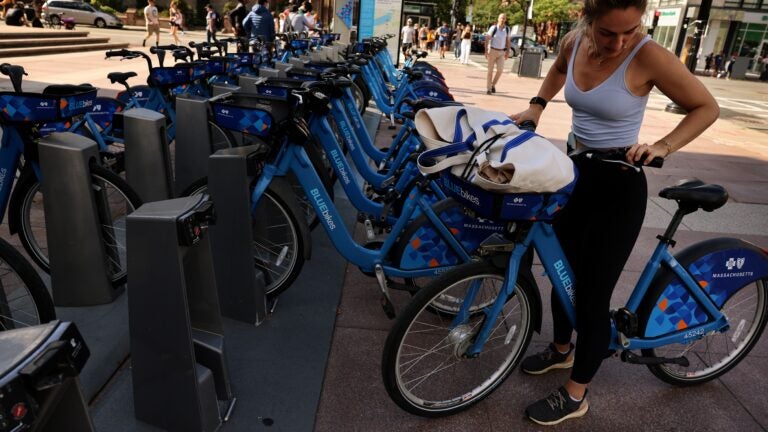
Bicycling is a popular activity in the United States. Last year, Bluebikes, the service that rents out bikes across Massachusetts, recorded over 3.78 million total trips.

In Somerville, however, bicycling is stirring up controversy.
Last week, two members of the Somerville City Council proposed allowing bicyclists to pass through intersections given that they yield to any pedestrians or traffic. They brought up the “Idaho Stop,” which allows bicyclists to treat red lights as stop signs, and stop signs as yield signs.
States that have implemented the Idaho Stop or a similar law have seen decreased amounts of crashes involving bicyclists, according to the National Highway Traffic Safety Administration. Delaware passed a similar law (the “Delaware Yield”) in 2017 and saw a 23% decrease of crashes at stop signs involving bicyclists in the following 30 months.
Under current Massachusetts state law, bicyclists are required to stop at red lights and stop signs.
We asked readers if they think bicyclists and drivers should be treated differently, and if the Idaho Stop should be implemented in Massachusetts. For the most part, readers felt that the two vehicles should be treated the same and that the Idaho Stop should not be a law in Massachusetts. About 77% of the 279 readers who responded said there should be no different treatment for bicyclists and drivers.
Many of the readers who disagreed with treating bicyclists and drivers differently felt that everyone who wants to be on the road needs to follow the same rules, regardless of what vehicle they use, as the area has too much going on (with both lots of people and quirky roads) to take chances.
“If cars and bikes are going to share the roads, there needs to be one set of ‘rules of the road’ so everyone (drivers, riders, and pedestrians) knows what to expect from each other,” said reader Monica, formerly from Charlestown. “Greater Boston is just too congested with too many narrow roads, sharp turns, funky intersections, etc. to not have the same set of rules for everyone on wheels.”
Similarly, many of the 76% of readers who disagreed with implementing the Idaho Stop in Massachusetts said that Somerville is too densely populated and has too many narrow roads to make this policy safe.
“That said, cyclists must still be responsible and the density in Somerville makes a blanket implementation of the Idaho Stop too dangerous,” said reader Chris from Somerville. “The poor visibility from narrow streets and cars parked close to curbs makes a universal implementation of this policy too risky.”
Readers who agreed with treating bicyclists differently than drivers pointed out that sometimes drivers can be unpredictable, making it more dangerous for cyclists.
“Going through an intersection after carefully checking for pedestrians and cross-traffic can be safer for cyclists as it means not entering the intersection together with cars, who may decide at the last minute to turn right rather than going straight, for example,” said reader Marco from Newton.
Read below to see what readers had to say about treating bicyclists and drivers differently, as well as their thoughts on implementing the Idaho Stop in Massachusetts.
Some responses have been lightly edited for length and clarity.
Should bicyclists and drivers be treated differently?
No
“Cyclists and drivers need to be held accountable for their actions in the event that they are involved in a collision. Both need to be mindful of pedestrians who are crossing legally in crosswalks.” — Terri, Cambridge
“I am a cyclist. The stop signs and red lights are there for a reason which is public safety with ‘public’ being defined as those in automobiles, pedestrians and cyclists. If cyclists can run stop signs and red lights why shouldn’t drivers be allowed to do the same?” — Tommy, Quincy
“Motorists must pass an exam and take a road test to demonstrate their skills before they can obtain a license to drive on the road. If bicyclists want to share the roads as peers then they should abide by the same rules, be subject to the same regulations and face the same penalties for infractions.” — Theo N., Somerville
“If cars and bikes are going to share the roads, there needs to be one set of ‘rules of the road’ so everyone (drivers, riders, and pedestrians) knows what to expect from each other. Greater Boston is just too congested with too many narrow roads, sharp turns, funky intersections, etc. to not have the same set of rules for everyone on wheels.” — Monica, formerly Charlestown
“If you ride in the road, you need to follow the rules of the road. As a pedestrian, I have been almost hit by bikers running lights countless times.” — Anna C., Marblehead
“As both a cyclist and a motorist I want to be treated fairly under both roles. I believe that safety requires consistency in traffic behavior.” — Michael F., Gloucester
“As a long time road cyclist and 10 year Pan Mass Challenge rider, nothing is more nerve-wracking than cars blasting by cyclists at a close distance. The last five or so years I’ve seen a significant increase in distracted drivers texting or doom scrolling while driving. It’s absolutely terrifying and almost enough to keep me off my beloved bike. That said, however, the same rules of the road should apply to cars and cyclists alike, especially in the city. There are too many distracted drivers and an extra layer of safely stopping at red lights and stop signs can only help.” — Casey, Raynham
Yes
“Going through an intersection after carefully checking for pedestrians and cross-traffic can be safer for cyclists as it means not entering the intersection together with cars, who may decide at the last minute to turn right rather than going straight, for example.” — Marco, Newton
“Cyclists and drivers are different so they should be treated differently. The risks of a car on the road are much different from the risks of a bicycle on the road. Policies and enforcement should reflect those differences. That said, cyclists must still be responsible and the density in Somerville makes a blanket implementation of the Idaho Stop too dangerous. The poor visibility from narrow streets and cars parked close to curbs makes a universal implementation of this policy too risky.” — Chris, Somerville
“Looking at the destructive capabilities of a vehicle compared to a bicycle, we should absolutely enforce traffic violations related to vehicles more frequently than bicycles. I’ve had interactions with bikes where I’ve almost been hit or have seen them act without regard for pedestrians but that pales in comparison to how vehicles behave. Look at the amount of deaths and injuries related to motor vehicles compared to what happens with bicycles and that alone should be enough to end the argument.” — Matt, Medford
“Traffic enforcement should very obviously start where there is more danger to the public — cars and trucks. Start by enforcing traffic laws with vehicles that can literally crush a family to death before we enforce traffic laws on bicycles which may just knock a person over. Neither are wanted, but exponentially more people die in accidents involving at least one car or truck. Fewer people die in accidents only involving a bicycle.” — Anonymous, Somerville
Boston.com occasionally interacts with readers by conducting informal polls and surveys. These results should be read as an unscientific gauge of readers’ opinion.




Be civil. Be kind.
Read our full community guidelines.To comment, please create a screen name in your profile
To comment, please verify your email address