
More than 230 readers voted. Here’s why they think Mass. and Cass should move to Widett Circle
“It’s a complicated issue with no easy solutions, but Widett Circle could be a start,” one of the 237 respondents said.
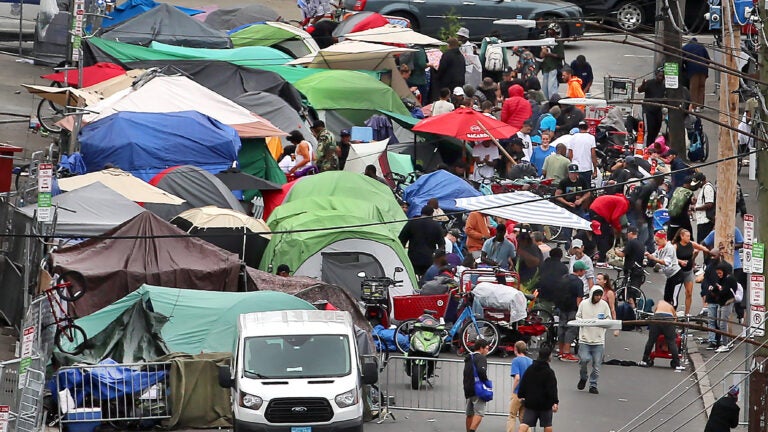
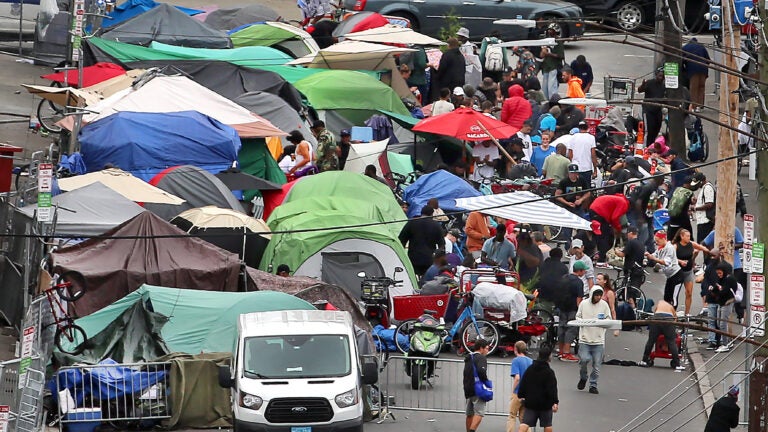
Boston Mayor Michelle Wu filed an ordinance to the City Council Monday to clear homeless encampments in the city as part of ongoing efforts by the city and local groups to curb open-air drug use, human trafficking, and violence in the area around Massachusetts Avenue and Melnea Cass Boulevard (also called “Mass. and Cass”).
“The ordinance will establish a prohibition against unsanctioned use of tents, tarps, and similar temporary structures on public property and in the public way which have been shielding much of the dangerous activity in the area and undermining the ability of providers to safely and effectively deliver services,” Wu wrote in a letter to the council.
Writing on Substack, a blog platform, Wu said the ordinance is part of a “three-part plan for a phase change” for the area, which also includes expanding overnight low-threshold housing and increasing shelter capacity, as well as returning Atkinson Street, where crowds would gather daily to sell and use drugs, to standard roadway usage.
More on Mass. and Cass:
It’s not the only proposal to improve the situation at Mass. and Cass. A coalition of South End businesses and neighborhood groups have called on the city to move Mass. and Cass to Widett Circle, a 24-acre property that was previously home to the New Boston Food Mart Corporation and is currently owned by the MBTA.
Under their proposal, dozens of temporary pallet houses would be built at the new site to support residents throughout the various steps on their road to recovery, under the guidance of nurses and recovery coaches on site — as well as amenities such as laundry, a cafeteria, and bathrooms.
We asked readers for their thoughts on the proposal and what can be done to address the crisis at Mass. and Cass. The majority (73%) of the 237 readers who responded to our poll were in favor of the Widett Circle proposal, with 27% against it.
Many who voted yes, such as Derek L. from the South End, said it’s time for a new solution to a problem that has plagued the neighborhood for years.
“The status quo is clearly not working,” he said, “And this possible solution has input from many stakeholders.”
The move to Widett Circle would be temporary, coalition leaders said, lasting about three to four years while the Long Island Bridge and addiction treatment center and Shattuck Hospital’s supportive housing is being built.
Stephen Fox, the chair of the South End Forum, said the main objective of the proposal is not to simply move the crisis from one location to another, but to address the crisis “and begin to move it into a solution-oriented system.”
“It’s not simply to provide a bed someplace on a one-night basis. It’s to provide a consistent opportunity for people to feel safe and to reach out for recovery modalities,” he said.
Brian from the South End said the proposal would be “more humane” than letting Mass. and Cass residents live on the street. “We need to help our fellow community members,” Brian said.
Even though he supports the proposal, Sam from Somerville said he’s not totally convinced moving residents to Widett will help. Nonetheless, he’s glad that there’s a new solution to the decades-old problem.
“What’s happening at Mass. and Cass right now is simply unacceptable,” he said. “I’m not convinced that moving it to Widett will help, but at least it’s addressing the problem with a new solution.”
Mayor Wu’s recent proposal aims to address some of the problems most concerning to readers. Under the ordinance, anyone who violates the new rules would be offered shelter space before their encampment would be taken down, and authorities would be required to provide storage for personal belongings to violators, according to the letter.
Additional beds will be created to “absorb the disruption and ensure that no one is stuck with nowhere to go during this transition,” Wu wrote on her blog. The city’s shelter partners will temporarily house up to 30 people who are already working with case managers and housing search at the Boston Public Health Commission’s Miranda-Creamer Building nearby.
Many Boston.com readers who said they don’t agree with the Widett Circle proposal reasoned that moving residents from one location to another won’t do much to address the problems.
“The problem doesn’t need relocation,” Michael W. from the South end said. “It needs vigorous enforcement.”
Similarly, an anonymous reader from Norwell called on better enforcement by police officers: “There are laws against drug dealing, public intoxication, public urination, assault, and sleeping on a public sidewalk. Empower our police to enforce these laws.”
Read below to see what readers had to say about the proposal and ways to help the Mass. and Cass crisis.
Do you agree with the proposal to relocate people from Mass. and Cass. to Widett Circle?
Yes
“The city needs an immediate short-term solution that does not continue to place neighborhoods, residents, and businesses at risk and actually gives folks in recovery a chance to heal. Widett Circle provides an ideal geographic area to house and treat folks in a confined and safe area before they transition to a longer-term care facility such as on Long Island. Widett Circle is accessible and can be made secure with controlled access in and out so folks in recovery are safe, and the surrounding neighborhoods (South End and Roxbury) can be relieved of the inhumane and unsafe conditions generated by the crisis.” – J.A., South End
“I have lived on Mass Ave for 7 years – it’s time to try something else. The situation for me is heartbreaking – these folks are in desperate need of better resources and support from the local, state, and federal government. As an RN I have cared for many in that patient population, although I am advocating compassion for them as many have mental health issues, we as a community need to fully commit to managing our environment. The litter, needles, and unsanitary conditions are public health emergencies and Boston needs to actually do something – what has been tried is not enough!” – Gregory K., South End
“While initially skeptical of a plan that includes forcibly moving people, I think the entities involved have a real plan to attack the persistent issues at Mass & Cass. Local government has a responsibility to mitigate potential harm to the general public, and by enforcing drug and camping laws, are not infringing on personal freedoms, but attempting to ensure the problems don’t escalate. Boston seems to be using a proactive and compassionate approach to addressing homelessness and addiction issues that could be a model for others in the country, and should embrace that status. – Tom H., Newton
“It sounds like a well-thought-out plan that is worth trying. Something has to be done. Some of the funding should come from the pharmaceuticals that sold opioids and brought about a great deal of this crisis.” – Christine W., Quincy
“I work at the BU medical campus and drive by this daily, it breaks my heart. There has to be a better solution than just moving these unhoused individuals from street to street! We have to treat the larger problem and provide support. Love the idea of having housing and treatment available.” – Leah, Quincy
“The issues plaguing Mass & Cass are multifaceted. It seems that since the pandemic, the mentally unstable & crime-committing people have become emboldened. We need to do a better job of treating the mentally ill and drug abusers AND enforce laws of public safety and health. We, as residents of Boston, do deserve nice things, such as safe streets & public amenities. A structured plan for recovery for the folks of Mass & Cass, with housing and healthcare access around the clock is the way to go.” – Anna B., South End
“Keep the issue away from neighborhoods while the politicians find a long-term solution to addressing the root causes. Mass. and Cass is just too close to businesses, schools, and homes. We will not even go to do any shopping at South Bay due to the rampant drug use and individuals passed out in the parking lot. Needles and trash are littered everywhere by these people. We are moving next month, and this is partly a reason for us leaving. Just unsafe.” – Marc, South Boston
“This makes a huge amount of sense. We need a campus that can be created now to help people and we need to end the open-air drug trafficking and encampments. People suffering from addiction require help, treatment, health services, and housing. The City should also focus on a longer-term permanent plan at Long Island. Sue Sullivan and the New Market BID have shown such thoughtful leadership and must be commended for this solution-based vision.” – Meg M., Boston
“I am in recovery, and when I was housed I could stay sober. But being homeless on the street, it was not an option for me. I could stand myself not showering and not eating properly. Your life needs to have some kind of order. They say in recovery, ‘messy bed, messy head.’ Just imagine when your life is a mess.” – Jennifer P., Cambridge
No
“Moving the encampment does not solve the human trafficking and drug dealing problems, it just moves them to a different part of the city. There are no simple solutions, it’s not an easy problem to solve, I sympathize. But relocation does not put an end to any of the activities that harm the population at and around Mass and Cass.” – Vanessa, Southie
“I vote no because there is very little detail provided for how the actual problems of drug abuse and human trafficking will be addressed. How does moving the blight to a new location solve both problems? How will these people be admitted to the five-step program mentioned? How will they be monitored to prevent drug use and other illegal activity indoors? Will this add more strain to a different district of the Boston Police? This sounds like a bandaid that’s already falling off.”– Kat, South Boston
“The problem is not what people on the streets do (shoot up, commit crimes) that causes us to notice them but the fact that society has been indifferent for decades with short-term, stopgap type responses instead of a comprehensive, sensible approach to address the suffering out there. Moving troubled people out of sight is being put forward so that the problem can continue to be ignored – ‘out of sight, out of mind.’ It is shameful.” – Thea P., Arlington
“Treatment and care need to resume on Long Island. There’s no reason why the ferry service couldn’t be used in the meantime while the bridge is rebuilt. Relocating this population to Widett Circle doesn’t address the constant temptation facing this population seeking treatment when they’re back on the street every day. It just doesn’t make sense. At least on Long Island, there’s an actual, physical separation from street life, giving these folks a real chance to get clean.” – Megan
“Open drug use should result in relocation to jail, not to free temporary housing.” – Steve, Andover





Be civil. Be kind.
Read our full community guidelines.To comment, please create a screen name in your profile
To comment, please verify your email address