
Sign up for the Today newsletter
Get everything you need to know to start your day, delivered right to your inbox every morning.
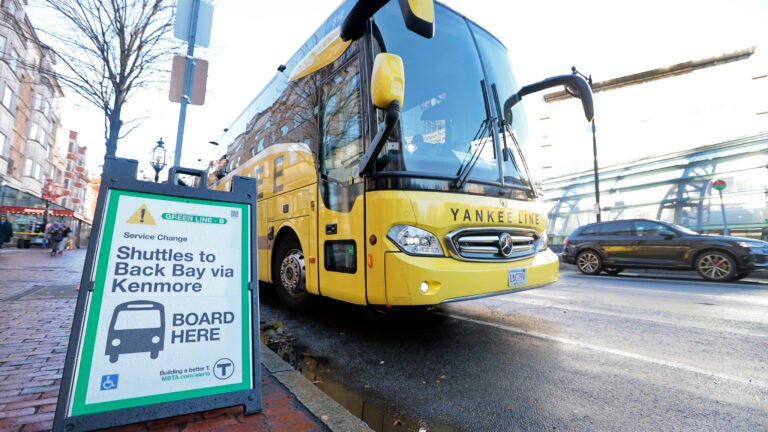
Now that Green Line service in downtown Boston has officially resumed after a nine day closure between Kenmore and North Station, and the Medford/Tufts Green Line extension is expected to resume after this weekend, T riders are left wondering if these closures will improve the quality and safety of the city’s transit system.
These closures come as part of the T’s campaign to remove “slow zones” on subway and trolley routes, and have left T riders wondering if they will actually result in an improved quality and safety of the trains and stations.
The slow zones are a result of ongoing safety issues the MBTA has been struggling to combat since the Federal Transit Administration (FTA) issued a 90-page report in August 2022, instructing the MBTA to implement dozens of measures to improve its safety.
Additionally, a MassINC poll from September, which surveyed 1,000 residents who ride the T, found that “70% have felt unsafe at least once or twice due to the condition of the trains, buses, stations, or other infrastructure,” highlighting how safety issues on the T have become a major public concern.
In October, we asked our readers to share with us what they thought were the most unsafe T stations, after a Reddit user pointed out the poor infrastructure and lack of safety measures in several stations on the Green Line.
Of the 295 readers who responded to our poll, a majority (63%) said they do not feel safe at MBTA stations. Many readers (186) named the specific stations where they felt the most unsafe. The most named station, named by 10 readers, was Downtown Crossing on the Red and Orange Lines.
Ahead, see a sampling of reader experiences of infrastructure safety at MBTA stations, and how officials responded to Boston.com.
“Has anyone ever looked at the ceiling in Downtown Crossing?” Jenny from Quincy said. “I take the train from there every day to get to work/ home and I cannot tell you how many times I’ve had to essentially sprint from fear that I don’t get hit in the head from whatever nastiness could fall from the ceiling,” she said.
“In the tunnel between the Red and Orange Lines… the ceiling is very low, and crumbling, and held up by supports, but only in one place,” Brian from Cambridge said.
“Also, there is a lot of water that forms and pools around the flooring and stairs, near the walls, as if it’s leaking from somewhere,” he added.
“The platforms are not big enough to accommodate the number of people waiting there, so people routinely have to walk down the yellow line to make their way down… and there are no T employees nearby if there was an incident,” Brian said.
JFK/UMass station on the Red Line was also among the most unsafe T stations according to readers, with nine readers naming the station.
“The steel caps on the two flights of stairs descending the station in the direction of UMass are cracking off and bending into the path of footfall, and protruding over the step below,” Glenn from Westford said.
“They are sticking out in a way that could catch your shoes, laces, or pant cuffs and lead to a serious fall, and possibly bad gashes to whatever body part might come in contact with rotting, rusted pieces of stair cap.”
“JFK/UMass station is literally crumbling before our very eyes,” Kenneth from Dorchester said, citing visible holes in the stairs.
A Boston University professor fell to his death at the JFK/UMass station last year after running on a severely rusted staircase that gave way.
“The platforms themselves are unsafe for people to walk on. They have become so uneven due to the concrete erosion that I find it impossible that a wheelchair could ever navigate them safely. I know people are upset with the speed restrictions imposed on the Red Line but anyone in their right mind who has ever ridden the T from JFK/UMass to North Quincy would know how scary of a ride that used to be at full speed.”
Andrew Square and Harvard Square stations, also on the Red Line, were not far behind, with five votes and four votes respectively. Earlier this year, a woman was almost hit by falling ceiling tile earlier at Harvard Square station.
Additionally, Broadway station on the Red Line also received two votes. The station is where a 39-year-old Dorchester man was dragged to death in 2022 when his arm got stuck in the door of a moving train.
Boston.com reached out to the MBTA for a response to station safety concerns. When asked about the stations that readers named as the most unsafe, MBTA Deputy Press Secretary Lisa Battiston highlighted repairs the MBTA undertook on the Red Line, specifically at JFK/UMass station. These included overdue repairs to the tracks, platforms, stairs and overpass.
During the Red Line closure earlier this year, Battiston said the MBTA intended to remove 28 speed restrictions, but succeeded at removing 38. During the most recent closure of the Red Line, there were six restrictions intended to be removed, but nine were removed as a result.
According to Battiston, work crews made a number of station improvements to JFK/UMass during the recent 16-day Ashmont Branch and Mattapan Line diversion in October.
“These included repairing the floor along the elevated walkway and its tiles, installing a new floor within the lobby, repairing the concrete platform canopy and stairway ceiling, painting the Ashmont platform ceiling, replacing tactile edging on the Ashmont platform, removing the old Newspaper booth from the lobby, adding new jet drains, tiling the stairway wall, removing the roll-down gate at the Sydney Street and Columbia Road stairwells, removing the Monitor from the lobby, repairing the Columbia Road stairs, and installing new lighting in the station,” she said.
Battiston also mentioned the planned improvements to street level stations on the Green Line’s B and C branches.
According to Battiston, the MBTA’s Track Improvement Plan aims to remove 191 “slow-zones” across the T by the end of 2024. This plan will allow for spot repairs, tie replacements, rail replacements, and ballast replacements to be made.
Battiston explained that the MBTA also intends to improve the safety and reliability of its services by replacing over 27,900 railroad ties and 124,880 feet of track.
Regarding the FTA 2022 report on the MBTA’s safety issues and lack of personnel, Battiston highlighted that the organization has already made more hires than it had originally intended.
“The MBTA is focused on rebuilding the workforce with a focus on recruitment, retention, skills training, and leadership development to cultivate the workforce needed to operate and maintain a modern transportation system,” Battiston said.
She said the MBTA has exceeded hiring nearly 1,200 employees in 2023, exceeding a goal set by the Healey-Driscoll administration.
Battiston said their top priorities are always rider and employee safety.
“With a strong workforce and leadership team in place, the MBTA can break the years-long cycle of underinvestment and accelerate infrastructure upgrades, maintenance, and inspection improvements,” she said.
Boston.com occasionally interacts with readers by conducting informal polls and surveys. These results should be read as an unscientific gauge of readers’ opinion.
Get everything you need to know to start your day, delivered right to your inbox every morning.




Be civil. Be kind.
Read our full community guidelines.To comment, please create a screen name in your profile
To comment, please verify your email address