
Divisions shake Jewish Bostonian families amid Israel-Hamas war
“For the first time, I feel compelled to speak up…To question my Israeli family — even if they dismiss my views.”
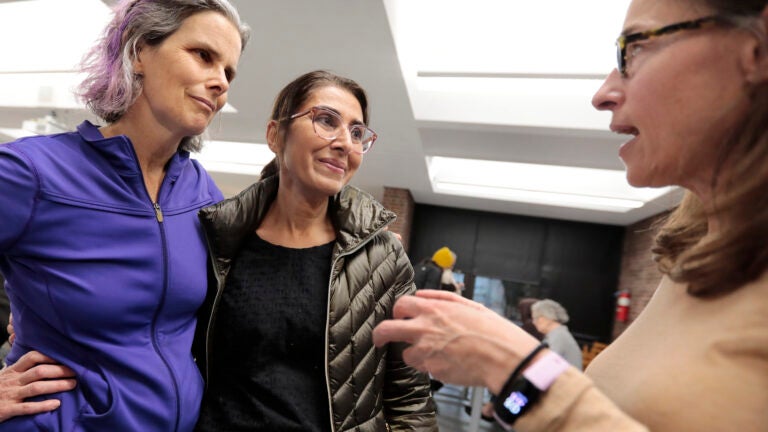
At her family’s Thanksgiving celebration this year, Meredith, a Boston.com reader from Maynard, noticed two extra children’s place settings at one end of the dinner table. Curious, she asked her mom who the extra place settings were for.
“My mom told me that through her synagogue, they had a list of the Israeli hostages and you could pick specific people to honor,” she said. “They picked two of the children hostages, and that was their way of showing support.”
Meredith, who asked that her real name not be used, was both shocked and saddened by her mother’s answer. As an anti-Zionist Jewish-American, she found the gesture “really touching,” but couldn’t help but feel it was hypocritical. At the time, the death toll of Palestinian children killed in the bombardment of Gaza was climbing into the thousands.
“When my mom explained this to me, I said, ‘Okay, what about all the place settings for all the Palestinian children?’”
“We’ll discuss it later,” her parents said after some silence.
Meredith, like many progressive Jewish Bostonians, told us she feels a sense of disconnection and frustration when talking with her family about the war and Israel.
“Politically, we’re similar enough, but this is just such an area of discomfort,” Meredith said. “I know how they feel about it. And I don’t think there’s anything I can say that would change their mind.”
There has been a widespread feeling of devastation within the Jewish community since Oct. 7, according to journalism professor and Associate Director of Jewish Studies at Northeastern University, Laurel Leff.
“People on the right, people on the left, people who are supporters of Israel, people who are critical of Israel, are just having this be a devastating experience,” she said.
Leff lived through the 1967 and 1973 wars and the First and Second Intifada. But she said those experiences pale in comparison to the kind of devastation Jewish and Israeli-Americans are currently experiencing in response to and in the wake of the Oct. 7 attack.
“I don’t think I’ve seen anything like it. Nothing even begins to come close,” she said. “This is the most upset and distressed I’ve ever seen the Jewish community.”
Greater Boston is home to the fourth-largest Jewish community, one that is far from a monolith. Since the Oct. 7 attack, the wide variety of perspectives and political ideologies have led to devastation, division, and disillusionment within their families and communities.
We asked our Jewish readers to share some insight into the discussions they’ve been having with their loved ones since the start of the Israel-Hamas conflict and they shared the complicated conversations that the last couple of months have brought about.
‘This situation can end friendships – lifelong friendships – and it’s happened to me‘
The current divisions are numerous and nuanced, but have often centered around aid to Israel, Zionism, and calls for a cease-fire. As the war continues, many Democrats — even some Jewish American Democrats — are finding it increasingly difficult to support Israel’s actions against Palestinians. Sympathy for Israel among Democrats has dipped, and a higher percentage of Democrats expressed sympathies for Palestinians at 49% compared to Israelis at 38%, according to a Gallop poll.
And a Brookings Institute study conducted two weeks after the Oct. 7 attack found that American support for Israel is falling along partisan lines. An increasing majority of Republicans want the United States to lean toward Israel, while a declining majority of Democrats want the United States to lean toward neither side. Notably, those who want the U.S. to lean toward Israel have increased since last June, the last time the Institute asked about this issue.
For progressive, anti-Zionist Jewish Americans, public criticism of Israel can create conflict with loved ones. Within her Jewish community, Meredith said it has been “extremely hurtful” to be called anti-Semitic for being a Jewish anti-Zionist.
“I think that it’s a horrible conflation to say that anti-Zionism and anti-Semitism are the same,” she said.
Among her Jewish friends, she said it has been “particularly painful” when they refuse to read sources critical of Israel and call her anti-Semitic or a “self-hating Jew” for expressing criticism of Israel. She has lost friends because of it.
“It’s sad. I feel like this situation can end friendships – lifelong friendships – and it’s happened to me. It’s not the first time that has happened, and it probably won’t be the last,” she said.
For now, Meredith said she has found support from her activist community in Maynard, and they are considering holding weekly vigils spearheaded by other anti-Zionist Jews. She said she will continue to speak out against Israeli occupation of Palestine, despite her fears.
“I feel like it’s a really important part of my Jewish identity to do that. Anywhere there’s oppression, it’s important to speak out about it because Jewish people have been oppressed for thousands of years. I think it’s worse to hide from it.”
‘[College] should be a warm and welcoming environment and it doesn’t feel that way to them‘
Standing at 6 feet three inches tall and weighing 250 pounds, David L., a Jewish-American Boston.com reader from Natick, describes himself as a “big presence.”
He’s not afraid to hide who he is, and proudly wears an “Am Yisrael Chai” bracelet (“The people of Israel live” or “The nation of Israel lives” in Hebrew) and displays a sticker on his car in support of Israel. But he said his two children, who are in college, are afraid to show their Jewish heritage outwardly out of fear of anti-Semitism.
His third child is in high school and will be going to college in two years. David is concerned about where she might apply and said he won’t pay for her to go to certain schools that have had anti-Semitic incidents in recent months and years.
“It should be a warm and welcoming environment and it doesn’t feel that way to them,” he said. “As a father, it makes me wonder what I can do to help support.”
Across the country, anti-Semitism is growing. The ADL reported a nearly 400% increase in anti-Semitic incidents, including vandalism, harassment, and assault, between Oct. 7 and 23 this year in comparison to the same time frame last year.
“The Jewish community feels really vulnerable right now,” Oren Segal, the vice president for the Anti-Defamation League’s Center on Extremism told PBS.
As anti-Semitism grows, particularly on college campuses, David has felt compelled to talk to his children more about the risks they could encounter.
“I tried to talk with my kids more about [anti-Semitism] now. To let them know that there are people who want to hurt us. They’ve always been around, but it’s more prevalent now,” he said.
On top of fearing for their safety amid a rise in anti-Semitism on campus, Boston University professor and Associate Director of the Elie Wiesel Center Ingrid Anderson has seen firsthand the “painful relationship” many of her young Jewish college students have with Israel.
“It’s partly they want to support it [Israel], they know that their parents or their grandparents do, but if they are politically progressive in the American sense, they feel a great deal of pressure to be anti-Israel, to come out sort of publicly and say ‘I’m an anti-Zionist or I’m anti-Israel,” she said. “They feel a great deal of pressure, kind of like a litmus test. And this has been the Jewish experience since the modern period in the West.”
She described the current moment as “existential” for many American Jews, as they question their identity, faith, and the history they’ve been taught.
“Jews may be trying to understand the conflict more than they had done. There’s often a script that you get taught – and this is true, I think, for all religious communities – about what you believe, or the history of something. I think that many American Jews are having to come to more realistic terms about how the state [of Israel] was created,” Anderson said.
“In many ways, it’s a reckoning in many directions,” she added.
‘I cry almost every day about what is happening to the Palestinian people. I feel responsible. I feel shame. It is very painful.‘
For Oren, an Israeli-American reader from Boston, the conflict has turned his world upside down. Israel’s response to the Oct. 7 attacks motivated him to speak up in support of Palestinians, a move that has alienated him from his Israeli family and caused him to question his identity.
Living in the U.S., he’s met several Palestinian-American organizers with family still in Palestine. Not only does he know people who have been personally affected by Israel’s bombardment, but he said he feels a sense of personal culpability for the violence as both an Israeli and an American.
“My own family is justifying and supporting the [Israeli] military that’s carrying this out. My tax dollars, under the president who I voted for, are giving them weapons with absolutely no conditions or strings,” he said.
His feelings are extremely complicated, he said, because just as he feels sympathy for Palestinians and disgust at Israel’s bombardment, he still loves his family in Israel.
“I cry almost every day about what is happening to the Palestinian people. I feel responsible. I feel shame. It is very painful.”
Anderson, the Boston University professor, who describes herself as a progressive Zionist (“yes, we do exist”), said this kind of internal conflict is not uncommon.
“The love and support is not uncritical,” she said. “I do think that American Jews do feel a connection to each other as Jews, and so even though there are painful divisions around the idea of Israel, there’s also a connection, a sense of responsibility, a sense of obligation [to each other].”



Be civil. Be kind.
Read our full community guidelines.To comment, please create a screen name in your profile
To comment, please verify your email address