
Boston.com Tonight
Sign up to receive the latest headlines in your inbox, every night.
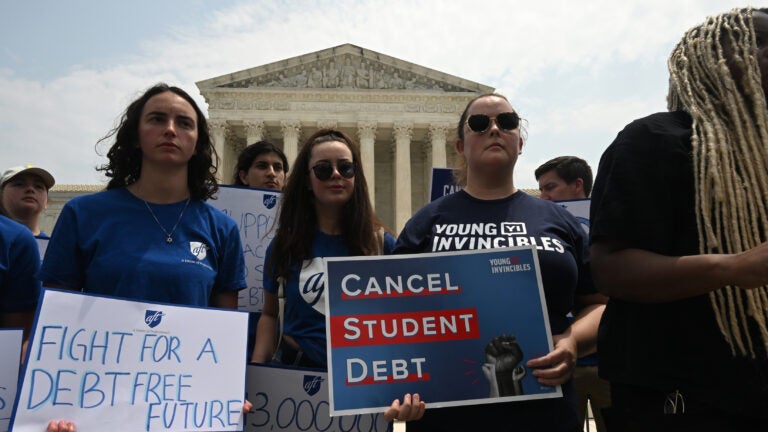
The Biden-Harris Administration announced July 14 that it will begin forgiving $39 billion in student loans for over 800,000 borrowers.
We asked Boston.com readers how they might be impacted, and a few dozen readers responded. For some readers like Jimmy C. from Weston, the relief will have a significant impact.
“My balance would be cut in half, allowing me to retire in two years versus five,” Jimmy C. said.
Other readers, however, said borrowers should take responsibility for their decisions.
“I worked through college and attended a state school I could afford rather than take loans to go to the private school to which I had been accepted,” said reader Hugo from Jamaica Plain. “Accept the responsibilities of the decisions you have made and fulfill your commitments.”
Barry Coleman, vice president of program management and education at the National Foundation for Credit Counseling, told Boston.com that many people on income-driven repayment plans are now dealing with added interest instead of loan forgiveness.
“What we’re seeing is instead of folks being granted forgiveness, their loan balances have doubled, in some cases tripled, because of the interest that was added on because they were making smaller payments under the income-driven repayment plans, with hopes that these balances would be forgiven. But it maxed out and they weren’t forgiven,” Coleman said.
A borrower under an income-driven repayment plan becomes eligible for loan forgiveness after making equivalent to 20 to 25 years’ worth of payments. However, many of these payments were not properly accounted for, and as a result many did not receive loan forgiveness, and it is impacting their loans.
A statement from the Department of Education said these loan discharges will ensure that all payments a borrower made under income-driven repayment plans will be counted in their total number of payments.
Read below to see how some Boston.com readers are impacted by student loan forgiveness.
Some responses have been lightly edited for length or clarity.
“It won’t wipe out everything, but I’m hoping it takes care of at least half.” — Jo, Olympia, Wa.
“I’ll be able to sleep at night. Priceless.” — Joe T., Somerville
“I do not know what the details are of student loan forgiveness under new regulations, but I hope I am included. I have bachelor, masters and PhD related student loans. I have been paying them at max or over my required amounts and throughout many periods or allowed forbearance and deferment (e.g., continued education) for over two decades. I have never missed a payment or underpaid. I currently owe close to what I originally borrowed while I have already paid back the equivalent or more than I took out due to interest rates. It does not make sense to pay back two- or three-fold of what you originally took out. Imagine if that is how mortgage or car loans worked?” — Anonymous
“My balance would be cut in half, allowing me to retire in two years versus five.” — Jimmy C., Weston
“I worked through college and attended a state school I could afford rather than take loans to go to the private school to which I had been accepted. I acted responsibly. The same people with school debt should do the same — act responsibly. Accept the responsibilities of the decisions you have made and fulfill your commitments. Don’t take the money and run.” — Hugo, Jamaica Plain
“I paid my loans off and now I will be paying off others loans! Where’s my refund check for paying mine?” — George, Framingham
“As a person who took a longer time working, scrimping and saving to pay for my education, I don’t think it is right to have to pay off voluntary obligations of others through my taxes and increased inflation. I earned and paid for my way; why do I have to pay for others?” — Anonymous, Peabody
“It won’t directly. Nonetheless, the equity in the debts, themselves, becomes worthless if they are simply written off. Going forward educational institutions, which are financially benefiting from the current student loan framework, should have some skin in the game.” — Tom A., Duxbury
“My tax money will be used to pay this back. The colleges, universities and third party processors created this mess. Their money should be returned to the students … not mine!” — Joe, Acton
“It makes me further angry at this administration and colleges. Colleges can continue charging what they want and the taxpayer that paid their loans or never went are on the hook.” — John, Shrewsbury
Boston.com occasionally interacts with readers by conducting informal polls and surveys. These results should be read as an unscientific gauge of readers’ opinion.
Sign up to receive the latest headlines in your inbox, every night.





Be civil. Be kind.
Read our full community guidelines.To comment, please create a screen name in your profile
To comment, please verify your email address