
Here’s how Boston.com readers feel about AI in the workplace
“I think for some roles it could be done, but when it comes to dealing with people I don't think it would do well.”
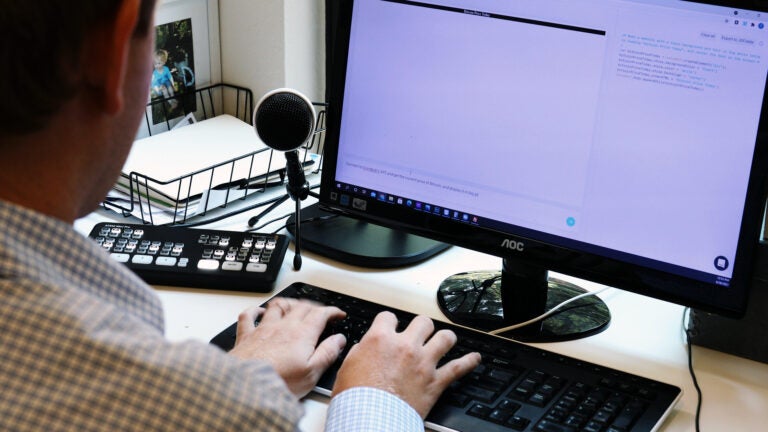
In May, Boston became the first city in the nation to adopt a generative AI policy that encourages “responsible experimentation.”
The City of Boston’s chief information officer Santiago Garces sent the guidelines to every city official encouraging them to start responsibly experimenting with AI “to understand [the tools’] potential.”

The policy outlined several ways government officials can use AI to their benefit, ranging from simple tasks such as writing a memo or creating a job description to more demanding tasks such as “translating” government jargon into plain English for audiences of all ages and reading levels, and even drafting content in other languages.
The guidelines are the first-of-its-kind for the nation, and set precedent for how governments could approach generative AI tools.
“These principles represent a shift from fear-mongering about the dangers of AI to a more proactive and responsible approach that provides guidance on how to use AI in the public workforce,” Beth Noveck, Director of the Burnes Center for Social Change at Northeastern University, wrote in a Wired article.
She said the city’s letter changes the “usual narrative about AI killing jobs” to something more proactive, which could produce tangible benefits for the city and its residents.
“By enabling better communication and conversation with residents of all kinds, AI could help repair historical harm to marginalized communities and foster inclusivity,” Noveck wrote. “Boston’s vision serves as an inspiration for other governments to break free from fear and embrace the opportunities presented by generative AI.”
But others aren’t as trusting of AI and its potential benefits. Boston’s generative AI policy comes amid some fears and distrust of AI, including Boston.com readers.
In May, more than 400 Boston.com readers told us they were anxious over artificial intelligence, with the vast majority expressing concern over the speed with which AI is developing.
“Everything about this is a terrible idea,” Dan from Everett said.
James from Lexington pointed out, “We don’t know what we do not know. Society has not thought through where it wants to go, toward sustained growth or self-destruction.”
We recently asked readers what they thought about AI in the workplace, and for 33% of the 18 readers who responded, fears of AI taking over their job aren’t even on their radar, while 22% of readers are extremely worried about the possibility they could lose their job to a bot.
The remaining votes were varied: 17% of readers said were fairly worried about AI taking over their job, and 17% said they only had some concerns. Eleven percent of readers said they were not worried at all.
The votes were equally split, each at 41%, when it came to whether or not their job would benefit from AI.
Cass from Watertown praised generative AI as “transformational,” while others like Eliot K. from Brighton were more skeptical of the new technology, calling it “malicious software.”
See examples of what readers had to say about the rise of artificial intelligence in the workplace below.
Responses have been edited for length and clarity.
What readers think about generative AI in the workplace:
“ChatGPT may produce an inferior work product. However, company management may believe that the tradeoff of expertise in a role is worthwhile if it reduces costs to a company.” – Karl, Lexington
“Why would we integrate malicious software into our everyday lives? Part of the reason many people are miserable is that they have to do less for themselves than their parents did, they have less human interaction, and their worldview is informed by algorithms instead of other people. Why expand that?” – Eliot K., Brighton
“I think for some roles it could be done, but when it comes to dealing with people I don’t think it would do well. People want to talk to people, especially if they feel that the situation they are in is complicated and can’t be easily explained. For simple things, AI and ChatGPT could be beneficial, but for the things that require talking to people and finding, sometimes, wacky solutions would NOT be best suited for that.” – Jenny, Quincy
“At this point I don’t care about my job anymore anyway so a machine taking over does not bother me, I have other options. Management only cares about metrics anyway. Gee why do people leave? D’uh! However, I can guarantee there will be deals that the computer mucks up and management/corporate will have no one to blame but themselves since they won’t blame themselves for getting rid of people that had a brain and could see and fix the problems. Nope, just cut people/salaries, all [in] the name of the ever declining almighty dollar.” – Amanda, Stoneham
“I find it personally useful.” – Greg B., Newton
“I don’t think my company has any interest in replacing me with a tool trained using racist language models with unverifiable data.” – Jason, Allston
“Transformational.” – Cass, Watertown
Boston.com occasionally interacts with readers by conducting informal polls and surveys. These results should be read as an unscientific gauge of readers’ opinion.




Be civil. Be kind.
Read our full community guidelines.To comment, please create a screen name in your profile
To comment, please verify your email address