
Sign up for the Today newsletter
Get everything you need to know to start your day, delivered right to your inbox every morning.
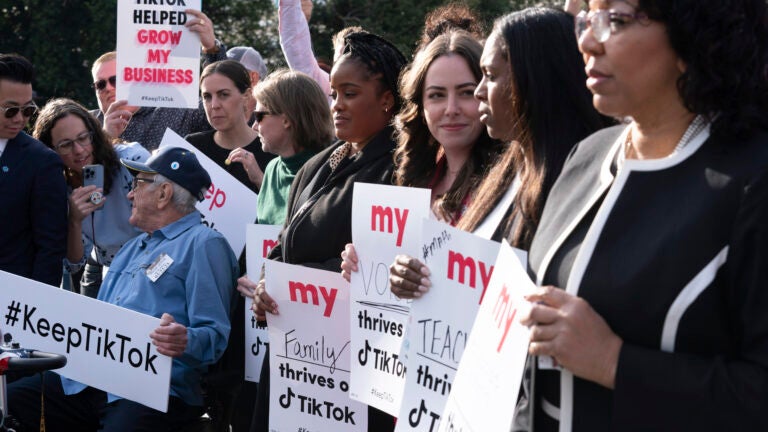
After the TikTok congressional hearing, it seems the short form video platform is no longer considered just for fun and games — and Boston.com readers seem to agree.
In a nearly six-hour congressional hearing on March 23, TikTok CEO Shou Zi Chew testified before the House Energy and Commerce Committee about the platform’s security amidst a proposal to ban the app in the U.S. We asked Boston.com readers how they felt about the potential ban, and 253 readers responded to our survey. A majority of respondents, or 68%, said that TikTok should be banned in the U.S., with 32% voting no.
The majority of voters, 71%, also identified as not being TikTok users, with only 29% claiming to use the app.
Many who voted in favor of the ban agreed with Congress that it was a threat to national security and that it was harmful for teenagers and children.
“It is distracting to children and a national security threat,” said a reader from Lynnfield.
Other readers who opposed a ban provided reasons that mentioned free speech, seeing similar issues on other social media platforms, and the popularity of the app.
“The argument people are making can be done on any social media,” said Fred J. in Wellesley.
The main concern lawmakers have surrounding TikTok is of national security. TikTok’s Beijing-based parent company, ByteDance, is said to pose a national security threat by having access to U.S. user data. The company is required by Chinese law to hand over information about its customers if requested by the government.
Both Democrats and Republicans agreed that TikTok is a growing concern that should accept their ultimatum: sell its stake to the U.S. or be banned. All the while, Chew’s testimony asserting their approach has been to work transparently and cooperatively with the U.S. has done little to ease lawmakers’ minds. A ban on TikTok in the U.S. has the potential to impact 150 million of the app’s active U.S. users.
Below you’ll find some of the responses from readers sharing why they think TikTok should be banned in the U.S. or why not.
Responses have been lightly edited for length and clarity.
“It’s a threat to national security, not to mention that Chinese have banned American apps like Facebook and Instagram. This is a great opportunity for the Biden administration to stand up to China.”
-Daniel K. in Boston
“It’s useless, no one needs it, and yes, there was life before TikTok.”
-Hakeem from Cambridge
“The toxicity of social media sites, like Facebook and Twitter, has been established for years. Why we would allow a Trojan horse from a hostile, dishonest government to collect data, spread propaganda, and further destabilize our culture is no brainer.”
-Jay M. from Cambridge
“Broadly, there is no upside to allowing the app other than that some enjoy it. Two mains reasons: 1) Level the playing field between the US and China from a competition standpoint. It is unfair that Chinese companies can operate in the US but not vice versa and it disadvantages the American worker. 2) Security concerns. The CCP clearly has sway over the leaders of this company. Who knows what they can and will algorithmically push to destabilize American society and predispose our youth towards.”
-Jeff from Rockland
“While there may be some good that comes from TikTok, it is a dangerous platform for kids. Parents don’t do the necessary research or education for their kids and allowing kids to download and use TikTok is hazardous. It is no longer the fun, safe app of dances and kid videos. If other parents won’t protect their kids, I want mine protected from it.”
-Elise from Abington
“Too addictive especially for younger people.”
-Mike from Waltham
“In a perfect world, people would be smart enough to know that TikTok is spyware and stop using it themselves.”
-Jim B. from Canton
“Can we ban all social media? It’s an addiction. Scientifically, we know this. It’s harmful for teens. Again, we have the data. It started off as an innocent way to connect. Now, all it does is fuel hate and division.”
-Lisa from Western Massachusetts
“Social media makes EVERYTHING worse, even the supposed “benefits” can be made up for in a much more responsible way that does not include making society sicker. If you can’t live without it, it’s high time to reevaluate your priorities.”
-Tucker from Brookline
“Unless they can provide positive proof that the app is a danger to the security of the US, no.”
-Bruce J.
“There needs to be more protections for citizens against data mining/tracking for all social media like there are in the EU and other countries. Especially for the Meta platforms.”
-Lissa C. from Lancaster
“I don’t like the government having a say in what I do with my free time. This is just the start. I’ve met people via TikTok from across the world that I am better friends with than many of the people I know locally.”
-RP from Wakefield
“If [our] government won’t hold all the social media apps to the same standards as they are demanding of TikTok, then this is nothing more than [a] hit job by ignorant lawmakers who have no clue what they are talking about.”
-Matt R. from Peabody
“If the government wants to restrict social media about what personal information it can gather, they need to make more general laws, and not single out particular companies. Then if TikTok was shown to have broken some law, it could be legally shut down in the US. Banning TikTok now gives an advantage to Facebook and Twitter, while punishing TikTok and its users, and showing the world that we act arbitrarily.”
-Fezzik from Boston
“Why should they? I don’t understand, the meetings made no sense, the questions they asked made no sense. There is no reason to ban it, and I believe it goes against free speech.”
-Scott from Hingham
“Banning it is not going to solve anything. Like with all social media, there are positive uses of this tool, the real issue is educating parents about their kids’ use of it, and finding a way to have some regulation or oversight of these apps to prevent abuse. Maybe similar to the parental ratings on TV, providers could be required to have some kind of rating system or better parental controls.”
-Erica from Foxboro
“It does the same stuff as every other app and is the government overstepping in the population’s decision making and is a violation of the first amendment.”
-Shade E. from Sheridan
Get everything you need to know to start your day, delivered right to your inbox every morning.



Be civil. Be kind.
Read our full community guidelines.To comment, please create a screen name in your profile
To comment, please verify your email address