
Sign up for the Today newsletter
Get everything you need to know to start your day, delivered right to your inbox every morning.
The Supreme Court’s conservative majority ruled last week that a Christian business owner could refuse to work with same-sex couples, a decision that a majority of Boston.com readers agree with.
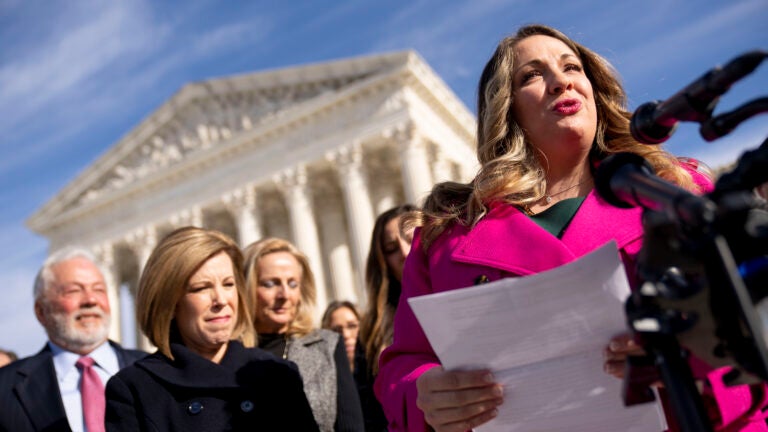
The case was brought forward by Lorie Smith, a Colorado-based graphic designer, who wanted to refuse same-sex couples looking for her services for wedding websites. She said a state law that bars discrimination based on sexual orientation, race, gender, and other characteristics violates her freedom of speech. In a 6-3 vote, the Supreme Court ruled in her favor, the latest in recent wins for religious plaintiffs.
Justice Neil Gorsuch wrote that “the opportunity to think for ourselves and to express those thoughts freely is among our most cherished liberties and part of what keeps our Republic strong.”
Opponents argue that the decision isn’t just a blow to gay rights, but opens the door to other forms of discrimination against protected classes. Justice Sonia Sotomayor, who wrote the dissent and was joined by Justice Elena Kagan, and Justice Ketanji Brown Jackson, warned that this could allow services to be denied to interracial couples, disabled people, non-traditional families, and more.
After the ruling, we asked Boston.com readers if they thought the Supreme Court made the right decision. A slight majority of the 753 readers polled, or 53%, said they agreed with the Court. Many who voted in favor cited the constitutional rights to freedom of speech and freedom of religion as their reason why. Another 46% of readers said they didn’t agree with the Court’s decision.
Several Massachusetts lawmakers have come out against the Court’s ruling and affirmed that the Bay State will stand for LGBTQ+ rights. Maura Healey, the nation’s first openly lesbian governor and longtime supporter of gay rights, said in a statement that the decision was “deeply disappointing and yet another example of the Supreme Court’s callous disregard for the wellbeing of the very communities that need protecting.”
“Freedom isn’t using the First Amendment as license to shut your doors on LGBTQ+ customers. Freedom is the ability to live and love openly without fear. Massachusetts will always stand for freedom and equality because it wasn’t about a cake then, and it’s not about a website now,” she added.
Ahead, you’ll find responses from readers sharing why they do or don’t agree with the Supreme Court’s decision.
Some responses have been lightly edited for length and clarity.
“Artistic expression is covered under the First Amendment and cannot be forced. A Jewish business owner should not have to take a request from a bigot to create a racist website. A transgender business owner should not have to bake a cake that disparages their community.” — Aaron, Littleton
“A private business should be able to choose who they provide services for. Let the market decide if they make the right decisions and not the government.” — J, South Shore
“The right to freedom of religion is protected in the United States. Any religion, or those that follow an atheistic practice, must not be compelled to act against their conscience. Any politician who forces such a choice would solidly prove their inadequacy to serve the public and their constituency.” — Terse A., Allston
“A private business should be allowed to serve whom it pleases. If it were a government business or funded by a local, state or federal government that would be a different story.” — Catherine R., Andover
“I am a gay woman and married. Although it makes me sad to read this, I do feel the First Amendment is the First Amendment. People have the right to their beliefs and although my wish and hope is there will come a day where discrimination won’t exist, it still does. I’d rather know how this woman feels and thinks. If she was forced to do things in her job that she was against and I gave her my business and she was fake the whole time or deep down hating me, this would bother me more. I want to know who these people are. I don’t ever want to give my money to them.” — JRO, Marshfield
“Freedom of religion is enshrined in the constitution and takes precedence over recent state laws regarding discrimination. The states will have to make updates to their laws to respect religious rights.” — Jeff W., Framingham
“All it did was open up a back door to legal discrimination. Based on a false premise that a service provided for a fee is a form of self-expression, rather than what it is: a paid gig. When I tell a painter to paint all my walls lime green, the painter isn’t expressing his love of lime green. When a baker squirts “Happy Birthday, Becca” onto a cake, she is not personally expressing birthday wishes to Becca. You can have rules about what you won’t do for clients, but not rules that specifically discriminate against a client based solely upon their race, religion, preference, etc. And yes, that means if you offer any sort of wedding services, you cannot choose to not create same-sex wedding content. If you are unwilling to make such content, you are free to not be in business.” — Mark, Dedham
“SCOTUS’ conservative majority is pulling at the threads of a protective legal fabric which has taken decades of activism to weave. Their deep animus against LGBTQ+ people is obvious and abhorrent.” — Thomas W., Littleton
“Under the guise of religious freedom, it grants permission for individuals to discriminate as they see fit. In short, it places personal beliefs over civil rights. The decision opens the door to other forms of discrimination, be they by race, religion, ethnicity, or whatever, simply by evoking one’s right to religious freedom. This is the sort of state-sanctioned segregation that I thought had been outlawed decades ago. It is sadly and cruelly ironic that in virtually the same breath the Supreme Court has ruled against affirmative action, seeing this attempt at inclusion as being discriminatory. One can only surmise that these rulings are connected and evidence that the majority of this court is committed to cultivating segregation and division.” — Joe B., Harwich
“It is a free pass to discriminate hidden under the guise of religious freedom. The decision will undoubtedly lead to more harassment of LGBTQ people as well as other groups that extremist right-wingers will say violate their ‘religion.’ It shows that the Supreme Court has become borderline illegitimate and public confidence in it should rightfully be at an all-time low.” — Nick, Winthrop
“The U.S. Constitution states unequivocally that we are all equal in the eyes of the law. This ruling is in sharp contrast to that. The extremist right-wing Christians will now use this ruling as a means to freely discriminate against anyone who doesn’t share their views.” — Jack, Lynn
Boston.com occasionally interacts with readers by conducting informal polls and surveys. These results should be read as an unscientific gauge of readers’ opinion.

Get everything you need to know to start your day, delivered right to your inbox every morning.



Be civil. Be kind.
Read our full community guidelines.To comment, please create a screen name in your profile
To comment, please verify your email address