
Sign up for the Today newsletter
Get everything you need to know to start your day, delivered right to your inbox every morning.
A big change could be coming to the way Bostonians vote in municipal elections. That’s the hope of Ranked Choice Boston, a new coalition that’s aiming to reform the current voting system to one that would allow residents to rank candidates in each race from most to least preferred.
With ranked-choice voting, votes for the candidate with the lowest ranking get moved to the next ranked-choice until there is a winner. This way of voting has already been in place in Cambridge municipal elections for decades and Maine approved ranked-choice voting in statewide elections for governor, state legislature, and Congress in 2016.
Proponents say it allows the candidate with the broadest support to take office, reduces the risk of “spoiler” candidates, and encourages a more engaged electorate. On the other hand, critics worry that the system needlessly complicates the voting process and offers little benefit.
As advocates try to make ranked-choice voting in Boston a reality, we posed the question to our readers: Should the city adopt this new form of voting? Of the 221 readers who responded to the informal poll, the majority of readers said yes to ranked-choice voting in municipal and state elections. While 12% said yes to changing the voting process in Boston, an additional 41% said ranked-choice voting should be the practice not just in Boston but in statewide elections as well. Forty-six percent of readers said no to ranked-choice voting.
Stephen G. from Wayland said ranked-choice voting would “level the playing field as well as reduce the possibility of expensive revotes.”
Laslo, an Everett resident who voted against ranked-choice voting in our poll disagreed. “Most people seem to have difficulty voting now,” he said. “Add this and there will be more confusion and cheating.”
Nationwide, alternative voting systems are growing in popularity. The Pew Research Center identified 261 jurisdictions in the U.S. that have “adopted some voting method other than the standard single-winner, plurality system most American voters know.”
Ed Shoemaker, the executive director of Ranked Choice Boston, has been making the rounds to different communities in Boston, explaining why ranked-choice voting is the right move for the city. He said he’s seen support from progressives, conservatives, and everyone in between.
Ranked-choice voting leads to more “equitable and democratic” outcomes in voting, according to Shoemaker. Low voter turnout in preliminary elections leads to a smaller portion of voters weighing in on the options in a general election. In Minneapolis, where ranked-choice has been in place for municipal elections since 2006, voter turnout increased after implementation, with the highest impact in poorer communities, according to a 2019 study. Shoemaker is optimistic it will empower more people to show up to the polls in Boston, too.
“We’re updating and improving the election system because this is what the people want…there’s a demand for it,” he said. “Anytime you have more choices, it’s more equitable and a better outcome for democracy, for the electorate as a whole.”
Advocates at Ranked Choice Voting also believe that the system will incentivize politicians to do more coalition-building and pay attention to the needs of the broader community, not just the base that will help them win an election. The idea is that even a candidate performing well on the campaign trail will want to broaden their appeal so they can get the favor of people who may not see them as the number one choice.
Some readers worried that allowing voters to rank their options goes against the “one person, one vote” principle, Shoemaker called the argument a “red herring.”
“You still are submitting one ballot. If you put your number one vote for somebody who gets second place. And in the subsequent rounds, your candidate ends up winning, that’s still one vote. If you vote for somebody in the first place who has a low chance of winning, but you still want to support that candidate, you’re still able to register your second choice. It’s still one vote,” he said.
The question of ranked-choice voting was previously on the state ballot in 2020. While 62% of Boston residents supported the measure, the question ultimately failed, with 55% of Massachusetts voters saying no to ranked-choice voting. Shoemaker said that loss was in large part because the pandemic hampered the ability to effectively educate the public about the measure.
Paul Craney of the Massachusetts Fiscal Alliance, however, sees the ballot measure’s loss in 2020 as a clear indication that voters don’t want ranked-choice voting in their elections, local or not. The conservative advocacy group opposed the ballot measure then and continues to believe that ranked-choice voting doesn’t work “in Boston or anywhere else,” according to Craney.
“No system is perfect by any means but the current system in Boston works pretty darn well…The great thing about run-off voting is that one it allows the [candidates] to recalibrate their positions in order to have a broader coalition for victory…and it also allows the voters to tune in to those two candidates and weigh them side by side. It’s good for the voters, it’s good for the candidate,” he said.
A study from the MIT Election Lab on the effectiveness of ranked-choice voting in Maine found that it did boost the number of people voting for non-major-party candidates and encouraged “sincere voting,” or voting on more than just electability. However, the study found that ranked-choice voting negatively impacted “voter confidence, voter satisfaction, and ease of use” and didn’t improve campaign civility.
The effect on the confidence of the electorate is a big concern for Craney, who questioned whether voters will know enough about every candidate in a race to make an informed ranking of their options.
“The problem with ranked-choice voting in elections is that most people, even though you want them to be highly sophisticated voters, are not going to put the time in there and get to know all the candidates running for every cycle and have the bandwidth to rank them,” he said. “You can’t pass a law to force people to become more sophisticated voters.”
There’s a way to go before voters could see any changes to the city’s voting system. Advocates are moving forward with a plan to bring ranked-choice voting to Boston through a home rule petition at the state Legislature.
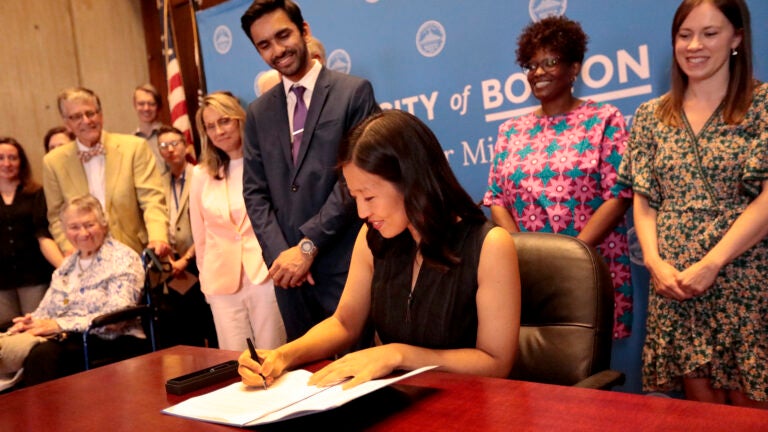
Council members Ruthzee Louijeune and Julia Mejia will co-sponsor an ordinance that will need to be approved by the City Council before moving to Mayor Michelle Wu’s desk. If Wu signs off, the petition will be sent to the joint committee on election laws at the State House, and then to the House floor for final approval.
In the meantime, both sides want Boston residents to be informed about ranked-choice voting and what it would mean for local elections. Below, you’ll find a sampling of responses from our readers sharing what they think about this push for voting reform and how they feel about the current state of local elections.
Some responses have been lightly edited for clarity.
“Massachusetts has one of the lowest rates of election competition in the U.S. Regardless of political party, competition in politics is a positive attribute to keep government responsive to the governed. The current system has proven that it does not work and winner-by-plurality has proven to be a disaster at the state and federal levels. Let’s adopt a system of voting like RCV to ensure that every vote counts and that majority vote is required to win.” — Dan W., Boston
“If we use something like the Cambridge system, I think the city-wide at-large candidates would be more representative of the people of Boston by being more diverse.” — Ralph W., Roxbury
“We need more competitive elections and diverse opinions in politics. This would encourage more people to run and more people to vote. I think that’s great for democracy.” — Vanessa, Hyde Park
“I feel very positively about ranked-choice elections. There are countless examples of how our current system fosters vote splitting where two candidates with similar views split the votes for their policies and then a candidate with less popular views wins. Currently, an energized community that produces multiple political candidates is punished by vote splitting and a community that fields fewer candidates is more likely to win.
“RCV incentivizes building alliances between candidates and communities as often second and third choice votes are needed to win an election…The only reason I can see to oppose RCV is if the current system, with huge non-participation on the part of citizens, suits you. If the status quo is what you want, keep our current system with its negativity, splitting, and victories with less than 50% support.” — Martha K., Boston
“Ranked-choice voting has proven itself to be a fairer system that rewards more civil forms of politics. Other countries like Ireland and Australia, which are ranked as some of the most democratic societies in the world, have decades of experience using it. The track record speaks for itself.” — Sam, Dorchester
“Boston (and Massachusetts) had so many talented and skilled political leaders, which makes primaries and preliminary elections crowded with appealing candidates. When a plurality vote-getter wins without the mandate of a majority, it weakens the eventual elected’s standing and ability to muster government for good, while undermining the public’s confidence in the process and its outcome. It is high time a true majority-producing mechanism came to Massachusetts.” — David M., Cambridge
“Ranked-choice voting is the most fair method and breaks the stranglehold of the two-party system without a ‘spoiler’ effect. It also allows for voters to only list their first choice if they find ranking cumbersome while encouraging a greater number of voters to be more engaged. I was grateful for the opportunity to use RCV when I lived in Cambridge.” — Deborah H., Somerville
“This is an incredibly important electoral reform that should be adopted at all levels. Municipal elections are a good starting point. They will encourage moderate candidates instead of rewarding partisan extremism.” — Ben B., Bedford
“It is a bad idea that will lead to confusion at the polls.” — Haley J., Charlestown
“We don’t need ranked-choice voting. It’s needlessly complicated, and in elections with multiple ideologically similar candidates, it would allow people to effectively vote for more than one candidate (since their vote would be allocated to their second choice after their first choice loses). This would favor the political faction with the most candidates running (in Massachusetts, almost always ultra-liberals) and make it impossible for centrist or center-right candidates to ever win. This would deepen the big problem we have with Massachusetts being a one-party state.” — Eva W., Brighton
“I don’t want my vote going to someone I would never vote for. NYC had a mess due to RCV.” — Philip W., Boston
“I live in a community that uses ranked-choice voting. The process is difficult to understand and may lead to unintended outcomes.” — Contessa, Cambridge
“Voting should be simple and straightforward. Proponents of this system claim that one of the key benefits is that it ensures majority support. If a person wins an election only after multiple reallocations of votes do they really have majority support? Or does it make marginal candidates look like they have more support than they actually do? Massachusetts has made many changes to voting in the past few years which has caused a significant burden on our cities and towns. Per Secretary of State Galvin, one-third of the top election officials have left their positions since 2020. In addition, Secretary Galvin is currently investigating possible mail ballot fraud in Lawrence and there are calls for an investigation into people being paid to cast ballots in Springfield. We should be working to make our elections more secure rather than making them more complicated.” — Cheryl L., lives outside Boston
“It’s a bad idea because it would allow candidates with marginal support from voters to win elections. That usurps the will of the people.” — Kristen A., Hingham
“I feel RCV is a bad idea as it fundamentally violates one person, one vote. RCV is equivalent to holding multiple elections (round 1, round 2, round 3, etc.) and letting some (but only some) voters vote more than once. That’s wrong. Ballot exhaustion is another problem. RCV is also opaque, has not demonstrated the benefits that its proponents claim, and is not necessary.” — Steve S., Newton
Boston.com occasionally interacts with readers by conducting informal polls and surveys. These results should be read as an unscientific gauge of readers’ opinion.

Get everything you need to know to start your day, delivered right to your inbox every morning.





Be civil. Be kind.
Read our full community guidelines.To comment, please create a screen name in your profile
To comment, please verify your email address